This Week's Highlights — issue 002, August 28, 2026
 THE AI TOOLCHAIN NO. 002
 The best tooling updates that shipped this week.
Every feature release from the 174 tools on our watchlist goes into the daily newsletter. Once a week we read the whole field side by side and choose our top picks, judged on two questions: how deep and complete is the single best capability in the release, and how much it changes what you can actually do.
A tool is judged on everything it shipped that week, so a project that releases daily gets credit for the sum — and still only takes one slot. We would rather run a short list than a padded one.
Open-Source Evaluation & Testing library for LLM Agents
Ships `vulnerability_scan`, an autonomous red-teaming function that probes an agent across the OWASP LLM Top-10 (prompt injection, harmful content, stereotypes, misinformation) and reports findings — plus new LLM-judge checks (Toxicity, AnswerRelevance), regex/composition operators, and JUnit XML export for CI gating. The v3 rewrite into installable giskard-checks/agents/core packages makes it adoptable piecemeal.
Giskard shipped a full v3 rewrite as a modular monorepo (giskard-checks, giskard-agents, giskard-core, giskard-scan, giskard-llm) with async Scenario/Suite testing APIs, built-in LLM-as-judge checks, and an OWASP LLM Top-10 vulnerability scanner, while dropping v2 APIs, requiring Python 3.12+, and tightening scenario validation and typing.
what's the number?
Each feature carries 0–100 for how completely the vendor documented it — not how big or important the work is. A major capability described in eight words scores low, and that is the finding.
- depth0–40what it does and how it works or what changed
- specificity0–30names real surfaces — APIs, flags, formats, limits, numbers
- actionability0–30enough to go use it — a named endpoint, flag, or config key tops this; a UI path is a starting point
Code and config rank first by construction: a documented endpoint, flag or config key scores at the top of specificity and actionability, so it sorts above a feature described only in prose. Under 60 the notes go thin — everything below the “thinner coverage” line is thinner documentation, not smaller work. Hover any meter for that feature's three sub-scores.
Giskard v3 is a full rewrite structured as a modular monorepo with three installable packages — giskard-checks, giskard-agents, and giskard-core — plus giskard-scan (via pip install 'giskard[scan]') and a new provider-agnostic LLM routing layer giskard-llm replacing litellm, with provider extras such as pip install 'giskard[openai]' and pip install 'giskard[anthropic]'. It requires Python 3.12+, drops v2 APIs (giskard.Model, giskard.Dataset, giskard.testing, Giskard Hub — retained via pip install 'giskard[llm]>2,<3'), removes Scenario.from_sequence and the scenario() factory in favor of the step-based Scenario constructor, makes the Interact injection name-based instead of positional, makes Jinja parsing in Workflow.chat opt-in, drops templating support in conformity rules, and adds opt-out telemetry via DO_NOT_TRACK=1 or GISKARD_TELEMETRY_DISABLED=1.
giskard.scan.vulnerability_scan automates red-teaming of agents across OWASP LLM Top-10 threat categories (prompt injection, harmful content, stereotypes, misinformation), taking target, description, and languages parameters; a minimal OWASP LLM suite generator covers LLM01 indirect injection. generate_suite accepts custom ScenarioGenerator instances via a vulnerability_suite_generator_registry, which now also exposes default registry generators on the public API and integrates third-party ScenarioGenerator instances into the scan pipeline. The built-in prompt-injection dataset was expanded with additional scenarios and templates for broader adversarial coverage.
import asyncio
from giskard.scan import vulnerability_scan

async def my_agent(inputs: str) -> str:
    return f"Echo: {inputs}"  # replace with your real agent

async def main() -> None:
    await vulnerability_scan(
        target=my_agent,
        description="A customer support chatbot for an e-commerce platform.",
        languages=["en"],
    )

asyncio.run(main()) import asyncio
from giskard.scan import vulnerability_scan
async def my_agent(inputs: str) -> str:
return f"Echo: {inputs}" # replace with your real agent
async def main() -> None:
await vulnerability_scan(
target=my_agent,
description="A customer support chatbot for an e-commerce platform.",
languages=["en"],
)
asyncio.run(main()) giskard-checks ships built-in LLM-as-judge checks Groundedness, Conformity, and LLMJudge (default model openai/gpt-4o-mini), later joined by AnswerRelevance and Toxicity; judge results now enforce non-blank reasons so every verdict carries an explanatory rationale. set_default_generator also accepts plain model name strings (e.g. 'openai/gpt-4o-mini') in addition to generator objects, reducing boilerplate when configuring the default judge/generator.
from giskard.checks import set_default_generator

set_default_generator('openai/gpt-4o-mini') import asyncio
from giskard.checks import Scenario, Groundedness
def get_answer(inputs: str) -> str:
return my_agent(inputs) # replace with your model/agent
async def main() -> None:
scenario = (
Scenario("test_capital")
.interact(inputs="What is the capital of France?", outputs=get_answer)
.check(
Groundedness(
name="answer is grounded",
context="France is in Western Europe. Its capital is Paris.",
)
)
)
result = await scenario.run()
result.print_report()
asyncio.run(main()) import asyncio
from giskard.checks import Scenario, Groundedness
def get_answer(inputs: str) -> str:
return "Paris" # replace with your RAG pipeline
async def main() -> None:
scenario = (
Scenario("test_capital_grounded")
.interact(inputs="What is the capital of France?", outputs=get_answer)
.check(
Groundedness(
name="answer is grounded",
context="France is in Western Europe. Its capital is Paris.",
)
)
)
result = await scenario.run()
result.print_report()
asyncio.run(main()) The Scenario API in giskard.checks composes multi-turn eval interactions via chained .interact() and .check() calls with an async .run() entrypoint and .print_report() for human-readable output; scenarios support annotations for attaching metadata to eval steps and can run multiple times within a suite. Suite runs batches of scenarios with dynamic binding and a chainable Suite.append(), and suite reports now include scenario/check error details plus JUnit XML export for SuiteResult, enabling CI integration.
New check types added to giskard-checks: RegexMatching for asserting outputs match a regular expression (with ReDoS mitigation via regex timeout), AllOf/AnyOf/Not composition operators for combining checks with boolean logic, and a JSON validity check; checks now also support pydantic-compatible input types.
giskard-agents gains generator retry and timeout policies, a step-level type discriminator with tool input coercion and output serialization, a generator-as-protocol-adapter pattern for wrapping arbitrary LLM backends, personas and extended context support for UserSimulator, and a metadata parameter on the generator completion pipeline.
Persisted scenarios now undergo strict validation — unknown fields anywhere in the persisted-scenario tree are rejected, so saved scenarios with unrecognised fields fail to load after upgrade — and the field holding the value under test on every check has been renamed to target_key, breaking code that referenced the old field name.
giskard-core, giskard-llm, giskard-checks, and giskard-scan now ship PEP 561 py.typed marker files for full static-type-checking support in downstream projects, and giskard.types exports tightened public Literal/status types as a stable import surface.
quality_scan with KnowledgeBase support in giskard-scan evaluates RAG knowledge-base quality, replacing the v2 RAGET functionality.
- !Giskard v3 is a full rewrite; v2 APIs (
giskard.Model,giskard.Dataset,giskard.testing, Giskard Hub) are not available in v3. Installpip install 'giskard[llm]>2,<3'to keep v2. - !Requires Python 3.12+; Python versions below 3.12 are no longer supported.
- !
Scenario.from_sequenceis removed; use the step-based Scenario API instead. - !Templating in conformity rules is no longer supported; configurations relying on template syntax in conformity rules will break.
- !Jinja parsing in
Workflow.chatis now opt-in; workflows that relied on Jinja template rendering by default will no longer render templates unless explicitly enabled. - !The Interact injection is now name-based; code using positional injection patterns will break.
- !The scenario() factory is removed; use the mutable Scenario constructor directly.
- !Unknown fields anywhere in the persisted-scenario tree are now rejected (strict validation); saved scenarios containing unrecognised fields will fail to load after upgrade.
- !The field holding the value under test on every check is renamed to
target_key; any code that referenced the previous field name will break. - !Giskard v2 is no longer actively maintained; the v2 automatic tabular scan (
giskard.Model+giskard.Dataset),giskard.testingML test suite, and Giskard Hub are not present in v3 — installpip install 'giskard[llm]>2,<3'to retain v2 behavior. - !Requires Python 3.12+; earlier Python versions are no longer supported.
A full-stack AI Red Teaming platform securing AI ecosystems via Agent Scan, Skills Scan, MCP scan, AI Infra scan and LLM jailbreak evaluation.
Adds a dedicated API security audit module (API Checker) with web-proxy integration and new detection for LLM API poisoning attacks, alongside a refactored agent red-team mutation engine (aig-agent-redteam v5.0.0) — extending the scanner from infrastructure fingerprinting into live API and agent attack surfaces.
AI-Infra-Guard's biggest window overhaul refactors its agent red-team mutation engine into a unified mutation-attack command, adds a new API Checker security-audit module with LLM API poisoning detection, and open-sources its frontend while modularizing Agent-Scan, MCP-Scan and Skill-Scan into standalone CLI/PyPI packages — alongside steady growth in its vulnerability rule library, jailbreak methods, and agent/MCP detection skills.
what's the number?
Each feature carries 0–100 for how completely the vendor documented it — not how big or important the work is. A major capability described in eight words scores low, and that is the finding.
- depth0–40what it does and how it works or what changed
- specificity0–30names real surfaces — APIs, flags, formats, limits, numbers
- actionability0–30enough to go use it — a named endpoint, flag, or config key tops this; a UI path is a starting point
Code and config rank first by construction: a documented endpoint, flag or config key scores at the top of specificity and actionability, so it sorts above a feature described only in prose. Under 60 the notes go thin — everything below the “thinner coverage” line is thinner documentation, not smaller work. Hover any meter for that feature's three sub-scores.
aig-agent-redteam v5.0.0 introduces a refactored mutation engine; the former workflow-attack command is merged into mutation-attack, so any automation or invocation referencing workflow-attack must be updated to use mutation-attack.
Repackages Skill-Scan as a standalone PyPI package aig-skill-scan for CI/CD integration, adding Agent Skill security auditing across 9 risk categories and achieving a SkillTrustBench top score of 0.9848.
v4.5.0 added 4 new detection skills to Agent-Scan; v4.5.1 added 5 OWASP-based skills (agentic-supply-chain, cascading-failure, human-agent-trust, inter-agent-comm, unexpected-code-execution) plus web-exfiltration-detection, bringing Agent-Scan to 10 total detection skills.
The AIG rules library expanded to cover 130 AI components with 1888 rules and new AI component fingerprints (v4.5.0), grew further to 2000+ CVE rules (v4.5.2), and was refreshed with the 2026-07-24 rule set (v4.5.1).
v4.5.0 added 2 new MCP security detection rules plus ATR-derived rules covering additional attack surfaces; v4.5.1 added 4 more MCP detection rules covering hardcoded secrets and insecure deserialization.
Adds Many-Shot, PAIR, GOAT, and ActorAttack multi-turn jailbreak attack methods to PromptSecurity evaluation.
Vulnerability rule definitions now require id and severity fields, enforced through strict YAML validation.
Adds GET-only, non-invasive fingerprint detection for Qdrant, Chroma, and Weaviate vector databases.
New API security audit module (API Checker) adds web proxy integration, a unified CLI command, and new detection algorithms for auditing API security.
Modularizes MCP-Scan with dual-mode support (CLI + AIG Web) and adds a standalone mcp-scan-lite module.
Skill-Scan Stage 2 Code Audit now outputs a Markdown report instead of XML.
Modularizes Agent-Scan as a standalone CLI with AIG integration support.
Adds an agentic-tool-misuse evaluation dataset to the Eval module.
Open-sources the full frontend code along with open-source environment configuration.
New DeepSeek Harness prompt injection assessment research project.
Adds the SkillJack research project, a new AI red-teaming research capability within the platform.
Adds detection for LLM API poisoning attacks.
- !In
aig-agent-redteam,workflow-attackis merged intomutation-attack; any invocation or automation referencingworkflow-attackmust be updated to usemutation-attack. - !Skill-Scan Stage 2 Code Audit now outputs a Markdown report instead of XML.
Security scanner for AI agent skills. Detect vulnerabilities, malicious patterns, security risks, prompt injection, data exfiltration, and supply-chain risks in Claude Code, Codex, and MCP skills before you install them.
Detects malicious bundled lifecycle hooks and directly-proven remote exfiltration of sensitive file/event content in AI skills (BH1–BH3), and adds transitive scanning of referenced skills plus inspection of hidden and nested ZIP/DOCX artifacts — closing a supply-chain gap in agent skills that manual review misses.
SkillSpector's biggest window additions are transitive supply-chain scanning of referenced skills, MCP registry posture scanning, and inspection-ledger accounting that lets CI fail closed on incomplete scans, alongside a wave of new static findings (BH1–BH3 bundled hooks, EA5 model switching, SC8/SC9 supply-chain, AST10/TT6/DS1–DS4 deserialization) and expanded LLM provider support (Ollama, Azure OpenAI, OpenAI-compatible) with new sampling and concurrency controls.
what's the number?
Each feature carries 0–100 for how completely the vendor documented it — not how big or important the work is. A major capability described in eight words scores low, and that is the finding.
- depth0–40what it does and how it works or what changed
- specificity0–30names real surfaces — APIs, flags, formats, limits, numbers
- actionability0–30enough to go use it — a named endpoint, flag, or config key tops this; a UI path is a starting point
Code and config rank first by construction: a documented endpoint, flag or config key scores at the top of specificity and actionability, so it sorts above a feature described only in prose. Under 60 the notes go thin — everything below the “thinner coverage” line is thinner documentation, not smaller work. Hover any meter for that feature's three sub-scores.
New --transitive flag opts into scanning skills referenced by the target skill, with --transitive-depth, --transitive-allow-prefix, and --transitive-deny-prefix to bound traversal depth and restrict which sources are followed, catching supply-chain risk in referenced dependencies.
$ skillspector scan ./my-skill/ --transitive --transitive-depth 2 --transitive-allow-prefix https://github.com/trusted-org/
Adds canonical inspection-ledger accounting across static and LLM analysis stages, with per-component coverage and explicit out-of-scope records in JSON and SARIF output. New execution_successful and analysis_completeness.ledger_exceptions fields let automation distinguish a complete scan from a partial or failed one; the CLI now exits with code 2 for a fatal execution or accounting failure even when a JSON report was produced, and recursive scans propagate child scan failures into the combined report with a non-zero exit when any child fails. JSON integrations must treat invalid or missing output, a nonzero exit, or execution_successful: false as a blocking validation error.
$ skillspector scan ./my-skill/ --format json --output report.json; python3 -c "import json,sys; r=json.load(open('report.json')); sys.exit(1 if not r.get('execution_successful') else 0)"
New SKILLSPECTOR_TEMPERATURE (values 0–1) and SKILLSPECTOR_SEED (integer) environment variables let you pin LLM sampling for reproducible semantic analysis; both are forwarded to OpenAI-compatible and Azure OpenAI endpoints and left unset to preserve provider defaults.
$ SKILLSPECTOR_PROVIDER=openai OPENAI_API_KEY="$OPENAI_API_KEY" SKILLSPECTOR_TEMPERATURE=0 SKILLSPECTOR_SEED=42 skillspector scan ./my-skill/ skillspector baseline <path> now produces version 2 fingerprints that bind accepted findings to the scanner version, source content, and full finding evidence. Baseline files containing version 1 fingerprints are rejected on upgrade — run skillspector baseline <path>, review the generated version 2 entries, and commit the replacement; rules-only version 1 baselines remain supported with a warning.
$ skillspector baseline ./my-skill/ -o .skillspector-baseline.yaml
New BH1, BH2, and BH3 findings detect bundled lifecycle hook execution (hooks/hooks.json), directly proven remote transfer of sensitive event or file content, and broad or ignored project permission surfaces (.claude/settings.json, .claude/settings.local.json). Existing scans may start surfacing these findings, so review them before accepting into a baseline.
New risk_assessment.max_issue_severity field in JSON/SARIF output reports NONE when no active issue exists, giving downstream automation a single field to gate CI pipelines on.
$ SKILLSPECTOR_OUTPUT_LANGUAGE=French skillspector scan ./my-skill/ --format json --output report.json && jq '.risk_assessment.max_issue_severity' report.json
langgraph-cli[inmem] is no longer included in the base installation; LangGraph Studio users who install only the base package must now install skillspector[langgraph-dev] explicitly.
Adds opt-in automatic discovery of a top-level .skillspector-baseline.yaml file so CI can suppress known findings without an explicit flag; an explicitly supplied baseline via --baseline remains authoritative.
$ skillspector baseline ./my-skill/ -o .skillspector-baseline.yaml
# commit .skillspector-baseline.yaml to the repo root, then in CI:
skillspector scan ./my-skill/
Enforces INGEST_MAX_BYTES (100 MiB per-ingest cap) and INGEST_MAX_ZIP_MEMBERS (10,000 entries) for streamed URL downloads, zip archives, and Git repository clones, failing closed with IngestLimitExceededError on breach.
Adds Ollama support for local OpenAI-compatible inference, Azure OpenAI deployment routing, and a configurable provider for other OpenAI-compatible endpoints, all selected via SKILLSPECTOR_PROVIDER. skillspector scan --help now lists every supported hosted, local, compatible, and CLI-backed provider together with its authentication path.
Adds bounded local inspection of hidden files and ZIP-compatible nested artifacts (ZIP, DOCX, XLSX, PPTX) without extracting or executing members, raising HIGH-severity SC9 findings for concealed executables.
Scans can now safely traverse intermediate path components using O_PATH on Linux, allowing scans in restricted sandboxes where ancestor directories lack read permission, while preserving final-file and no-symlink protections.
HTTP MCP clients can no longer scan local filesystem paths or supply local YARA-rule directories; use a remote repository or URL for HTTP requests, or use stdio transport for local scans.
Adds MCP registry posture scanning via skillspector mcp, available by installing the mcp extra: skillspector[mcp].
New SKILLSPECTOR_OUTPUT_LANGUAGE environment variable sets the language of human-readable LLM-generated finding text across discovery analyzers, the meta-analyzer, and MCP tool-poisoning analysis.
$ SKILLSPECTOR_OUTPUT_LANGUAGE=French skillspector scan ./my-skill/ --format json --output report.json && jq '.risk_assessment.max_issue_severity' report.json
Adds static analysis coverage for insecure deserialization patterns, surfaced as AST10, TT6, and DS1–DS4 findings.
Adds structured skill summaries for valid AISOP/AISP bundles, rendered across terminal, Markdown, JSON, and SARIF output formats.
New EA5 static findings flag external model or provider selection, covering silent coding-CLI account switches and top-level model pins.
YARA matches are now mapped back to source lines using byte offsets, so non-ASCII content is reported at accurate locations. The destructive-autonomy YARA post-filter is now scoped to SkillSpector's built-in rule namespace, preventing custom YARA rules that reuse a built-in rule name from being incorrectly post-filtered.
Adds a HIGH-severity SC8 finding when a skill ships Python bytecode or __pycache__ content, expanding supply-chain coverage.
Adds detection for whitespace-padding techniques used to conceal prompt-injection instructions inside skill content.
Adds dynamic analyzer discovery and validates risk-score inputs against the registered analyzer set.
Remediation text and documentation now recognise allowed-tools as valid least-privilege permission guidance.
SkillSpector now scans npm lockfiles as part of its supply-chain risk checks.
Ships a Skill Inspector companion skill guide.
$ SKILLSPECTOR_MAX_LLM_CONCURRENCY=1 skillspector scan ./my-skill/ .env file.$ SKILLSPECTOR_PROVIDER=anthropic
ANTHROPIC_API_KEY=sk-ant-...
SKILLSPECTOR_MAX_LLM_CONCURRENCY=3 - !Existing scans may now surface new BH1, BH2, or BH3 findings for supported bundled hook and settings files (
hooks/hooks.json,.claude/settings.json,.claude/settings.local.json); review those findings before accepting them into a baseline. - !
langgraph-cli[inmem]is no longer included in the base installation; LangGraph Studio users who install only the base package must now installskillspector[langgraph-dev]explicitly. - !HTTP MCP clients can no longer scan local filesystem paths or supply local YARA-rule directories; use a remote repository or URL for HTTP requests, or use stdio transport for local scans.
- !Baseline files containing version 1 fingerprints are rejected on upgrade. Run
skillspector baseline <path>, review the generated version 2 entries, and commit the replacement; rules-only version 1 baselines remain supported with a warning. - !JSON integrations must now treat invalid or missing output, a nonzero process exit, or
execution_successful: falseas a blocking validation error and surfaceanalysis_completeness.ledger_exceptionsfor diagnosis.
Promptfoo is a testing framework for evaluating and benchmarking language model prompts and applications across multiple providers.
Red team scans now support multiple input variables for probing systems with complex input structures, and add a Telecom industry plugin plus a RAG Source Attribution plugin to test whether retrieval systems properly attribute sources; a Transformers.js provider also enables fully local model testing in Node or the browser.
Promptfoo's snapshot-20260823 release adds an adaptive rate limit scheduler, a Transformers.js provider for local model inference, new video-generation and AI gateway providers, a Telecom red team plugin, and support for multi-input red team scanning, alongside a broad set of CLI, config, and UI additions.
what's the number?
Each feature carries 0–100 for how completely the vendor documented it — not how big or important the work is. A major capability described in eight words scores low, and that is the finding.
- depth0–40what it does and how it works or what changed
- specificity0–30names real surfaces — APIs, flags, formats, limits, numbers
- actionability0–30enough to go use it — a named endpoint, flag, or config key tops this; a UI path is a starting point
Code and config rank first by construction: a documented endpoint, flag or config key scores at the top of specificity and actionability, so it sorts above a feature described only in prose. Under 60 the notes go thin — everything below the “thinner coverage” line is thinner documentation, not smaller work. Hover any meter for that feature's three sub-scores.
Adds a promptfoo logs command for viewing log files directly from the CLI; a -d/--description flag on redteam generate commands for labeling generated scans; --share and --no-share flags on Model Audit for controlling cloud sharing; $VAR syntax support in file paths for referencing environment variables in configuration; support for multiple --env-file flags to load several environment files in a single invocation; and an --extension CLI flag to load extensions via command line.
$ promptfoo logs $ promptfoo redteam generate -d 'nightly-telecom-scan' --config redteam.yaml
$ promptfoo eval --env-file .env --env-file .env.secrets -c promptfooconfig.yaml
Adds a numTests config key to cap the number of test cases generated per red team strategy; metadata.sessionId as a surfaced variable column in eval result tables and exports; a word-count assertion type for validating response word counts; a __count variable for use in derived metrics to compute averages; and test-level prompts filter, providers filter, and per-test structured output configuration at the individual test case level.
strategies:
  - id: jailbreak
    numTests: 20
assertions:
  - type: word-count
threshold: 200 Adds apiBaseUrl and websocketUrl override config and function call support to the xAI Voice provider.
New Transformers.js provider to run Hugging Face models locally in Node.js or the browser.
New Telecom red team plugin for industry-specific testing of telecommunications AI systems, and new RAG Source Attribution plugin to test whether RAG systems properly attribute sources in responses.
New adaptive rate limit scheduler automatically adjusts concurrency based on provider rate limits and response headers.
New AWS Bedrock Video provider supporting Nova Reel and Luma Ray 2 video generation, and new Azure AI Foundry Video provider for Sora video generation.
Adds collaboration_mode support and integrated tracing to the OpenAI Codex provider.
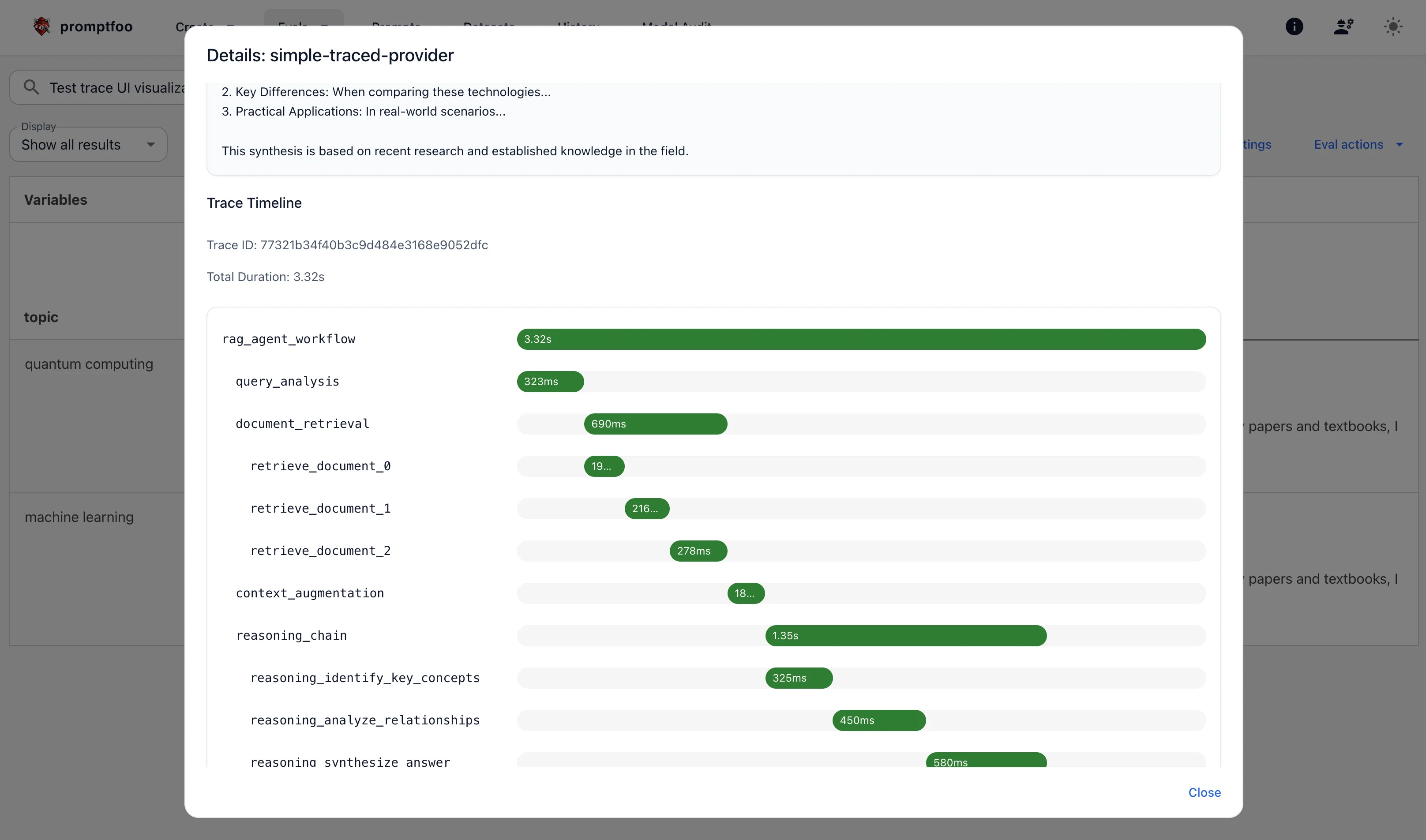
Adds a user-rated filter in the UI to show only manually rated eval results, and a provider config hover in eval results UI to view provider configuration details inline.
HTTP provider gains native session endpoint support for stateful conversations.
Code scanning adds support for fork pull requests and comment-triggered scans.
New Vercel AI Gateway and Cloudflare AI Gateway providers for routing requests.
Red team scans now support multiple input variables for testing systems with complex input structures.
Automatic retries for transient 5xx errors in Enterprise environments.
ToolHive is an enterprise-grade platform for running and managing Model Context Protocol (MCP) servers.
Blocks MCP plugin upgrades whose signer identity differs from the lock file (exit code 4) unless explicitly confirmed, stopping silent malicious plugin swaps, and adds private-CA trust for embedded auth servers — building on the prior release's end-to-end Sigstore bundle verification for plugin artifacts.
Across seven releases (v0.41.0–v0.46.0), ToolHive built out a full skill and AI-plugin lifecycle — lock files, Sigstore-verified sync/upgrade/push, and a plugin CLI/registry — while layering in RFC 8693 delegated token exchange, end-to-end MCP 2026-07-28 'Modern' spec support, and tighter vMCP tool-aggregation and Cedar authorization controls.
what's the number?
Each feature carries 0–100 for how completely the vendor documented it — not how big or important the work is. A major capability described in eight words scores low, and that is the finding.
- depth0–40what it does and how it works or what changed
- specificity0–30names real surfaces — APIs, flags, formats, limits, numbers
- actionability0–30enough to go use it — a named endpoint, flag, or config key tops this; a UI path is a starting point
Code and config rank first by construction: a documented endpoint, flag or config key scores at the top of specificity and actionability, so it sorts above a feature described only in prose. Under 60 the notes go thin — everything below the “thinner coverage” line is thinner documentation, not smaller work. Hover any meter for that feature's three sub-scores.
thv skill sync restores a project's pinned skill set and verifies on-disk content in CI, and thv skill upgrade re-resolves pinned skills to newer content without silent drift; both pin installs in toolhive.lock.yaml (including Sigstore provenance fields) with typed exit codes and a pre-install confirmation gate. Sigstore signature verification was added for skills at install, sync, and upgrade time. Signing of pushes was enabled by default (the lock feature gate removed), and lock provenance now records certificate ref and runner, enforced during skill verification. The --clients flag on thv skill sync and a {"clients": [...]} body field on POST /api/v1beta/skills/sync let operators scope which skill-supporting clients are targeted; qoder was added as the 18th skill-supporting client, materializing skills into <project>/.qoder/skills/. thv skill push now signs keylessly by default and requires exactly one of --key, --identity-token, or --no-sign.
$ thv skill sync toolhive.lock.yaml without silent drift.$ thv skill upgrade qoder client does not cause unexpected drift and a non-zero exit.$ thv skill sync --check --clients claude-code
$ curl -X POST http://127.0.0.1:8080/api/v1beta/skills/sync \
  -H 'Content-Type: application/json' \
  -d '{"clients": ["claude-code", "cursor"]}'
thv ai-plugin ships a full CLI and REST API for end-to-end AI-tool plugin management, alongside a registry catalog for discovering and managing plugins. A plugins key was added to the lock file schema to track plugin entries, backed by a new PluginLockService and a managed install flag, with lock provenance recording certificate ref and runner. Plugin artifacts gained end-to-end Sigstore bundle verification; stored bundles and git commit payloads/signatures are rejected with HTTP 422 above 1 MiB. thv ai-plugin upgrade gained an --allow-signer-change flag so operators can explicitly confirm a signer rotation — without it, upgrades whose signature identity differs from the lock file, or that are unsigned, are blocked with exit code 4 and signer-change-blocked, gated behind the experimental TOOLHIVE_PLUGINS_LOCK_ENABLED environment variable.
$ thv ai-plugin upgrade --allow-signer-change <plugin-name>
Adds aggregation.defaultToolVisibility: deny to vMCP config so only workloads explicitly listed in aggregation.tools have their tools advertised, closing the fail-open gap in tool aggregation; on the Modern (2026-07-28) path, tools excluded via filter, excludeAll, or excludeAllTools are no longer directly callable — tools/call now returns -32602 at HTTP 400 instead of executing. Composite tools now support MCP tool annotations (readOnlyHint, destructiveHint, idempotentHint, openWorldHint), with a conservative fail-closed safety floor derived from the workflow's step tools when none are set explicitly.
name: "engineering-vmcp"
groupRef: "engineering-team"
aggregation:
  defaultToolVisibility: deny
  tools:
    - workload: github
- workload: jira A caBundleRef field was added to OIDC and OAuth2 upstream specs, letting an embedded auth server trust a private CA for discovery, token, user-info, and dynamic client registration calls to that upstream only; the operator-crds chart must be upgraded to 0.46.0 before or with the operator chart, or a stale CRD silently prunes the field. An insecureAllowHTTP: true field under spec.inline in MCPOIDCConfig lets operators opt in to plain-HTTP issuer and JWKS URLs for dev/test; production configs must use HTTPS, and inline configs with a plain-HTTP, malformed, or scheme-less issuer/jwksUrl now flip to Valid=False on reconcile, blocking dependent MCPServer, MCPRemoteProxy, and VirtualMCPServer resources.
caBundleRef: my-internal-ca-secret
apiVersion: toolhive.stacklok.dev/v1beta1
kind: MCPOIDCConfig
metadata:
  name: keycloak-auth
spec:
  type: inline
  inline:
    issuer: http://keycloak:8080/realms/toolhive
    jwksUrl: http://keycloak:8080/realms/toolhive/protocol/openid-connect/certs
insecureAllowHTTP: true The embedded authorization server's token endpoint now supports RFC 8693 token exchange, with delegated token audience bounded by the subject token; subject tokens from trusted external OIDC issuers (Keycloak, Entra, Okta) can be validated for exchange, and audit logs capture the RFC 8693 act claim and full delegation chain. trusted_issuers was added to the embedded auth server config so agents can exchange subject tokens from external OIDC providers for ToolHive-scoped delegated tokens under a fail-closed RFC 8693 consent policy. actor_token support was added for delegated-identity scenarios where an acting party is distinct from the subject. RFC 8693 delegate (token-exchange) clients configured in vmcp-config.yaml are now reachable and usable for downstream token exchange workflows.
backends:
  github:
    type: token_exchange
    tokenExchange:
      tokenUrl: "https://keycloak.example.com/realms/myrealm/protocol/openid-connect/token"
      clientId: "vmcp-github-exchange"
      clientSecretEnv: "GITHUB_EXCHANGE_SECRET"
      audience: "github-api"
scopes: ["repo", "read:org"] status.referencingWorkloads, status.referenceCount, and the References printer column are removed from all six config CRDs (MCPOIDCConfig, MCPAuthzConfig, MCPExternalAuthConfig, MCPToolConfig, MCPWebhookConfig, MCPTelemetryConfig); replace any automation reading them with workload field queries via -o json | jq.
The StorageVersionMigrator controller is now enabled by default (operator.features.storageVersionMigrator: true); namespace-scoped Helm installs (operator.rbac.scope=namespace) now fail helm upgrade at render time unless operator.features.storageVersionMigrator: false is explicitly set.
helm upgrade.operator:
rbac:
scope: namespace
features:
storageVersionMigrator: false Supports the MCP 2026-07-28 stateless ("Modern") spec revision end-to-end across transport proxies, transparent proxy, and Virtual MCP, bridging era-mismatched client×backend combinations; Modern client-facing dispatch is gated per capability instead of a global kill-switch, with listen-stream support and pagination. Adds opt-in strict MCP-Protocol-Version header validation for the streamable proxy; the readiness probe now sends the current MCP protocol version instead of a hardcoded 2024-11-05; guarantees tools/list pagination completeness for aggregated sets exceeding 1,000 tools; tool definitions carrying invalid x-mcp-header annotations (SEP-2243) are now rejected; W3C trace context propagates through outbound MCP _meta (SEP-414); backend list_changed notifications are consumed and propagated to clients for tools, resources, and prompts; multi-line Modern SSE events can now be parsed for better transport compatibility.
Package names in npx://, uvx://, and go:// references are now validated against [A-Za-z0-9@/:._+=~[\]-] at build time, blocking shell metacharacter injection into generated Dockerfiles; names outside this pattern now fail at build time with an "invalid package name" error instead of being interpolated into the Dockerfile.
thv serve management API now enforces Content-Type: application/json on state-changing requests over TCP, and adds Origin validation with a loopback-only allowlist on those same listeners; callers omitting the header receive 415 Unsupported Media Type.
Content-Type: application/json is required on state-changing TCP requests.$ curl -X POST http://127.0.0.1:8080/api/v1beta/workloads \ -H 'Content-Type: application/json' \ -d '{"name":"fetch","image":"ghcr.io/example/fetch:latest"}'
runtime_config.build_with on npx:///go:// images is now a 400 Bad Request, and runtime_config.runtime_env is now actually applied via POST /api/v1beta/workloads (previously silently discarded).
Adds TOOLHIVE_API_TIMEOUT environment variable to override the CLI API client timeout for thv skill and thv ai-plugin commands (default is 10 minutes).
thv skill calls time out in a slow environment by shortening the API client timeout.$ TOOLHIVE_API_TIMEOUT=30s thv skill list Virtual MCP protocol negotiation now stabilizes instead of flapping between Modern and Legacy MCP revisions. Virtual MCP is now MCP-conformant, supporting completions, resource templates, subscriptions, and mid-call server-to-client forwarding. Virtual MCP also now honours operational.timeouts configured values and propagates backend health changes to live sessions — a configured value below 30s now actually cuts backend calls that previously received a silent 30s default.
Cedar authorization policy is now evaluated against the post-mutation MCP request instead of the original, closing a bypass window that allowed length-preserving mutating webhook rewrites to evade authorization; audit records also reflect the post-mutation body, so operators combining a mutating: entry in --webhook-config with Cedar should re-audit policies and SIEM rules.
OAuth token and Dynamic Client Registration (DCR) endpoints are now guarded against Server-Side Request Forgery (SSRF) attacks. DCR now supports confidential clients, expanding the OAuth client types available to the auth layer, and CIMD documents advertising unsupported grant types are now ignored rather than rejected. Dynamically registered OAuth clients now automatically renew expiring client secrets per RFC 7591/7592.
JSON-RPC batch requests (top-level arrays) are now rejected with HTTP 400 / error code -32600 instead of being executed; send individual requests.
Adds rate-limiting observability via metrics and tracing (OpenTelemetry), covering the proxy rate-limit path. The rate-limit JSON-RPC error code changed from -32029 to 429; clients branching on error.code == -32029 must match 429 instead.
The thv llm local proxy now returns 401 token_required instead of 502 server_error when the stored credential has been rejected by the IdP. LLM config is now reset when the last tool is torn down, preventing stale configuration from persisting after all tools exit, and the token helper now uses a bare thv command, simplifying token-helper integration for LLM clients.
With Cedar authorization enabled (--authz-config), MCP POST requests without Content-Type: application/json (including a missing header) now return 400 instead of being forwarded unauthorized. Multi-valued JWT claims can now be normalized to canonical space-delimited form for Cedar policies.
pkg/telemetry/providers is deleted and two optimizerdec constants are removed from the Go API; out-of-tree Go importers must drop references to these before upgrading.
Recovered HTTP panics no longer produce a slog.Error log line or stack trace; log-based alerts on recovered panics will silently stop firing unless Sentry is configured.
Signs the macOS thv binary with a Developer ID certificate, removing Gatekeeper warnings for macOS users.
Displays recorded trust state to the user in the CLI, surfacing container image trust information at runtime.
Prometheus metrics move to a dedicated diagnostics port, controlled by a migration switch.
Drops the build fingerprint from the proxy /health response, reducing information exposure on that endpoint.
Enables multiple MCP clients to share a single stdio server simultaneously.
Adds an opt-in Envoy network-isolation backend.
- !The
operator-crdschart must be upgraded to 0.46.0 before or together with the operator chart; a stale CRD silently prunes the newcaBundleReffield from applied resources instead of rejecting it. - !
thv servemanagement API over TCP now requiresContent-Type: application/jsonon state-changing requests with a body; callers omitting it receive415 Unsupported Media Type. - !Package names in
npx://,uvx://, andgo://references containing characters outside[A-Za-z0-9@/:._+=~[\]-]now fail at build time with an 'invalid package name' error instead of being interpolated into the Dockerfile. - !
thv skill syncwithout--clientsnow targets every skill-supporting client; any skill locked under v0.44.0 will report as drifted on first sync after upgrade, andthv skill sync --checkwill exit non-zero in CI. - !
runtime_config.build_withonnpx:///go://images is now a400 Bad Request;runtime_config.runtime_envis now actually applied (was silently discarded) viaPOST /api/v1beta/workloads. - !
thv skill pushnow returns400when both--keyand--no-signare supplied; exactly one of--key,--identity-token, or--no-signis required. - !Virtual MCP now honours
operational.timeouts; a configured value below 30 s will now actually cut backend calls that previously received the silent 30 s default. - !Exported Go interfaces
plugins.MaterializationAdapter,state.Storewriters,storage.UpstreamTokenStorage, and six function signatures gained required methods or changed signatures. - !The
thv llmlocal proxy now returns401 token_requiredinstead of502 server_errorwhen the stored credential has been rejected by the IdP. - !With Cedar authorization enabled (
--authz-config),POSTrequests withoutContent-Type: application/json(including a missing header) now return400instead of being forwarded unauthorized; all MCP POST clients must sendContent-Type: application/json. - !vMCP tools excluded via
filter,excludeAll, orexcludeAllToolsare no longer directly callable on the Modern (2026-07-28) path —tools/callnow returns-32602at HTTP 400 instead of executing; un-filter the tool or wrap it in a composite tool. - !MCPOIDCConfig resources of
spec.type: inlinewith a plain-HTTP, malformed, or scheme-lessissuerorjwksUrlflip toValid=Falseon next reconcile and block reconciliation of every MCPServer,MCPRemoteProxy, andVirtualMCPServerreferencing them; addinsecureAllowHTTP: trueor switch to HTTPS. - !
status.referencingWorkloads,status.referenceCount, and the References printer column are removed from all six config CRDs (MCPOIDCConfig,MCPAuthzConfig,MCPExternalAuthConfig,MCPToolConfig,MCPWebhookConfig,MCPTelemetryConfig); replace any automation reading them with workload field queries via-o json | jq. - !Cedar policy and audit records now evaluate against the post-mutation MCP request body; re-audit Cedar policies and update SIEM rules keyed on
typeortarget.namebefore upgrading workloads that combine amutating:entry in--webhook-config(orMCPWebhookConfig.spec.mutating) with Cedar authorization. - !Recovered HTTP panics no longer produce a
slog.Errorlog line or stack trace; log-based alerts on recovered panics will silently stop firing unless Sentry is configured. - !
pkg/telemetry/providersis deleted and twooptimizerdecconstants are removed from the Go API; out-of-tree Go importers must drop references to these before upgrading. - !Namespace-scoped Helm installs (
operator.rbac.scope=namespace) now failhelm upgradeat render time unlessoperator.features.storageVersionMigrator: falseis set, because the StorageVersionMigrator controller is now enabled by default (operator.features.storageVersionMigrator: true). - !JSON-RPC batch requests (top-level arrays) are now rejected with HTTP 400 / error code
-32600instead of being executed; send individual requests. - !Rate-limit JSON-RPC error code changed from
-32029to429; clients branching onerror.code == -32029must match429instead.