The daily firehose — everything the toolchain shipped today, already filtered.
// HOW THIS ISSUE IS MADE
We read every release from the 193 tools on our watchlist at the source — GitHub and GitLab release notes, vendor release pages and changelogs, project blogs and feeds, vendor press releases, and the source code behind the tag. Bug-fix-only releases and non-product newsroom noise are dropped; what's left is summarized down to the new capability, how to try it, and any screenshots or videos the release itself published. Every entry links to the sources it was built from.
VIEW
ISSUE VIEWfull issue
Do you prefer full issue?
▾
↕
filter by tool name…
$ tct list# 31 tools matched
Same issue, same prompt, two writers:
A read across the whole issue before you read any of it: what stands out in today's releases, grouped by what it lets you do. Every tool named links to its entry below.
Three unrelated things stand out. SGLang added a no-GPU Simulator, so you can benchmark scheduling and KV-cache configs before you book hardware. llama.cpp's lazy tensor loading cuts startup memory, and video/audio inputs land in the same pipeline. LangSmith made per-project trace limits enforceable, so one noisy service stops eating another team's ingestion budget.
deploy
Tune scheduler and KV-cache settings before you rent a GPU
SGLang's Simulator runs benchmarks of scheduling and KV-cache configs with no GPU attached, turning a search that previously burned real accelerator hours into a cheap sweep. llama.cpp's lazy tensor loading only materializes weights as they are needed, so the startup memory spike that decides whether a model fits on a box drops.
Cap trace ingestion per project and follow a request through the gateway to the provider
LangSmith's per-project trace limits are enforceable rather than advisory, so a chatty experiment cannot silently consume the org's ingestion quota. ai-gateway v1.5.4 propagates request identity end to end and records per-attempt routing outcomes, so a retried call that eventually succeeded still shows which provider failed first.
Get more done per token on long video, and stop paying full price for spec-decode drafts
Gemini's agentic video understanding in Flash models analyzes long-form video far more token-efficiently, which is the cost wall that usually kills video pipelines. SGLang's UNO speculative decoding reuses the target model as its own drafter, so you get the latency win without hosting and syncing a second draft model.
Three unrelated things stand out today: SGLang can benchmark scheduler and KV-cache choices without tying up GPUs; v0 lets teams fix preview-branch CI, merge, and deploy failures from chat; ai-gateway now carries request identity through provider attempts so routing failures are traceable end to end.
deploy
Tune inference scheduling without burning accelerator time
SGLang added a no-GPU Simulator for benchmarking scheduling and KV-cache configurations. That makes capacity and latency experiments cheaper to run before touching production hardware, instead of discovering bad batching or cache settings under real load.
Move a generated app from chat to GitHub without leaving the workflow
v0 now publishes through isolated GitHub preview branches and lets users resolve CI, merge, and deployment issues directly from chat. The handoff from AI-generated changes to repository hygiene becomes less manual: failed checks and deployment blockers can be handled where the change was created.
Trace an AI request across gateway retries and provider calls
ai-gateway now propagates request identity end to end and records per-attempt routing outcomes, while LangSmith added OpenTelemetryOpenTelemetryA CNCF-maintained open standard and SDK collection for capturing traces, metrics, and logs from applications in a vendor-neutral format, letting cyber tools ingest observability data without locking into a proprietary pipeline. resource metadata and enforceable per-project trace limits. Operators get a clearer path from an app request to the gateway and upstream provider traces, with guardrails that stop one project from flooding trace storage.
Turn agent and app security checks into repeatable evidence
GitHub Copilot CLI added a built-in security-review agent and enterprise content-exclusion enforcement; xalgorix expanded deterministic pentest verifiers to CORSCORSA browser mechanism that lets servers declare which foreign origins may read their HTTP responses, enforcing cross-site request boundaries that cyber tools probe or bypass when testing web applications., BFLABFLABroken Function Level Authorization, an API vulnerability class where an application fails to enforce access controls on specific endpoints, letting lower-privileged users call admin or restricted functions., BOLABOLABroken Object Level Authorization, an API vulnerability class where a caller can access or modify another user's resources by substituting a different object ID in the request, bypassing ownership checks., POST reflected XSS, and CSRF; agent-safe-pipeline can verify Decision Dossiers offline or against production endpoints with Ed25519 signatures. These reduce ad hoc review by making security findings and governance artifacts reproducible instead of screenshots and one-off prompts.
The xalgorix platform runs AI pentesting agents for reconnaissance, vulnerability detection, and exploitation workflows.
xalgorix expanded its AI pentesting benchmark harness with new CORSCORSA browser mechanism that lets servers declare which foreign origins may read their HTTP responses, enforcing cross-site request boundaries that cyber tools probe or bypass when testing web applications., BFLABFLABroken Function Level Authorization, an API vulnerability class where an application fails to enforce access controls on specific endpoints, letting lower-privileged users call admin or restricted functions., and two-account BOLABOLABroken Object Level Authorization, an API vulnerability class where a caller can access or modify another user's resources by substituting a different object ID in the request, bypassing ownership checks. challenges, extended verify_xss to confirm POST-based reflected XSS, and shipped verify_csrf — completing its deterministic verifier family covering SQLi, SSTI, XSS, XXE, OOB, and CSRF.
└──▷ WHAT SHIPPED · 5 FEATURES4 OF 5 FEATURESmost completely described firstwhat's the number?
Each feature carries 0–100 for how completely the vendor documented it — not how big or important the work is. A major capability described in eight words scores low, and that is the finding.
depth0–40what it does and how it works or what changed
specificity0–30names real surfaces — APIs, flags, formats, limits, numbers
actionability0–30enough to go use it — a named endpoint, flag, or config key tops this; a UI path is a starting point
Code and config rank first by construction: a documented endpoint, flag or config key scores at the top of specificity and actionability, so it sorts above a feature described only in prose. Under60 the notes go thin — everything below the “thinner coverage” line is thinner documentation, not smaller work. Hover any meter for that feature's three sub-scores.
0100
POST-based reflected XSS verificationIMPROVED93how completely this was documenteddepth35/40specificity28/30actionability30/3093 / 100
Extends verify_xss to confirm POST-based reflected XSS by passing the form action as url, a urlencoded form body as data (e.g. search=<payload>), with method defaulting to POST whenever data is present; the verifier stages a self-submitting cross-origin form so the payload executes exactly as it would for a victim.
Confirm a reflected XSS that is only reachable via a POST form submission — previously unverifiable without manual browser steps.
— Runnable example with exact parameters and mechanismv4.6.53
0201
Authenticated two-account BOLA challengesNEW85how completely this was documenteddepth35/40specificity30/30actionability20/3085 / 100
Adds authenticated, two-account challenge support to the benchmark harness, wiring role A as the scan session and role B as the authorization comparison identity via XALGORIX_TARGET_AUTH / XALGORIX_TARGET_AUTH_B. Adds a bola challenge that serves every order to any logged-in user with no per-object ownership check, producing a CWE-639 IDOR/BOLA signal via cross-account differential (card_last4 PII leak), plus a safe-bola negative-control challenge that enforces per-object ownership (403) to verify a scanner does not over-report.
— Names env vars, CWE, and cross-account mechanismv4.6.58
0302
verify_csrf completes deterministic verifier familyNEW85how completely this was documenteddepth35/40specificity30/30actionability20/3085 / 100
Adds verify_csrf, a Cross-Site Request Forgery confirmer that replays a forged Origin/Referer request without an anti-CSRF token, reusing the scan session's cookies, and confirms CSRF when the server accepts it (2xx/3xx with no token/forbidden rejection); records CWE-352 evidence and declines on Authorization-header-protected endpoints to avoid false positives on token-auth APIs. This completes the deterministic verifier family — verify_sqli, verify_ssti, verify_xss, verify_xxe, verify_oob, and now verify_csrf — giving every common injectable or forgeable vulnerability class a one-call exploit-proven evidence path.
— Names mechanism, CWE, and complete verifier family listv4.6.52
0403
CORS benchmark challenge and scorerNEW80how completely this was documenteddepth35/40specificity30/30actionability15/3080 / 100
Adds a cors-credentialed-reflect benchmark challenge where /api/account reflects any request Origin into Access-Control-Allow-Origin with Access-Control-Allow-Credentials: true, exposing email and api_token to any attacker origin, plus a safe-cors negative control that reflects only a single fixed trusted origin. Adds a CORS text-signal check (matching 'CORS', 'cross-origin resource sharing', or 'access-control-allow-origin') evaluated before CWE lookup so generic access-control findings (e.g. CWE-284) aren't folded into the idor class, plus CWE-942/CWE-346 -> cors canonical-class mappings and cors canonicalClass variants.
— Names endpoint, headers and CWE mappings; no runnable examplev4.6.64
0504
BFLA benchmark challenge coverageNEW65how completely this was documenteddepth30/40specificity25/30actionability10/3065 / 100
Adds a bfla challenge exposing an admin-only user-list function (emails + SSN fragments) that checks authentication but not caller role, enabling vertical privilege escalation testing scored under the idor class. Adds a safe-bfla negative control that enforces role checks (regular users receive 403) to catch over-reporting scanners.
— Describes challenge mechanism and scoring; no runnable examplev4.6.60
ⓘSourcesChangelog →1 RELEASE · 2026-09-05CHANGELOG ↗alsoWhy this ranktop features scored 75/70/70, +10 product media, +6 runnable example — 87.67How ranking works →
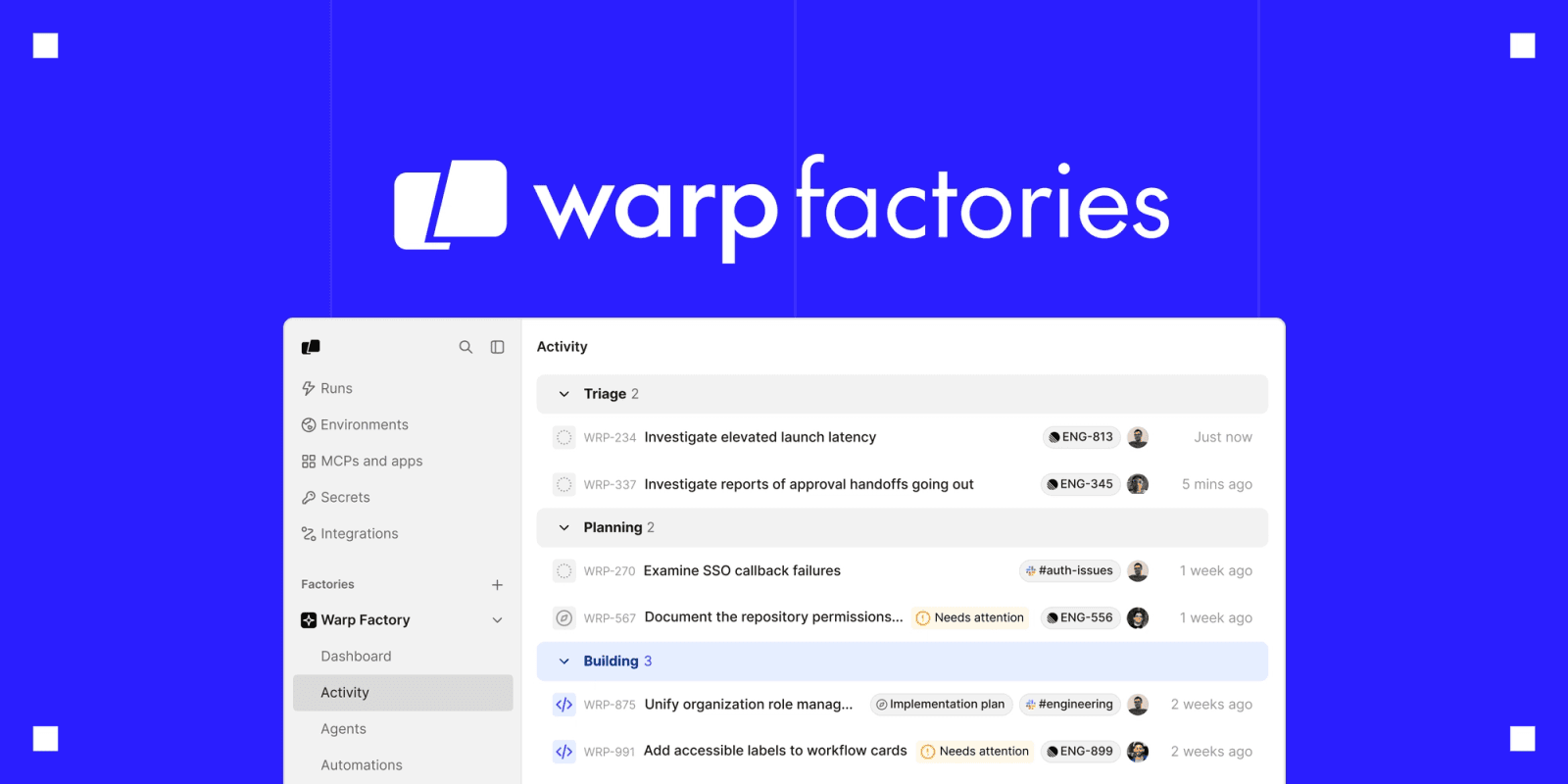
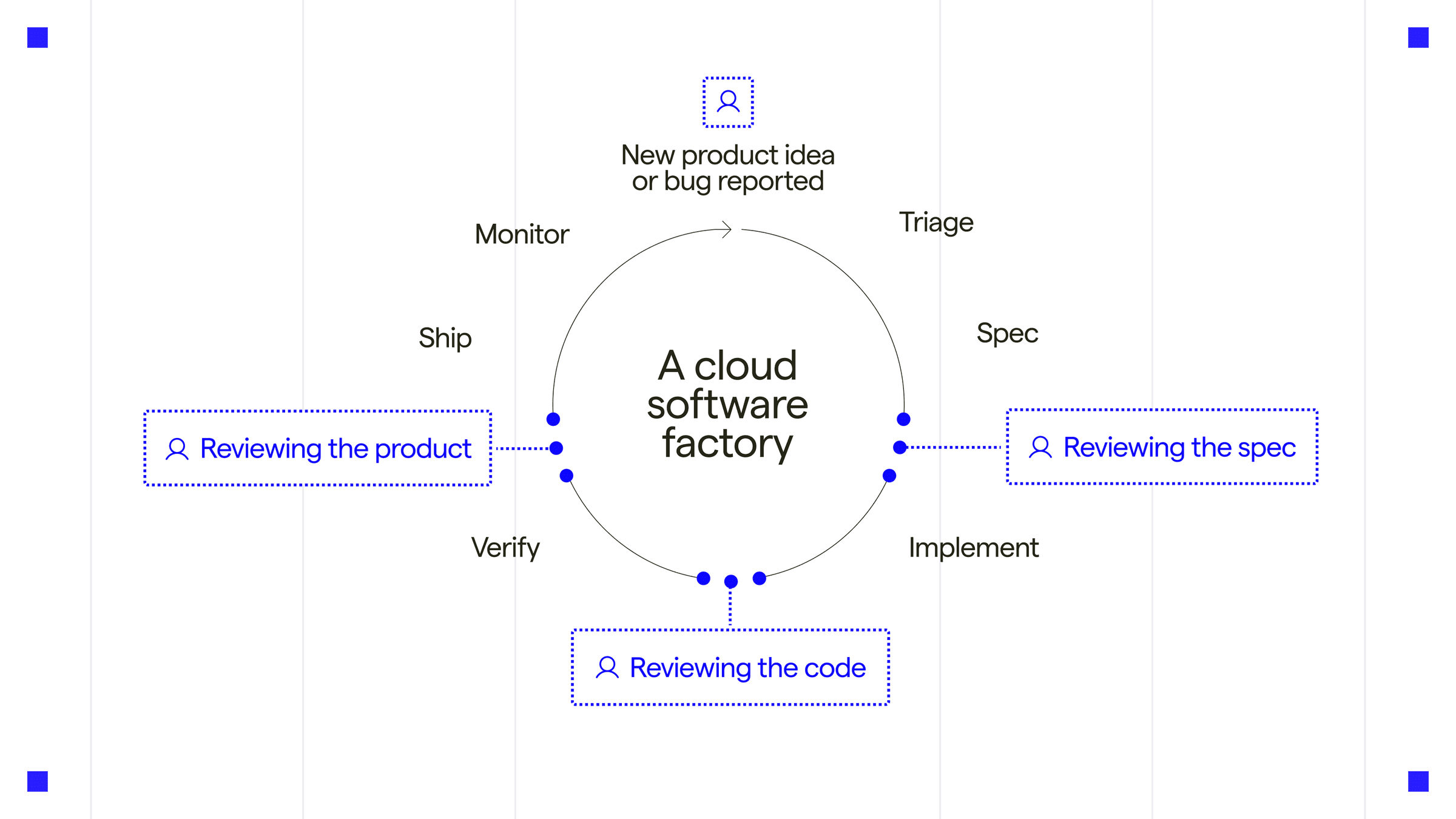
Warp introduced Warp Factories, an open infrastructure for building software factories with an Activity view and YAML-based configuration, alongside smaller agent and CLI additions for retrieving harness conversation transcripts and overwriting files in one step.
Warp is an AI terminal that runs commands and helps developers build software.
Warp introduced Warp Factories, an open infrastructure for building software factories with an Activity view and YAML-based configuration, alongside smaller agent and CLI additions for retrieving harness conversation transcripts and overwriting files in one step.
└──▷ WHAT SHIPPED · 3 FEATURES3 OF 3 FEATURESmost completely described firstwhat's the number?
Each feature carries 0–100 for how completely the vendor documented it — not how big or important the work is. A major capability described in eight words scores low, and that is the finding.
depth0–40what it does and how it works or what changed
specificity0–30names real surfaces — APIs, flags, formats, limits, numbers
actionability0–30enough to go use it — a named endpoint, flag, or config key tops this; a UI path is a starting point
Code and config rank first by construction: a documented endpoint, flag or config key scores at the top of specificity and actionability, so it sorts above a feature described only in prose. Under60 the notes go thin — everything below the “thinner coverage” line is thinner documentation, not smaller work. Hover any meter for that feature's three sub-scores.
0101
Conversation transcript retrieval for harness runsNEW75how completely this was documenteddepth20/40specificity25/30actionability30/3075 / 100
The oz run get --conversation <run-id> command retrieves the full conversation transcript from a third-party harness run, intended for post-incident review.
Retrieve the full conversation transcript from a third-party harness run for post-incident review.
Warp Factories software factory infrastructureNEW70how completely this was documenteddepth30/40specificity25/30actionability15/3070 / 100
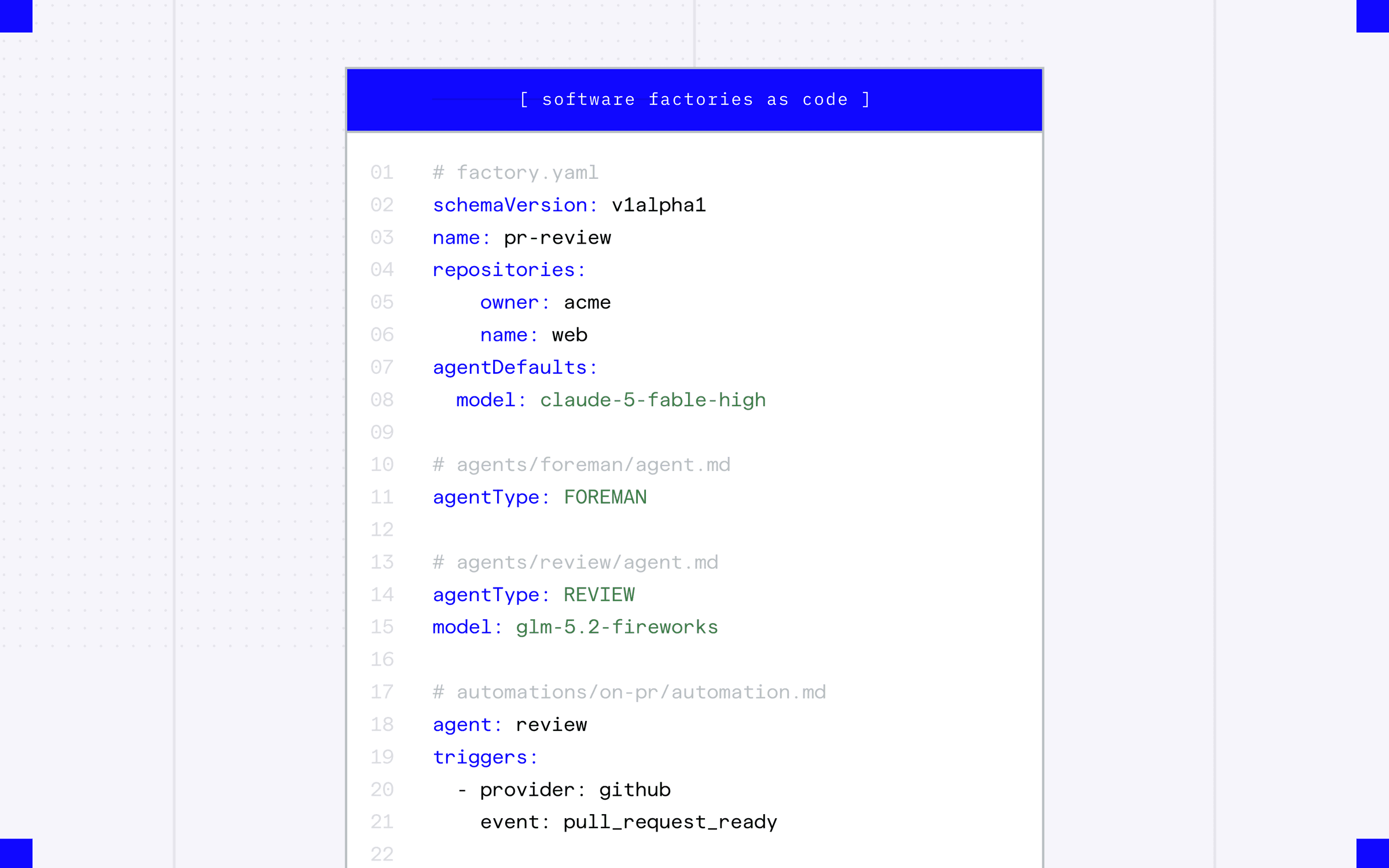
Warp Factories provide "open, flexible infrastructure for building your software factory." An Activity view groups tasks into Triage, Planning, and Building, with linked issues, implementation plans, channels, and "Needs attention" statuses. Factories can be defined as "software factories as code" via a YAML configuration specifying repositories, agent models and roles, and a GitHub pull-request trigger.
File overwrite flag for agent create_file actionNEW70how completely this was documenteddepth25/40specificity20/30actionability25/3070 / 100
The create_file agent action now accepts an allow_overwrite=true parameter, letting an agent overwrite an existing file in a single step without a preceding delete or edit — useful when a code-gen agent needs to regenerate a file from scratch, e.g. create_file(path='src/config.py', content='...', allow_overwrite=true).
Overwrite an existing file in one agent step without a preceding delete or edit, useful when a code-gen agent needs to regenerate a file from scratch.
bolt.new shipped a reorderable prompt queue for stacking follow-up instructions mid-build, a unified project deletion flow that cleans up domains and databases in one step, and image preview inside Code view.
Bolt.new is an AI-powered web development platform that builds websites and applications from prompts.
bolt.new shipped a reorderable prompt queue for stacking follow-up instructions mid-build, a unified project deletion flow that cleans up domains and databases in one step, and image preview inside Code view.
└──▷ WHAT SHIPPED · 3 FEATURES3 OF 3 FEATURESmost completely described firstwhat's the number?
Each feature carries 0–100 for how completely the vendor documented it — not how big or important the work is. A major capability described in eight words scores low, and that is the finding.
depth0–40what it does and how it works or what changed
specificity0–30names real surfaces — APIs, flags, formats, limits, numbers
actionability0–30enough to go use it — a named endpoint, flag, or config key tops this; a UI path is a starting point
Code and config rank first by construction: a documented endpoint, flag or config key scores at the top of specificity and actionability, so it sorts above a feature described only in prose. Under60 the notes go thin — everything below the “thinner coverage” line is thinner documentation, not smaller work. Hover any meter for that feature's three sub-scores.
0101
Prompt queue with reorder and pauseNEW72how completely this was documenteddepth30/40specificity22/30actionability20/3072 / 100
Bolt now lets you queue up to 20 prompts to send while it is still building, preserving per-prompt agent selection. Queued prompts can be edited, reordered, deleted, or paused before Bolt processes them, and in shared projects each queued prompt shows the collaborator's avatar so teams can see who queued what.
Unified project deletion and cleanupNEW72how completely this was documenteddepth30/40specificity24/30actionability18/3072 / 100
A single deletion action now disconnects custom domains, unpublishes the live site, deletes the Bolt database, and removes project files and chat history in one step. Before deleting, you can export the project to keep a local copy, and Bolt reports any resources it cannot clean up itself, such as external Supabase databases or third-party DNS records, so you know what to remove manually.
— Names concrete cleanup scope and manual-removal reporting, no exact menu path givenchangelog-20260905-42932b16
thinner coverage below
0303
Image preview in Code viewNEW40how completely this was documenteddepth15/40specificity10/30actionability15/3040 / 100
Clicking an image file in Code view now shows an image preview.
The v0 generative UI platform builds web applications from natural-language prompts.
v0 introduces a unified GitHub publishing workflow that isolates changes in preview branches and lets users resolve CI, merge, and deployment issues directly from chat.
└──▷ WHAT SHIPPED · 1 FEATURE1 OF 1 FEATUREmost completely described firstwhat's the number?
Each feature carries 0–100 for how completely the vendor documented it — not how big or important the work is. A major capability described in eight words scores low, and that is the finding.
depth0–40what it does and how it works or what changed
specificity0–30names real surfaces — APIs, flags, formats, limits, numbers
actionability0–30enough to go use it — a named endpoint, flag, or config key tops this; a UI path is a starting point
Code and config rank first by construction: a documented endpoint, flag or config key scores at the top of specificity and actionability, so it sorts above a feature described only in prose. Under60 the notes go thin — everything below the “thinner coverage” line is thinner documentation, not smaller work. Hover any meter for that feature's three sub-scores.
0101
Unified branch-and-Publish workflow for GitHub projectsNEW85how completely this was documenteddepth35/40specificity25/30actionability25/3085 / 100
A new Publish action for GitHub-backed projects creates or reuses a pull request, merges it into the base branch, and deploys to production in one step. Each change is auto-committed to an isolated working branch with its own preview deployment for validation before merging, and a branch menu lets users visit the latest preview deployment, review the code diff, create/open/merge the pull request, check CI checks and repository-rule status, and pull recent base-branch changes. Users can also ask v0 in chat to fix preview, CI, or merge issues without leaving the interface.
Validate a change in an isolated preview before it reaches production, then ship it without leaving v0.
📍1. Make your changes in v0 chat — each change is auto-committed to an isolated working branch and a preview deployment URL appears in the branch menu.
2. Open the branch menu and select 'Visit the latest preview deployment' to validate the app.
3. When satisfied, select Publish — v0 creates or reuses the pull request, merges it into the base branch, and deploys the merged result to production.
Unblock a stuck deploy by asking v0 to diagnose and fix a failing CI check without switching to another tool.
📍1. Open the branch menu and review CI checks and repository-rule status.
2. If a check is failing, type a prompt in the v0 chat such as 'Fix the failing CI check' — v0 analyzes the issue and applies a fix to the working branch.
3. A new preview deployment is created; re-check CI status in the branch menu before selecting Publish.
— Names the Publish action, branch menu options, and chat-based fixes with clear steps.changelog-20260905-a8a1bc7e
Replit Agent adds daily scheduled database backups with configurable retention, plus a new Project Analytics dashboard for published web apps including Agent-driven funnel analysis on paid plans.
Replit Agent is an AI coding agent that builds, tests, and deploys applications in Replit.
Replit Agent adds daily scheduled database backups with configurable retention, plus a new Project Analytics dashboard for published web apps including Agent-driven funnel analysis on paid plans.
└──▷ WHAT SHIPPED · 2 FEATURES2 OF 2 FEATURESmost completely described firstwhat's the number?
Each feature carries 0–100 for how completely the vendor documented it — not how big or important the work is. A major capability described in eight words scores low, and that is the finding.
depth0–40what it does and how it works or what changed
specificity0–30names real surfaces — APIs, flags, formats, limits, numbers
actionability0–30enough to go use it — a named endpoint, flag, or config key tops this; a UI path is a starting point
Code and config rank first by construction: a documented endpoint, flag or config key scores at the top of specificity and actionability, so it sorts above a feature described only in prose. Under60 the notes go thin — everything below the “thinner coverage” line is thinner documentation, not smaller work. Hover any meter for that feature's three sub-scores.
0101
Project Analytics dashboard for published appsNEW75how completely this was documenteddepth25/40specificity25/30actionability25/3075 / 100
Adds Project Analytics in the Growth pane showing visitor trends, popular pages, traffic sources, countries, browsers, and devices for published web apps, enabled by turning on Enable analytics and republishing. Also enables Agent-driven funnel analysis for actions such as sign-ups and purchases on paid plans via Project Analytics.
Start collecting visitor analytics for a published web app so you can see traffic sources and popular pages in the Growth pane.
📍In your Replit project, open the Growth pane, toggle on 'Enable analytics', then republish your app.
— Names UI location and toggle, plus paid-plan funnel analysis detail.snapshot-20260905
0202
Scheduled daily production database backupsNEW70how completely this was documenteddepth25/40specificity20/30actionability25/3070 / 100
Adds scheduled backups that create one full restore point per day for your production database, with a configurable retention period set under Keep backups for in production database settings.
Enable daily database backups with a custom retention window so you can recover production data after an incident.
📍In your Replit project, go to the production database settings, locate 'Keep backups for', set your desired retention period, then toggle on scheduled backups.
— Names exact setting and behavior, but no restore mechanics detailed.snapshot-20260905
Daytona 0.204.0 expands snapshot management to work by name, adds outbound proxy routing for sandbox traffic, and introduces typed git transport errors for programmatic handling.
Daytona provisions isolated development sandboxes for AI coding agents through an API and SDK.
Daytona 0.204.0 expands snapshot management to work by name, adds outbound proxy routing for sandbox traffic, and introduces typed git transport errors for programmatic handling.
└──▷ WHAT SHIPPED · 3 FEATURES2 OF 3 FEATURESmost completely described firstwhat's the number?
Each feature carries 0–100 for how completely the vendor documented it — not how big or important the work is. A major capability described in eight words scores low, and that is the finding.
depth0–40what it does and how it works or what changed
specificity0–30names real surfaces — APIs, flags, formats, limits, numbers
actionability0–30enough to go use it — a named endpoint, flag, or config key tops this; a UI path is a starting point
Code and config rank first by construction: a documented endpoint, flag or config key scores at the top of specificity and actionability, so it sorts above a feature described only in prose. Under60 the notes go thin — everything below the “thinner coverage” line is thinner documentation, not smaller work. Hover any meter for that feature's three sub-scores.
0100
Snapshot lookup by name and source lineage filterIMPROVED71how completely this was documenteddepth22/40specificity24/30actionability25/3071 / 100
Snapshot delete and activate operations now accept either an ID or a human-readable name, expanding beyond ID-only operations. The snapshot list operation also gains a sourceSandboxId filter parameter for targeted queries of snapshots derived from a specific source sandbox.
List only snapshots derived from a specific source sandbox to audit lineage.
$ curl -X GET 'https://api.daytona.io/v1/snapshots?sourceSandboxId=<sandboxId>' \
  -H 'Authorization: Bearer <token>'
Activate a snapshot by human-readable name instead of opaque ID, useful in scripted pipelines.
$ curl -X POST https://api.daytona.io/v1/snapshots/my-snapshot-name/activate \
  -H 'Authorization: Bearer <token>'
— Names exact params and operations, runnable examples givensnapshot-20260905
0201
Outbound proxy routing on sandbox createNEW70how completely this was documenteddepth20/40specificity22/30actionability28/3070 / 100
Adds an outboundProxyUrl parameter to the sandbox create API call, allowing sandbox traffic to be routed through an outbound proxy at creation time.
Route all outbound sandbox traffic through a corporate proxy at sandbox creation time.
The first AI coding agent that learns your coding taste. Powered by taste-1, a meta neuro-symbolic model.
Command Code v1.49.0 adds support for GPT-6 Astra as a selectable model.
└──▷ WHAT SHIPPED · 1 FEATURE1 OF 1 FEATUREmost completely described firstwhat's the number?
Each feature carries 0–100 for how completely the vendor documented it — not how big or important the work is. A major capability described in eight words scores low, and that is the finding.
depth0–40what it does and how it works or what changed
specificity0–30names real surfaces — APIs, flags, formats, limits, numbers
actionability0–30enough to go use it — a named endpoint, flag, or config key tops this; a UI path is a starting point
Code and config rank first by construction: a documented endpoint, flag or config key scores at the top of specificity and actionability, so it sorts above a feature described only in prose. Under60 the notes go thin — everything below the “thinner coverage” line is thinner documentation, not smaller work. Hover any meter for that feature's three sub-scores.
0101
GPT-6 Astra model supportNEW35how completely this was documenteddepth10/40specificity15/30actionability10/3035 / 100
Command Code adds GPT-6 Astra as a supported model, giving users a new model option for the coding agent.
— Names the model but no mechanism or setup steps.v1.49.0
Graphify's query scorer now ranks matches on a node's rationale attribute as a distinct tier, improving recall for rationale-only hits without diluting exact-match scores.
Graphify converts code, docs, SQL schemas, configs, and PDFs into a queryable knowledge graph with explainable relationships.
Graphify's query scorer now ranks matches on a node's rationale attribute as a distinct tier, improving recall for rationale-only hits without diluting exact-match scores.
└──▷ WHAT SHIPPED · 1 FEATURE1 OF 1 FEATUREmost completely described firstwhat's the number?
Each feature carries 0–100 for how completely the vendor documented it — not how big or important the work is. A major capability described in eight words scores low, and that is the finding.
depth0–40what it does and how it works or what changed
specificity0–30names real surfaces — APIs, flags, formats, limits, numbers
actionability0–30enough to go use it — a named endpoint, flag, or config key tops this; a UI path is a starting point
Code and config rank first by construction: a documented endpoint, flag or config key scores at the top of specificity and actionability, so it sorts above a feature described only in prose. Under60 the notes go thin — everything below the “thinner coverage” line is thinner documentation, not smaller work. Hover any meter for that feature's three sub-scores.
0101
Rationale attribute scoring tier in query scorerIMPROVED57how completely this was documenteddepth25/40specificity22/30actionability10/3057 / 100
The query scorer ranks a match on a node's rationale attribute as its own scoring tier, placed between an exact label match and a source-path match. This adds recall for rationale-only hits without inflating exact-match coverage scores.
— Names exact scoring tier order but no usage example or command shown.v0.9.54
Claude Code v2.1.261 adds command-line controls for subagent prompts and output size, a /skill-doctor command for pruning unused skills, org-policy diagnostics, and a batch of VS Code extension improvements spanning MCPMCPModel Context Protocol, an open standard from Anthropic that lets an AI model call external tools and data sources through a uniform interface, so cyber tools can expose capabilities directly to LLM-based agents. server management, session list, model picker, and output styles.
Claude Code is Anthropic's terminal coding agent that plans, edits, and tests code in local repositories.
Claude Code v2.1.261 adds command-line controls for subagent prompts and output size, a /skill-doctor command for pruning unused skills, org-policy diagnostics, and a batch of VS Code extension improvements spanning MCPMCPModel Context Protocol, an open standard from Anthropic that lets an AI model call external tools and data sources through a uniform interface, so cyber tools can expose capabilities directly to LLM-based agents. server management, session list, model picker, and output styles.
└──▷ WHAT SHIPPED · 9 FEATURES7 OF 9 FEATURESmost completely described firstwhat's the number?
Each feature carries 0–100 for how completely the vendor documented it — not how big or important the work is. A major capability described in eight words scores low, and that is the finding.
depth0–40what it does and how it works or what changed
specificity0–30names real surfaces — APIs, flags, formats, limits, numbers
actionability0–30enough to go use it — a named endpoint, flag, or config key tops this; a UI path is a starting point
Code and config rank first by construction: a documented endpoint, flag or config key scores at the top of specificity and actionability, so it sorts above a feature described only in prose. Under60 the notes go thin — everything below the “thinner coverage” line is thinner documentation, not smaller work. Hover any meter for that feature's three sub-scores.
0101
Inline output size limits for bash and tasksNEW80how completely this was documenteddepth25/40specificity25/30actionability30/3080 / 100
Adds bashOutputMaxChars and taskOutputMaxChars settings to control how much command and background-task output Claude receives inline before spilling to a file, configurable up to 128K characters.
Raise the inline output cap so Claude sees up to 128K characters of bash command output before it falls back to a file.
— Named config keys with exact limit and runnable JSON example.v2.1.261
0202
Subagent system prompt from fileNEW75how completely this was documenteddepth20/40specificity25/30actionability30/3075 / 100
Adds --append-subagent-system-prompt-file flag to read the subagent system prompt from a file, enabling prompts too large to pass on the command line.
Pass a large subagent system prompt from a file when it would be too long for the command line.
$ claude --append-subagent-system-prompt-file ./subagent-prompt.txt
— Exact flag with runnable command example, brief on mechanism.v2.1.261
0300
Faster Vertex AI startup with service account credentialsIMPROVED70how completely this was documenteddepth30/40specificity25/30actionability15/3070 / 100
Improves startup on Google Vertex AI when GOOGLE_APPLICATION_CREDENTIALS is set: API client creation no longer re-runs project discovery or spawns extra gcloud processes.
— Names env var and exact mechanism fixed, but no benchmark given.v2.1.261
0403
/skill-doctor command for unused skillsNEW60how completely this was documenteddepth20/40specificity20/30actionability20/3060 / 100
Adds /skill-doctor slash command to show which loaded skills go unused and what they cost in context tokens, so you can prune them.
— Named slash command with clear purpose, no example shown.v2.1.261
0500
Model picker shows human-readable namesIMPROVED60how completely this was documenteddepth25/40specificity20/30actionability15/3060 / 100
Improves the /model picker and the VS Code model pill to show a human-readable model name instead of its raw Bedrock, Vertex AI, or LLM gateway ID, and changes the VS Code model picker to one flat list of every model, with rows for older model spellings listed last.
— Names the surfaces affected and the before/after display change.v2.1.261
thinner coverage below
0604
Organization policy diagnosticsNEW55how completely this was documenteddepth20/40specificity20/30actionability15/3055 / 100
Adds an 'Organization policy' diagnostic line to /status and claude doctor explaining why an org policy could not be loaded (e.g., a proxy blocking the endpoint).
— Names both diagnostic surfaces but no example of output.v2.1.261
0705
Custom output style walkthroughNEW50how completely this was documenteddepth20/40specificity15/30actionability15/3050 / 100
Adds a 'Build a custom style' walkthrough to the Output styles menu in VS Code that writes a custom output style file and lists it immediately.
— Names the menu and outcome, no file path or format given.v2.1.261
0806
MCP server management in VS Code extensionNEW45how completely this was documenteddepth15/40specificity15/30actionability15/3045 / 100
Adds an Add server form and a Remove action to the MCP servers dialog in the VS Code extension so MCP servers can be managed without leaving the IDE.
— Clear UI starting point, no mechanism detail beyond the dialog.v2.1.261
0907
Fold button for permission and question promptsNEW40how completely this was documenteddepth15/40specificity10/30actionability15/3040 / 100
Adds a fold button to permission and question prompts in the VS Code extension so the conversation behind them can be read without dismissing them.
— Describes behavior but no named control or setting.v2.1.261
OpenAI Codex CLI runs an agent in the terminal that reads, changes, and tests code in local repositories.
OpenAI Codex CLI added GPT-6-Astra to the Amazon Bedrock model picker, expanding model choice for Mantle and Runtime global/US routes.
└──▷ WHAT SHIPPED · 1 FEATURE1 OF 1 FEATUREmost completely described firstwhat's the number?
Each feature carries 0–100 for how completely the vendor documented it — not how big or important the work is. A major capability described in eight words scores low, and that is the finding.
depth0–40what it does and how it works or what changed
specificity0–30names real surfaces — APIs, flags, formats, limits, numbers
actionability0–30enough to go use it — a named endpoint, flag, or config key tops this; a UI path is a starting point
Code and config rank first by construction: a documented endpoint, flag or config key scores at the top of specificity and actionability, so it sorts above a feature described only in prose. Under60 the notes go thin — everything below the “thinner coverage” line is thinner documentation, not smaller work. Hover any meter for that feature's three sub-scores.
0101
GPT-6-Astra added to Bedrock model pickerNEW50how completely this was documenteddepth15/40specificity20/30actionability15/3050 / 100
GPT-6-Astra is now selectable in the Amazon Bedrock model picker for Mantle and Runtime global/US routes.
— Names model and routes but no mechanism or config detailrust-v0.153.3
ⓘSourcesRelease notes →1 RELEASE · 2026-09-04NOTES ↗leadWhy this ranktop features scored 90/85/80, +15 breaking change, +6 runnable example — 106How ranking works →
GitHub Copilot CLI is a terminal-based coding agent that can plan, write, and test code in local repositories.
GitHub Copilot CLI adds a built-in security-review agent and enterprise content-exclusion enforcement, alongside a dense v1.0.83 update covering model fallback configuration, sandbox dev-tool and network controls (including breaking changes to local sandbox networking), MCPMCPModel Context Protocol, an open standard from Anthropic that lets an AI model call external tools and data sources through a uniform interface, so cyber tools can expose capabilities directly to LLM-based agents./CIMD OAuth, mTLSmTLSA mutual form of TLS where both client and server present certificates to authenticate each other, giving cyber tools cryptographic proof of identity at both ends of every connection. proxy support, and UI consolidation across sessions, sandbox, and plugins.
└──▷ WHAT SHIPPED · 15 FEATURES12 OF 15 FEATURESmost completely described firstwhat's the number?
Each feature carries 0–100 for how completely the vendor documented it — not how big or important the work is. A major capability described in eight words scores low, and that is the finding.
depth0–40what it does and how it works or what changed
specificity0–30names real surfaces — APIs, flags, formats, limits, numbers
actionability0–30enough to go use it — a named endpoint, flag, or config key tops this; a UI path is a starting point
Code and config rank first by construction: a documented endpoint, flag or config key scores at the top of specificity and actionability, so it sorts above a feature described only in prose. Under60 the notes go thin — everything below the “thinner coverage” line is thinner documentation, not smaller work. Hover any meter for that feature's three sub-scores.
0101
Model selection and fallback configurationNEW90how completely this was documenteddepth30/40specificity30/30actionability30/3090 / 100
Adds a model-policy: required config key alongside a multi-value model list in custom agents, which is tried in order until an available model is found and is kept as the active list for subsequent turns; also adds support for the claude-fable-5.1 model.
Lock a custom agent to a preferred model list so it never silently falls back to an unapproved model in a regulated environment.
— Named config keys plus a runnable YAML config examplev1.0.83
0202
Sandbox network egress restrictions and Allow local network toggleBREAKING85how completely this was documenteddepth35/40specificity30/30actionability20/3085 / 100
Sandboxed commands on macOS and Linux can no longer reach services running on the local machine; on macOS this also blocks servers the command itself starts on 127.0.0.1, so test suites that bind a local port will fail. Linux sandboxing now requires slirp4netns, nsenter, iptables, ip6tables, iptables-restore, and ip6tables-restore on PATH, and Linux sandbox network egress is now restricted to the configured proxy, which in proxy mode additionally requires slirp4netns, util-linux 2.35+, iptables, and /dev/net/tun access. Use the new Allow local network toggle in /sandbox to restore localhost access on macOS and Linux.
— Full mechanism and named binaries, with a clear remediation togglev1.0.83
0303
Relative path resolution change for --add-dir and --plugin-dirBREAKING80how completely this was documenteddepth30/40specificity30/30actionability20/3080 / 100
A relative --add-dir or --plugin-dir path now resolves against the session's working directory under --resume=<id> and --worktree, and after -C is applied, rather than the directory the CLI was launched from — scripts that relied on the old resolution order will break.
— Exact flags and before/after behavior with migration implicationv1.0.83
0404
Sandbox developer-tool path access controlNEW80how completely this was documenteddepth25/40specificity25/30actionability30/3080 / 100
Adds sandbox.allowDevToolAccess config key to control whether sandboxed file tools can read developer-tool paths such as ~/.npmrc; set to false to revoke those grants.
Prevent sandboxed commands from inheriting npm token paths (e.g. ~/.npmrc) when running untrusted code.
yaml
sandbox:
  allowDevToolAccess: false
— Named config key with concrete path example and runnable configv1.0.83
0505
Security-review specialist agentNEW75how completely this was documenteddepth25/40specificity20/30actionability30/3075 / 100
Adds a built-in security-review specialist agent invokable with the /security-review slash command, which searches the codebase for exploitable vulnerabilities and reports only high-confidence findings.
Run a focused, high-confidence vulnerability scan on your codebase without switching tools.
$ /security-review
— Runnable slash command with clear scope describedproduct docs
0606
Session transcript sharing flagsNEW70how completely this was documenteddepth20/40specificity20/30actionability30/3070 / 100
Adds --share and --share-gist flags to export a resumed session's whole transcript instead of only the latest run.
Export the full transcript of a long-running resumed session to a shareable gist for async review.
$ copilot --resume=<id>--share-gist
— Named flags with a runnable command examplev1.0.83
0707
herdr terminal multiplexer supportNEW60how completely this was documenteddepth20/40specificity25/30actionability15/3060 / 100
Adds herdr terminal multiplexer detection, enabling the Kitty keyboard protocol, color scheme following, terminal progress, /copy, and notifications in herdr panes.
— Names specific features enabled but no command to runv1.0.83
thinner coverage below
0800
Plugin management UI consolidationIMPROVED55how completely this was documenteddepth20/40specificity20/30actionability15/3055 / 100
Moves /mcp config and the MCP add/edit/authenticate forms into the plugins dashboard instead of a separate MCP manager, and shows bundled built-in plugins in plugin list commands and /plugin.
— Named commands but only a UI navigation pathv1.0.83
0900
Content exclusion policy enforcementIMPROVED50how completely this was documenteddepth25/40specificity20/30actionability5/3050 / 100
Copilot CLI now respects content exclusion policies configured at the enterprise, organization, and repository levels for Copilot Business and Copilot Enterprise users, ensuring excluded files are not used as context.
— Clear behavior change but no config surface namedproduct docs
1008
Sessions sidebar sorting optionsNEW50how completely this was documenteddepth20/40specificity15/30actionability15/3050 / 100
Adds Recent, Created, Name, and classic None sorting to the split Sessions sidebar, with the selected order saved across restarts.
— UI feature with named options but only a navigation starting pointv1.0.83
1100
Sandbox policy view improvementsIMPROVED45how completely this was documenteddepth15/40specificity15/30actionability15/3045 / 100
Improves the /sandbox policy view by grouping path grants by source and showing detected developer tools.
Enterprise sign-in organization pinningNEW40how completely this was documenteddepth15/40specificity15/30actionability10/3040 / 100
Adds the forceLoginOrgs managed setting for enterprise admins to pin sign-in to approved GitHub organizations.
— Named setting but no config location or example givenv1.0.83
1310
HTTPS proxy mTLS client certificate supportNEW35how completely this was documenteddepth15/40specificity15/30actionability5/3035 / 100
Adds automatic HTTPS proxy mTLS client certificate support for model and web requests.
— Named capability with no configuration detailv1.0.83
1411
MCP OAuth via Client ID Metadata DocumentNEW35how completely this was documenteddepth15/40specificity15/30actionability5/3035 / 100
Adds Client ID Metadata Document (CIMD) support for MCP OAuth sign-in.
— Named protocol but no usage steps providedv1.0.83
1512
Windows 11 taskbar session statusNEW35how completely this was documenteddepth15/40specificity10/30actionability10/3035 / 100
Shows running Copilot sessions in the Windows 11 taskbar with live hover status cards.
— Describes the feature but no interaction detailv1.0.83
└──▷ BREAKING ON UPGRADE
!On macOS and Linux, sandboxed commands can no longer reach services running on the local machine; on macOS this also blocks servers the command itself starts on 127.0.0.1 — test suites that bind a local port will fail. Use Allow local network in /sandbox to restore localhost access.
!Linux sandboxing now requires slirp4netns, nsenter, iptables, ip6tables, iptables-restore, and ip6tables-restore on PATH; sandboxed commands will fail to launch if these are missing.
!Linux sandbox network egress is now restricted to the configured proxy; proxy mode additionally requires slirp4netns, util-linux 2.35+, iptables, and /dev/net/tun access.
!A relative --add-dir or --plugin-dir path now resolves against the session's working directory under --resume=<id> and --worktree, and after -C is applied, rather than the directory the CLI was launched from — scripts that relied on the old resolution order will break.
PydanticAI v2.40.0 focuses on realtime voice session improvements — mid-speech interruption handling, custom provider instantiation, and out-of-band prompt injection — alongside background price updates and a new agent event listener API.
PydanticAI is a framework that builds type-safe Python agents with dependency injection, model integrations, tools, and structured outputs.
PydanticAI v2.40.0 focuses on realtime voice session improvements — mid-speech interruption handling, custom provider instantiation, and out-of-band prompt injection — alongside background price updates and a new agent event listener API.
└──▷ WHAT SHIPPED · 3 FEATURES3 OF 3 FEATURESmost completely described firstwhat's the number?
Each feature carries 0–100 for how completely the vendor documented it — not how big or important the work is. A major capability described in eight words scores low, and that is the finding.
depth0–40what it does and how it works or what changed
specificity0–30names real surfaces — APIs, flags, formats, limits, numbers
actionability0–30enough to go use it — a named endpoint, flag, or config key tops this; a UI path is a starting point
Code and config rank first by construction: a documented endpoint, flag or config key scores at the top of specificity and actionability, so it sorts above a feature described only in prose. Under60 the notes go thin — everything below the “thinner coverage” line is thinner documentation, not smaller work. Hover any meter for that feature's three sub-scores.
0101
Background model pricing updatesNEW77how completely this was documenteddepth25/40specificity22/30actionability30/3077 / 100
Adds pydantic_ai.prices.update_in_background() to keep model pricing data current without blocking the main thread, useful for long-running services that need accurate token-cost estimates.
Keep model pricing data refreshed in the background so token-cost estimates stay accurate in a long-running service.
— Names exact function and purpose, runnable example givenv2.40.0
0202
Agent event listener decoratorNEW75how completely this was documenteddepth25/40specificity20/30actionability30/3075 / 100
Adds an @agent.on_event decorator for registering event listeners directly on an Agent instance, letting code observe model responses, tool calls and other events without modifying the agent's tool or output logic.
Observe every agent event — model responses, tool calls, etc. — without modifying the agent's tool or output logic.
— Named decorator with runnable example, mechanism explainedv2.40.0
0303
Realtime session control: barge-in, provider factory, send/enqueueNEW72how completely this was documenteddepth22/40specificity28/30actionability22/3072 / 100
Realtime sessions gain several controls: handle_barge_in=True, interrupt(played_bytes=...), and played_audio_bytes for mid-speech interruption handling; a provider_factory parameter on infer_realtime_model for custom provider instantiation logic; a respond= parameter on RealtimeSession.send() to control whether a text turn solicits a model reply; and RealtimeSession.enqueue() for injecting out-of-band prompts from code driving the session.
— All named surfaces listed but no usage example givenv2.40.0
LangChain is an open-source framework that orchestrates applications powered by language models.
LangChain's langchain-core 1.6.2 release adds async tool support for OpenAI integrations.
└──▷ WHAT SHIPPED · 1 FEATURE1 OF 1 FEATUREmost completely described firstwhat's the number?
Each feature carries 0–100 for how completely the vendor documented it — not how big or important the work is. A major capability described in eight words scores low, and that is the finding.
depth0–40what it does and how it works or what changed
specificity0–30names real surfaces — APIs, flags, formats, limits, numbers
actionability0–30enough to go use it — a named endpoint, flag, or config key tops this; a UI path is a starting point
Code and config rank first by construction: a documented endpoint, flag or config key scores at the top of specificity and actionability, so it sorts above a feature described only in prose. Under60 the notes go thin — everything below the “thinner coverage” line is thinner documentation, not smaller work. Hover any meter for that feature's three sub-scores.
0101
Async tool support for OpenAI integrationsIMPROVED28how completely this was documenteddepth10/40specificity10/30actionability8/3028 / 100
langchain-core 1.6.2 adds async tool support for OpenAI integrations, letting tools used with OpenAI models be invoked asynchronously.
— No mechanism, API name, or usage example given beyond the bare statement.langchain-core==1.6.2
Agno v3.0.6 focuses on MCPMCPModel Context Protocol, an open standard from Anthropic that lets an AI model call external tools and data sources through a uniform interface, so cyber tools can expose capabilities directly to LLM-based agents. serving improvements — stateless transport, protocol-era negotiation, and a server discovery endpoint — alongside a new route-level auth exclusion, broader AgentOS upload support, and Bedrock client customization.
Agno is an agent framework and runtime that orchestrates and runs multi-agent systems.
Agno v3.0.6 focuses on MCPMCPModel Context Protocol, an open standard from Anthropic that lets an AI model call external tools and data sources through a uniform interface, so cyber tools can expose capabilities directly to LLM-based agents. serving improvements — stateless transport, protocol-era negotiation, and a server discovery endpoint — alongside a new route-level auth exclusion, broader AgentOS upload support, and Bedrock client customization.
└──▷ WHAT SHIPPED · 6 FEATURES5 OF 6 FEATURESmost completely described firstwhat's the number?
Each feature carries 0–100 for how completely the vendor documented it — not how big or important the work is. A major capability described in eight words scores low, and that is the finding.
depth0–40what it does and how it works or what changed
specificity0–30names real surfaces — APIs, flags, formats, limits, numbers
actionability0–30enough to go use it — a named endpoint, flag, or config key tops this; a UI path is a starting point
Code and config rank first by construction: a documented endpoint, flag or config key scores at the top of specificity and actionability, so it sorts above a feature described only in prose. Under60 the notes go thin — everything below the “thinner coverage” line is thinner documentation, not smaller work. Hover any meter for that feature's three sub-scores.
0101
Stateless MCP serving modeNEW85how completely this was documenteddepth30/40specificity25/30actionability30/3085 / 100
Adds MCPConfig(stateless=True) to serve /mcp without session tracking, enabling replica-agnostic routing in multi-instance deployments. This comes at the cost of server-initiated notifications and SSE resumability, and is off by default.
Deploy AgentOS MCP behind a load balancer with no sticky sessions — any replica handles any request.
python
from agno.mcp import MCPConfig

mcp_config = MCPConfig(stateless=True)
# Pass mcp_config to your AgentOS app; all replicas can now answer any /mcp request.
— Mechanism, tradeoffs, and runnable code example all given.v3.0.6
0202
MCP protocol era negotiationNEW85how completely this was documenteddepth30/40specificity25/30actionability30/3085 / 100
Adds MCPTools(protocol_mode=...) to select the MCP protocol era to negotiate: 'legacy' preserves session-based behaviour and is the default, while 'auto' negotiates the newest era both sides support, using the sessionless protocol available from 2026-07-28.
Negotiate the newest MCP protocol era automatically so your agent picks up sessionless transport once the server supports it.
python
from agno.tools.mcp import MCPTools

tools = MCPTools(protocol_mode='auto')
# 'auto' will use the sessionless protocol (from 2026-07-28) when both sides support it;
# falls back to legacy otherwise.
— Flag values, date, and runnable example fully specified.v3.0.6
0303
Public route exclusion in AuthorizationConfigNEW80how completely this was documenteddepth25/40specificity25/30actionability30/3080 / 100
Adds AuthorizationConfig.excluded_route_paths to mark custom routes public without disabling auth globally, so specific paths can bypass JWT auth while all other routes keep it enforced.
Expose a custom route publicly while keeping JWT auth active on all other routes.
python
from agno.auth import AuthorizationConfig

auth = AuthorizationConfig(
    excluded_route_paths=["/health", "/public/webhook"]
)
# All other routes continue to require a valid JWT.
— Config key demonstrated with a runnable, concrete example.v3.0.6
0404
MCP Server Card endpointNEW65how completely this was documenteddepth20/40specificity25/30actionability20/3065 / 100
Adds a GET /mcp/server-card endpoint that lists served tools and carries a configurable name, version, and instructions.
— Endpoint named with method and path but no usage example.v3.0.6
thinner coverage below
0505
Zip and Eml file upload support in AgentOSNEW35how completely this was documenteddepth10/40specificity15/30actionability10/3035 / 100
AgentOS now supports .zip and .eml file uploads.
— Formats named but no mechanism or example given.v3.0.6
0600
Custom async client for Bedrock model/embedderIMPROVED35how completely this was documenteddepth10/40specificity15/30actionability10/3035 / 100
Supports passing a custom async client to the Bedrock model or embedder.
— Bare description with no example, code path, or scope detail.v3.0.6
Perplexity API added a new low-cost model, GLM 5.3 Flash, to its chat completions endpoint.
Perplexity API Platform - build with the Router, Agent, Search, and Embeddings APIs. Real-time, web-wide research and Q&A capabilities for your products.
Perplexity API added a new low-cost model, GLM 5.3 Flash, to its chat completions endpoint.
└──▷ WHAT SHIPPED · 1 FEATURE1 OF 1 FEATUREmost completely described firstwhat's the number?
Each feature carries 0–100 for how completely the vendor documented it — not how big or important the work is. A major capability described in eight words scores low, and that is the finding.
depth0–40what it does and how it works or what changed
specificity0–30names real surfaces — APIs, flags, formats, limits, numbers
actionability0–30enough to go use it — a named endpoint, flag, or config key tops this; a UI path is a starting point
Code and config rank first by construction: a documented endpoint, flag or config key scores at the top of specificity and actionability, so it sorts above a feature described only in prose. Under60 the notes go thin — everything below the “thinner coverage” line is thinner documentation, not smaller work. Hover any meter for that feature's three sub-scores.
0101
GLM 5.3 Flash model addedNEW75how completely this was documenteddepth20/40specificity25/30actionability30/3075 / 100
The perplexity/glm-5.3-flash model is now available via the Perplexity chat completions endpoint at $0.15/M input tokens, callable by setting model to perplexity/glm-5.3-flash in requests to https://api.perplexity.ai/chat/completions.
Call the new GLM 5.3 Flash model for cost-efficient inference via the Perplexity chat completions endpoint.
Fireworks AI expanded its Serverless LoRA training pool with three new base models and introduced tiered rate limits by model size, while deprecating several older models from both Serverless inference and Serverless Training.
Fireworks AI provides hosted inference, model fine-tuning, and deployment APIs for open-weight models.
Fireworks AI expanded its Serverless LoRA training pool with three new base models and introduced tiered rate limits by model size, while deprecating several older models from both Serverless inference and Serverless Training.
└──▷ WHAT SHIPPED · 3 FEATURES2 OF 3 FEATURESmost completely described firstwhat's the number?
Each feature carries 0–100 for how completely the vendor documented it — not how big or important the work is. A major capability described in eight words scores low, and that is the finding.
depth0–40what it does and how it works or what changed
specificity0–30names real surfaces — APIs, flags, formats, limits, numbers
actionability0–30enough to go use it — a named endpoint, flag, or config key tops this; a UI path is a starting point
Code and config rank first by construction: a documented endpoint, flag or config key scores at the top of specificity and actionability, so it sorts above a feature described only in prose. Under60 the notes go thin — everything below the “thinner coverage” line is thinner documentation, not smaller work. Hover any meter for that feature's three sub-scores.
0101
Serverless and Serverless Training model deprecationsDEPRECATED85how completely this was documenteddepth30/40specificity30/30actionability25/3085 / 100
GPT OSS 20B, GPT OSS 120B, Kimi K2.6 Turbo/Fast, Kimi K2.7 Code Fast, DeepSeek V4 Pro, and DeepSeek V4 Pro (0813) are deprecated from Serverless effective August 27, 2026, after which workloads using these models will break. Separately, Qwen 3.5 9B and Qwen 3.6 27B are deprecated from Serverless Training effective August 26, 2026, and existing training workloads on these models must migrate to Qwen 3.8 27B.
New base models for Serverless LoRA trainingNEW60how completely this was documenteddepth20/40specificity25/30actionability15/3060 / 100
The shared Serverless Training pool now supports LoRA workloads on DeepSeek V4 Flash 0731 (up to 262K context), Qwen 3.8 27B (up to 128K context), and Muse Glimmer 30B (up to 128K context) as available base models.
Model-size-tiered serverless rate limitsIMPROVED55how completely this was documenteddepth25/40specificity20/30actionability10/3055 / 100
Serverless adaptive rate limit ceilings now vary by model size tier: models under 400B parameters receive higher ceilings, models between 400B and under 1.6T receive intermediate ceilings, and models at or above 1.6T retain the previous base ceilings.
!GPT OSS 20B, GPT OSS 120B, Kimi K2.6 Turbo/Fast, Kimi K2.7 Code Fast, DeepSeek V4 Pro, and DeepSeek V4 Pro (0813) are deprecated from Serverless effective August 27, 2026 — workloads using these models will break after that date.
!Qwen 3.5 9B and Qwen 3.6 27B are deprecated from Serverless Training effective August 26, 2026 — existing training workloads using these models must migrate to Qwen 3.8 27B.
Groq is a high-speed inference engine that runs large language models significantly faster than traditional GPUs.
Groq's only shipment this window was the addition of OpenAI's open-weight GPT-OSS models to its inference API, bringing built-in browser search and code execution at very high token throughput.
└──▷ WHAT SHIPPED · 1 FEATURE1 OF 1 FEATUREmost completely described firstwhat's the number?
Each feature carries 0–100 for how completely the vendor documented it — not how big or important the work is. A major capability described in eight words scores low, and that is the finding.
depth0–40what it does and how it works or what changed
specificity0–30names real surfaces — APIs, flags, formats, limits, numbers
actionability0–30enough to go use it — a named endpoint, flag, or config key tops this; a UI path is a starting point
Code and config rank first by construction: a documented endpoint, flag or config key scores at the top of specificity and actionability, so it sorts above a feature described only in prose. Under60 the notes go thin — everything below the “thinner coverage” line is thinner documentation, not smaller work. Hover any meter for that feature's three sub-scores.
0101
OpenAI GPT-OSS 20B and 120B models addedNEW95how completely this was documenteddepth35/40specificity30/30actionability30/3095 / 100
Groq added openai/gpt-oss-20b and openai/gpt-oss-120b as new models served via POST /openai/v1/chat/completions. Both offer a 131K token context window, 32K max output tokens, built-in browser search and code execution, and structured output support; the 20B model runs at ~1000+ TPS while the 120B model runs at ~500+ TPS.
Run a reasoning query against the fast 20B model to triage time-sensitive security incidents at ~1000+ TPS.
$ curl https://api.groq.com/openai/v1/chat/completions \
  -H "Authorization: Bearer $GROQ_API_KEY" \
  -H "Content-Type: application/json" \
  -d '{"model": "openai/gpt-oss-20b", "messages": [{"role": "user", "content": "Analyze this log and identify signs of lateral movement: <log>"}]}'
Use the 120B model for deep multilingual threat-intelligence analysis where accuracy outweighs throughput.
HyperFrames v0.8.28 adds frame-diffing for CI regression testing, a new lint check for mismatched media sources, and resolution scaling for transparent renders.
Write HTML. Render video.
HyperFrames v0.8.28 adds frame-diffing for CI regression testing, a new lint check for mismatched media sources, and resolution scaling for transparent renders.
└──▷ WHAT SHIPPED · 3 FEATURES2 OF 3 FEATURESmost completely described firstwhat's the number?
Each feature carries 0–100 for how completely the vendor documented it — not how big or important the work is. A major capability described in eight words scores low, and that is the finding.
depth0–40what it does and how it works or what changed
specificity0–30names real surfaces — APIs, flags, formats, limits, numbers
actionability0–30enough to go use it — a named endpoint, flag, or config key tops this; a UI path is a starting point
Code and config rank first by construction: a documented endpoint, flag or config key scores at the top of specificity and actionability, so it sorts above a feature described only in prose. Under60 the notes go thin — everything below the “thinner coverage” line is thinner documentation, not smaller work. Hover any meter for that feature's three sub-scores.
0101
Snapshot frame-diffing against reference videoNEW80how completely this was documenteddepth25/40specificity25/30actionability30/3080 / 100
The CLI snapshot command gains an --against flag that pairs each rendered frame against a reference video, enabling regression diffing in CI pipelines.
Catch frame-level regressions in CI by diffing the current render against a known-good reference video.
llama.cpp's v0.4.0 release adds lazy tensor loading to cut startup memory, expands multimodal pipelines with video/audio input and finer-grained tokenization, adds sparse flash attention and an Apple RDMARDMAA network transport mechanism that lets one machine read or write another machine's memory directly, bypassing both hosts' CPUs and operating system kernels, giving cyber tools extremely low latency and high throughput data movement. RPC transport for distributed inference, ships support for five new model architectures, and reworks KV-cacheKV-cacheA memory buffer in large-language-model inference that stores computed key and value tensors from previous tokens so the model skips redundant attention calculations on each new token, cutting latency sharply. handling in a way that breaks existing saved sessions.
└──▷ WHAT SHIPPED · 11 FEATURES9 OF 11 FEATURESmost completely described firstwhat's the number?
Each feature carries 0–100 for how completely the vendor documented it — not how big or important the work is. A major capability described in eight words scores low, and that is the finding.
depth0–40what it does and how it works or what changed
specificity0–30names real surfaces — APIs, flags, formats, limits, numbers
actionability0–30enough to go use it — a named endpoint, flag, or config key tops this; a UI path is a starting point
Code and config rank first by construction: a documented endpoint, flag or config key scores at the top of specificity and actionability, so it sorts above a feature described only in prose. Under60 the notes go thin — everything below the “thinner coverage” line is thinner documentation, not smaller work. Hover any meter for that feature's three sub-scores.
0101
Video and audio input for multimodal pipelineNEW85how completely this was documenteddepth30/40specificity30/30actionability25/3085 / 100
Adds --video-* CLI flags and mtmd_helper_init_opt server options for video input in multimodal pipelines; the server now accepts data: URLs for input_video and input_audio fields in multimodal requests, and a new mtmd_input_part struct plus mtmd_tokenize_from_parts() API enable fine-grained multimodal tokenization.
Send a video clip as a data: URL to a multimodal server endpoint — no file hosting required.
$ curl http://localhost:8080/v1/chat/completions -H 'Content-Type: application/json' -d '{"messages":[{"role":"user","content":[{"type":"text","text":"Describe this video"},{"type":"input_video","input_video":"data:video/mp4;base64,<base64data>"}]}]}'
— Names every flag, struct and API added, with runnable request example.v0.4.0
0202
Lazy tensor loading for model startupNEW75how completely this was documenteddepth25/40specificity25/30actionability25/3075 / 100
Adds --lazy-mode CLI flag enabling on-demand (lazy) tensor reading to reduce startup memory overhead, plus llama_lazy_mode and lazy_mode in the C API for programmatic control.
Load a large model without pre-reading all tensors into RAM — useful on memory-constrained hosts where full model load would OOM.
— Clear flag and API names, runnable example, but no perf numbers.v0.4.0
0303
KV cache reuse and restore fidelity, breaking session formatBREAKING65how completely this was documenteddepth30/40specificity20/30actionability15/3065 / 100
Adds n-gram history lookup via a KV-cell sequence position index to improve KV cache reuse, and adds KV-cell token tracking to improve context restore fidelity; this bumps session/state versions, so existing saved sessions will not be loadable after upgrading.
— Explains mechanism and flags breaking migration impact, but no config key.v0.4.0
0404
Per-layer CPU FFN offload for MoE modelsNEW65how completely this was documenteddepth20/40specificity20/30actionability25/3065 / 100
Adds a per-layer CPU FFN offload capability for mixture-of-experts models too large to fit entirely on GPU VRAM, exposed via the --n-cpu-ffn flag.
Offload FFN layers to CPU for MoE models too large to fit entirely on GPU VRAM, using the new per-layer CPU FFN flag.
$ llama serve -m deepseek-v4.gguf --n-cpu-ffn 8
— Runnable example names the flag, though no bullet describes internals.v0.4.0
0505
Sparse flash attention for DeepSeek-V4/GLM and Qwen4expNEW60how completely this was documenteddepth20/40specificity25/30actionability15/3060 / 100
Adds sparse flash attention via ggml_flash_attn_ext_set_n_kv_max for DeepSeek-V4/GLM and Qwen4exp models.
— Named function and target models, no usage example.v0.4.0
thinner coverage below
0606
New model architecture supportNEW55how completely this was documenteddepth15/40specificity30/30actionability10/3055 / 100
Adds initial support for Qwen3.8-Flash-Next (qwen4exp), NVIDIA Nemotron-3-Puzzle-75B-A9B, DSpark for Nemotron 3.5, nanbeige4.2-3B, and the DeepSeek-V4-Flash-Vision-Exp multimodal model.
— Names five models but no usage instructions.v0.4.0
0707
RPC transport and async execution for distributed inferenceNEW50how completely this was documenteddepth20/40specificity20/30actionability10/3050 / 100
Adds Apple RDMA as an RPC transport backend for distributed inference, and adds RPC event/async backend APIs enabling asynchronous execution and allocation-dependency tracking.
— Names both additions but lacks further API detail.v0.4.0
0808
Quantizer RAM cap via max_buf_sizeNEW45how completely this was documenteddepth15/40specificity20/30actionability10/3045 / 100
Adds max_buf_size to quantize params, capping quantizer RAM usage during large-model quantization.
— Named param but no usage example or values given.v0.4.0
0900
Preserve chain-of-thought reasoning by defaultIMPROVED40how completely this was documenteddepth15/40specificity15/30actionability10/3040 / 100
Enables preserve_reasoning by default in the server, preserving chain-of-thought content in responses.
— Named config flag but no example or override syntax.v0.4.0
1009
Per-slot context limit in serverNEW35how completely this was documenteddepth15/40specificity10/30actionability10/3035 / 100
Adds a per-slot context limit to the server, allowing each inference slot to have its own context cap.
— Describes capability but no config key or flag named.v0.4.0
1100
Autoscaled YaRN training contextIMPROVED30how completely this was documenteddepth15/40specificity10/30actionability5/3030 / 100
Autoscales YaRN training context when YaRN rope scaling is specified, removing the need for manual tuning.
— States behaviour change but no parameters or values.v0.4.0
└──▷ BREAKING ON UPGRADE
!Session and state file versions are bumped for KV-cell token tracking; existing saved sessions will not be loadable after upgrade.
vMLX 1.6.53 is a focused hardening release for MTP speculative decoding, adding a reversible AR safety valve, tunable native-MTP verify parameters, proposal-head improvements for Qwen models, and a finalized Flash-Next MTP bundle for qwen4_exp.
The vMLX server runs compressed MLX models on Apple Silicon with disk caching, paged memory, continuous batching, and hybrid SSM scheduling.
vMLX 1.6.53 is a focused hardening release for MTP speculative decoding, adding a reversible AR safety valve, tunable native-MTP verify parameters, proposal-head improvements for Qwen models, and a finalized Flash-Next MTP bundle for qwen4_exp.
└──▷ WHAT SHIPPED · 4 FEATURES4 OF 4 FEATURESmost completely described firstwhat's the number?
Each feature carries 0–100 for how completely the vendor documented it — not how big or important the work is. A major capability described in eight words scores low, and that is the finding.
depth0–40what it does and how it works or what changed
specificity0–30names real surfaces — APIs, flags, formats, limits, numbers
actionability0–30enough to go use it — a named endpoint, flag, or config key tops this; a UI path is a starting point
Code and config rank first by construction: a documented endpoint, flag or config key scores at the top of specificity and actionability, so it sorts above a feature described only in prose. Under60 the notes go thin — everything below the “thinner coverage” line is thinner documentation, not smaller work. Hover any meter for that feature's three sub-scores.
0101
Proposal-head enhancements for MTP (Qwen3.5/3.8 VLM, Qwen4)NEW65how completely this was documenteddepth25/40specificity25/30actionability15/3065 / 100
Adds a q4 proposal head for the Qwen3.5/3.8 VLM MTP lane (default off), a one-time per-bundle proposal-head stamp honored on later launches to avoid repeated head evaluation at startup, and enables the qwen4_exp q4 proposal head ON by default for Qwen4 models.
— Names default states and model targets, still no explicit flagv1.6.53
0202
Flash-Next MTP bundle finalization for qwen4_expNEW65how completely this was documenteddepth25/40specificity25/30actionability15/3065 / 100
Ships the final Flash-Next MTP bundle contract for qwen4_exp (index-driven weights plus calibrated sidecar), and adds a one-time dated redownload warning in the panel for the Flash-Next MTP fix, localized and conformance-aware.
— Names bundle contract and warning surface, points to panel UIv1.6.53
thinner coverage below
0303
Reversible AR safety valve for MTPNEW58how completely this was documenteddepth28/40specificity20/30actionability10/3058 / 100
Adds a policy-independent, on-the-fly AR safety valve for MTP that is windowed and context-scaled, running in both text and multimodal lanes. It pairs with a reversible AR fallback that tracks a measured AR tier and uses MTP re-entry probes so the engine can re-enter speculative decoding after a demotion.
— Describes mechanism and lanes but no flag or command to invoke itv1.6.53
0404
Native-MTP verify tuning: depth ceiling and projection paddingNEW50how completely this was documenteddepth20/40specificity20/30actionability10/3050 / 100
Adds a parameterized native-MTP depth ceiling for measurement, now covering verifier and profile caps, alongside stock-MLX projection padding for native-MTP verify (default off).
— Names the tuning surfaces but no exact key or commandv1.6.53
ai-memory 2.0.3 widens finalize-session --agent to cover all captured agent types and adds filesystem free-space visibility to status and migration output.
Solution for long term memory for agent coding CLIs and to facilitate handoff between different agent vendors
ai-memory 2.0.3 widens finalize-session --agent to cover all captured agent types and adds filesystem free-space visibility to status and migration output.
└──▷ WHAT SHIPPED · 2 FEATURES2 OF 2 FEATURESmost completely described firstwhat's the number?
Each feature carries 0–100 for how completely the vendor documented it — not how big or important the work is. A major capability described in eight words scores low, and that is the finding.
depth0–40what it does and how it works or what changed
specificity0–30names real surfaces — APIs, flags, formats, limits, numbers
actionability0–30enough to go use it — a named endpoint, flag, or config key tops this; a UI path is a starting point
Code and config rank first by construction: a documented endpoint, flag or config key scores at the top of specificity and actionability, so it sorts above a feature described only in prose. Under60 the notes go thin — everything below the “thinner coverage” line is thinner documentation, not smaller work. Hover any meter for that feature's three sub-scores.
0101
Broader agent support in finalize-sessionIMPROVED70how completely this was documenteddepth20/40specificity25/30actionability25/3070 / 100
finalize-session --agent now accepts all captured agents: hermes, claude-desktop, crush, and other, letting sessions from these agents be finalized without a separately registered agent profile.
Finalize a session captured by Claude Desktop or Hermes without needing a separately registered agent profile
Pinecone is the vector database for AI agents and applications, built for semantic search, knowledge retrieval, and long-term memory at scale.
Pinecone introduced Nexus BYOC, a new bring-your-own-cloud deployment model, and doubled the pod-to-serverless migration limit to 50 million records.
└──▷ WHAT SHIPPED · 2 FEATURES1 OF 2 FEATURESmost completely described firstwhat's the number?
Each feature carries 0–100 for how completely the vendor documented it — not how big or important the work is. A major capability described in eight words scores low, and that is the finding.
depth0–40what it does and how it works or what changed
specificity0–30names real surfaces — APIs, flags, formats, limits, numbers
actionability0–30enough to go use it — a named endpoint, flag, or config key tops this; a UI path is a starting point
Code and config rank first by construction: a documented endpoint, flag or config key scores at the top of specificity and actionability, so it sorts above a feature described only in prose. Under60 the notes go thin — everything below the “thinner coverage” line is thinner documentation, not smaller work. Hover any meter for that feature's three sub-scores.
0100
Higher pod-to-serverless migration limitIMPROVED50how completely this was documenteddepth20/40specificity20/30actionability10/3050 / 100
The record limit for migrating a pod-based index to serverless has been raised to 50 million records, up from 25 million.
Nexus BYOC deployment modelNEW40how completely this was documenteddepth15/40specificity15/30actionability10/3040 / 100
Pinecone introduces Nexus BYOC (Bring Your Own Cloud), a new deployment model with its own architecture distinct from Database BYOC, documented separately to clarify the relationship between the two.
— Names the model but not concrete setup steps or mechanismproduct docs
LangSmith is a platform for debugging, testing, and monitoring LLM applications built with LangChain.
LangSmith's latest release adds enforceable per-project trace limits, a thread evaluator validation endpoint, OpenTelemetryOpenTelemetryA CNCF-maintained open standard and SDK collection for capturing traces, metrics, and logs from applications in a vendor-neutral format, letting cyber tools ingest observability data without locking into a proprietary pipeline. resource metadata support, and bulk dataset split management in experiments, alongside breaking changes to bulk export compression, dataset comparison APIs, and ingestion log format.
└──▷ WHAT SHIPPED · 2 FEATURES2 OF 2 FEATURESmost completely described firstwhat's the number?
Each feature carries 0–100 for how completely the vendor documented it — not how big or important the work is. A major capability described in eight words scores low, and that is the finding.
depth0–40what it does and how it works or what changed
specificity0–30names real surfaces — APIs, flags, formats, limits, numbers
actionability0–30enough to go use it — a named endpoint, flag, or config key tops this; a UI path is a starting point
Code and config rank first by construction: a documented endpoint, flag or config key scores at the top of specificity and actionability, so it sorts above a feature described only in prose. Under60 the notes go thin — everything below the “thinner coverage” line is thinner documentation, not smaller work. Hover any meter for that feature's three sub-scores.
0101
OpenTelemetry resource attribute metadata on tracesNEW80how completely this was documenteddepth30/40specificity25/30actionability25/3080 / 100
LangSmith traces can now carry OpenTelemetry resource attributes as otel.resource.* metadata without modifying span emission code, populated via the standard OTEL_RESOURCE_ATTRIBUTES environment variable, e.g. user.id=user-42,deployment.environment=production.
Attach OpenTelemetry resource attributes (e.g. user ID, environment) to LangSmith traces as otel.resource.* metadata without modifying span emission code.
— Exact env var and metadata field named, ready to setsnapshot-20260905
0202
Batched-run ingestion log format changeBREAKING60how completely this was documenteddepth25/40specificity20/30actionability15/3060 / 100
The batched-run ingestion log now emits run_verbs as a list of run_id and verbs objects instead of a map keyed by run UUID, which may break structured-log aggregators that expected the previous map format.
— Exact field name and shape change, no migration tooling givensnapshot-20260905
└──▷ BREAKING ON UPGRADE
!Legacy dataset comparison helpers are removed from the public OpenAPI spec and generated SDKs; existing HTTP routes continue to work only for LangSmith UI clients.
!Bulk export compression default changes from gzip to zstandard (zstd); self-hosted deployments must set FF_BULK_EXPORT_DEFAULT_COMPRESSION to retain gzip.
!The batched-run ingestion log now emits run_verbs as a list of run_id and verbs objects instead of a map keyed by run UUID, which may break structured-log aggregators that expected the previous map format.
ⓘSourcesRelease notes →1 RELEASE · 2026-09-05NOTES ↗leadWhy this ranktop features scored 92/90/90, +15 breaking change, +6 runnable example — 111.67How ranking works →
Unified AI Gateway for 30+ LLMs (OpenAI, Anthropic, Bedrock, Azure etc) with Caching, Guardrails, A/B test & cost controls. Go-native Fastest & Scalable AI Gateway LiteLLM & Kong AI Gateway alternative.
ai-gateway v1.5.4 adds end-to-end request identity propagation and deeper distributed tracing, letting operators see per-attempt routing outcomes and tie gateway traces to upstream provider traces.
└──▷ WHAT SHIPPED · 4 FEATURES4 OF 4 FEATURESmost completely described firstwhat's the number?
Each feature carries 0–100 for how completely the vendor documented it — not how big or important the work is. A major capability described in eight words scores low, and that is the finding.
depth0–40what it does and how it works or what changed
specificity0–30names real surfaces — APIs, flags, formats, limits, numbers
actionability0–30enough to go use it — a named endpoint, flag, or config key tops this; a UI path is a starting point
Code and config rank first by construction: a documented endpoint, flag or config key scores at the top of specificity and actionability, so it sorts above a feature described only in prose. Under60 the notes go thin — everything below the “thinner coverage” line is thinner documentation, not smaller work. Hover any meter for that feature's three sub-scores.
0101
Per-attempt routing trace spansNEW92how completely this was documenteddepth32/40specificity30/30actionability30/3092 / 100
Adds observability.tracing.attempt_spans config key (default false) to emit one gateway.routing.attemptCLIENT child span per routing attempt — retries and failovers included — carrying ferro.routing.target_key, ferro.routing.sequence, and ferro.routing.outcome; backends plug in via the observability.AttemptSpanProvider interface.
Enable per-attempt child spans to see exactly which targets were tried, in what order, and with what outcome in your distributed trace.
yaml
observability:
  tracing:
    attempt_spans: true
— Names config key, span attributes and provider interface with runnable example.v1.5.4
0202
Upstream trace propagation on pass-through routesNEW90how completely this was documenteddepth30/40specificity30/30actionability30/3090 / 100
Adds observability.tracing.propagate_passthrough config key (default true) to forward W3C traceparent and tracestate headers upstream on /v1/* pass-through and fixed-target routes (/v1/responses, /v1/files, /v1/batches), joining the provider's trace to the gateway trace.
Disable upstream trace context injection on pass-through routes when you do not want providers joining the gateway trace.
— Exact config key, default and affected routes given with example.v1.5.4
0303
Request identity propagation across spans, logs and eventsNEW90how completely this was documenteddepth35/40specificity30/30actionability25/3090 / 100
Adds request identity propagation via the OpenAI user field, X-User-ID and X-Session-ID request headers, or W3C baggage entries user.id / session.id; recorded as enduser.id, session.id, and ferro.request.metadata.<key> on the request span, as User, SessionID, and Metadata on observability.RequestAttrs, Event, and RoutingAttempt, and as user_id / session_id on request-log rows (GET /admin/logs, schema migration 6). Embedders can attach request metadata programmatically via observability.ContextWithRequestIdentity.
— Names all input surfaces, storage fields and log endpoint, no runnable example.v1.5.4
0404
Metadata field added to RoutingAttempt and RequestAttrs typesBREAKING85how completely this was documenteddepth30/40specificity30/30actionability25/3085 / 100
observability.RoutingAttempt and observability.RequestAttrs each gain a Metadata map field: unkeyed composite literals no longer compile (switch to keyed fields), neither type is usable as a map key, and == comparison is unavailable — use reflect.DeepEqual instead.
— Gives exact migration steps and affected types.v1.5.4
└──▷ BREAKING ON UPGRADE
!observability.RoutingAttempt and observability.RequestAttrs each gain a Metadata map field: unkeyed composite literals no longer compile (switch to keyed fields), neither type is usable as a map key, and == comparison is unavailable — use reflect.DeepEqual instead.
Arize Phoenix is an open-source AI observability platform for tracing and evaluating LLM applications.
Phoenix v20.8.0 adds filtering capabilities to the trace list endpoint and introduces MiniMax as a supported LLM provider.
└──▷ WHAT SHIPPED · 2 FEATURES2 OF 2 FEATURESmost completely described firstwhat's the number?
Each feature carries 0–100 for how completely the vendor documented it — not how big or important the work is. A major capability described in eight words scores low, and that is the finding.
depth0–40what it does and how it works or what changed
specificity0–30names real surfaces — APIs, flags, formats, limits, numbers
actionability0–30enough to go use it — a named endpoint, flag, or config key tops this; a UI path is a starting point
Code and config rank first by construction: a documented endpoint, flag or config key scores at the top of specificity and actionability, so it sorts above a feature described only in prose. Under60 the notes go thin — everything below the “thinner coverage” line is thinner documentation, not smaller work. Hover any meter for that feature's three sub-scores.
0101
Error-status and latency filters on trace list endpointNEW65how completely this was documenteddepth20/40specificity25/30actionability20/3065 / 100
The trace list server endpoint now supports error-status and latency filters, enabling programmatic filtering of traces by error state and latency.
Open source AI engineering platform: LLM evals, observability, metrics, prompt management, playground, datasets. Integrates with OpenTelemetry, LangChain, OpenAI SDK, LiteLLM, and more. YC W23
Langfuse overhauled the Experiments UI around score-based comparison and rebuilt result views, while also tightening public-API auth enforcement across all migration modes.
└──▷ WHAT SHIPPED · 3 FEATURES1 OF 3 FEATURESmost completely described firstwhat's the number?
Each feature carries 0–100 for how completely the vendor documented it — not how big or important the work is. A major capability described in eight words scores low, and that is the finding.
depth0–40what it does and how it works or what changed
specificity0–30names real surfaces — APIs, flags, formats, limits, numbers
actionability0–30enough to go use it — a named endpoint, flag, or config key tops this; a UI path is a starting point
Code and config rank first by construction: a documented endpoint, flag or config key scores at the top of specificity and actionability, so it sorts above a feature described only in prose. Under60 the notes go thin — everything below the “thinner coverage” line is thinner documentation, not smaller work. Hover any meter for that feature's three sub-scores.
0100
Experiments UI overhaul: scoring, comparison, and layoutIMPROVED75how completely this was documenteddepth30/40specificity25/30actionability20/3075 / 100
The Experiments results grid was rebuilt around score columns, adding a worse than comparison filter and a score-by-run matrix view for spotting underperforming runs. The chart grid was replaced with a compact metric strip, the empty Analytics tab was dropped, table settings were merged into a single unified panel, and the comparison view is now selectable, grouped, and pre-picked by default.
Compare experiment runs and identify underperformers using the new worse-than-comparison filter and score-by-run matrix in the Experiments UI.
📍In the Langfuse UI, go to Experiments › select an experiment › open the Results grid › use the 'Worse than comparison' filter to surface runs scoring below a baseline, and switch to the score-by-run matrix view to compare scores across all runs at a glance.
— Names UI elements and flow but no config or API surfacev4.30.0v4.29.0
thinner coverage below
0200
Public API auth policy enforcement via policy seamIMPROVED45how completely this was documenteddepth20/40specificity15/30actionability10/3045 / 100
Public-API project routes are now gated through the policy seam in all migration modes, enforcing auth checks consistently across the API surface.
— No endpoint names or migration mode details givenv4.29.0
0301
Filter analytics tracking in evaluationsNEW23how completely this was documenteddepth10/40specificity8/30actionability5/3023 / 100
Adds filter analytics tracking to the evaluations (evals) feature.
— Bare one-line addition with no mechanism describedv4.29.0
Braintrust's latest releases add scheduled analysis and automation around its Loop agent (Patterns and Loop automations), a new built-in multimodal model, time-window-based score alerting, and a set of SDK and eval-action refinements including blind human reviews and Harbor plugin output capture.
Ship quality agents at scale. Braintrust is the AI observability platform for tracing production, running evals, and catching regressions before they reach users.
Braintrust's latest releases add scheduled analysis and automation around its Loop agent (Patterns and Loop automations), a new built-in multimodal model, time-window-based score alerting, and a set of SDK and eval-action refinements including blind human reviews and Harbor plugin output capture.
└──▷ WHAT SHIPPED · 8 FEATURES8 OF 8 FEATURESmost completely described firstwhat's the number?
Each feature carries 0–100 for how completely the vendor documented it — not how big or important the work is. A major capability described in eight words scores low, and that is the finding.
depth0–40what it does and how it works or what changed
specificity0–30names real surfaces — APIs, flags, formats, limits, numbers
actionability0–30enough to go use it — a named endpoint, flag, or config key tops this; a UI path is a starting point
Code and config rank first by construction: a documented endpoint, flag or config key scores at the top of specificity and actionability, so it sorts above a feature described only in prose. Under60 the notes go thin — everything below the “thinner coverage” line is thinner documentation, not smaller work. Hover any meter for that feature's three sub-scores.
0101
PR comment score/metric filtering in eval actionNEW83how completely this was documenteddepth25/40specificity28/30actionability30/3083 / 100
Adds report_scores and report_metrics inputs to the GitHub eval action (v2.1.0) to filter which scores and metrics appear in the PR comment, each accepting a comma- or newline-separated list of names.
Filter a PR comment to show only the scores and metrics you care about, reducing noise in high-signal CI pipelines.
— Exact input names, version, and a runnable workflow snippetsnapshot-20260905
0202
GLM-5.3 Flash built-in modelNEW75how completely this was documenteddepth25/40specificity25/30actionability25/3075 / 100
Adds glm-5.3-flash as a built-in multimodal reasoning model available via the Braintrust provider in playgrounds, prompts, and scorers, or via the Braintrust Gateway, with no AI provider setup required.
Use GLM-5.3 Flash as a zero-setup multimodal scorer in the Braintrust Gateway without configuring a third-party AI provider.
— Runnable Gateway curl example makes this immediately usablesnapshot-20260905
0303
Blind human reviews settingNEW65how completely this was documenteddepth30/40specificity20/30actionability15/3065 / 100
Adds blind human reviews: a project setting ('Blind human reviews') that hides peer scores, comments, and aggregates until a reviewer submits their own scores, with reviewers holding the project Update permission always exempt.
— Names the setting and exempt permission, no exact navigation pathsnapshot-20260905
0404
Agno eval instrumentation in Python SDKNEW63how completely this was documenteddepth20/40specificity28/30actionability15/3063 / 100
Adds Agno eval instrumentation to the Python SDK (v0.36.0) — AccuracyEval, AgentAsJudgeEval, ReliabilityEval, PerformanceEval, and eval suites — traced automatically via auto_instrument().
— Names all eval classes and the entry function but no examplesnapshot-20260905
0505
Harbor plugin verifier output uploadNEW63how completely this was documenteddepth20/40specificity28/30actionability15/3063 / 100
Adds standard verifier output upload to the Harbor plugin in the Python SDK (v0.36.0): test-stdout.txt, test-stderr.txt, and ctrf.json, with attachments and redact_patterns configuration.
— Names output files and config keys but no usage examplesnapshot-20260905
thinner coverage below
0606
Patterns scheduled failure analysisNEW50how completely this was documenteddepth25/40specificity15/30actionability10/3050 / 100
Adds Patterns, a scheduled analysis feature that runs Loop against your project to surface recurring failure modes and cost trends, saving each finding with supporting traces and a suggested fix.
— Describes mechanism but no config key or command shownsnapshot-20260905
0707
Scheduled Loop automationsNEW50how completely this was documenteddepth25/40specificity15/30actionability10/3050 / 100
Adds Loop automations: scheduled Loop runs with their own instruction, model, and write permissions, with results deliverable to a Slack channel or webhook.
— Explains behaviour but no exact setup surface namedsnapshot-20260905
0808
Time window alerts for score degradationNEW50how completely this was documenteddepth25/40specificity15/30actionability10/3050 / 100
Adds Time window alerts to detect and alert on LLM score degradations that persist over a configurable time window, with support for webhook-based external aggregation as an alternative.
— Names the alert type but no config key or UI path givenproduct docs
Doberman-Core v0.18.6 rebuilds its setup flow with dry-run previews, turns the dashboard and TUI into full decision browsers, ships an experimental Cursor native-hooks adapter, and makes plugin activation explicit after upgrades — a breaking change for anyone relying on auto-loaded custom rules or detectors.
Your AI's guard dog. Doberman sits at runtime, gating every input, output and tool call to stop unsafe or unintended actions before they execute.
Doberman-Core v0.18.6 rebuilds its setup flow with dry-run previews, turns the dashboard and TUI into full decision browsers, ships an experimental Cursor native-hooks adapter, and makes plugin activation explicit after upgrades — a breaking change for anyone relying on auto-loaded custom rules or detectors.
└──▷ WHAT SHIPPED · 5 FEATURES2 OF 5 FEATURESmost completely described firstwhat's the number?
Each feature carries 0–100 for how completely the vendor documented it — not how big or important the work is. A major capability described in eight words scores low, and that is the finding.
depth0–40what it does and how it works or what changed
specificity0–30names real surfaces — APIs, flags, formats, limits, numbers
actionability0–30enough to go use it — a named endpoint, flag, or config key tops this; a UI path is a starting point
Code and config rank first by construction: a documented endpoint, flag or config key scores at the top of specificity and actionability, so it sorts above a feature described only in prose. Under60 the notes go thin — everything below the “thinner coverage” line is thinner documentation, not smaller work. Hover any meter for that feature's three sub-scores.
0101
Explicit plugin activation after upgradeBREAKING80how completely this was documenteddepth25/40specificity25/30actionability30/3080 / 100
Plugins — custom rules, detectors, and auth-provider plugins — no longer auto-load on upgrade. Each must be explicitly reactivated with doberman plugins enable <name>.
Re-enable a custom detection plugin after upgrading, since plugins no longer auto-load in v0.18.6.
$ doberman plugins enable <name>
— Exact command and named plugin types, but no migration tooling describedv0.18.6
0200
Rebuilt `doberman setup` with dry-run previewIMPROVED65how completely this was documenteddepth25/40specificity20/30actionability20/3065 / 100
doberman setup is rebuilt with a dry-run preview, honest exit codes, and a closing doctor pass.
— Named command and three concrete changes, no example run shownv0.18.6
thinner coverage below
0300
Dashboard and TUI as decision browsersIMPROVED50how completely this was documenteddepth20/40specificity15/30actionability15/3050 / 100
The dashboard and TUI become real decision browsers, gaining filters, keyboard shortcuts, and a full explanation view.
— Describes new capabilities but no navigation path or command givenv0.18.6
0402
Experimental Cursor native-hooks adapterNEW50how completely this was documenteddepth20/40specificity20/30actionability10/3050 / 100
Adds an experimental native-hooks adapter for Cursor with a session heartbeat and a doctor check.
— Names the integration and two mechanisms but no setup commandv0.18.6
0500
Simplified auth dialog flowIMPROVED20how completely this was documenteddepth10/40specificity5/30actionability5/3020 / 100
The auth dialog now asks one question per screen.
— Bare description with no mechanism or scope detailv0.18.6
└──▷ BREAKING ON UPGRADE
!Plugins (custom rules, detectors, auth-provider plugins) no longer auto-load on upgrade — each must be re-enabled with doberman plugins enable <name>.
AI SAFE² v3.1 ships a unified safe2 command-line interface, structured AISM Decision Cards for translating assessments into governance decisions, new evidence-source integrations for NEXUS and NVIDIA SkillSpector, and a 27-requirement Unbiased AI Standard (UAS) regulatory profile extension.
The Universal Governance, Risk, Compliance (GRC) Operating System with Integrated Security for Agentic AI, Non-Human Identities, and Swarm Governance. AI SAFE² + AI Sovereignty Maturity Model (AISM), NEXUS-A2A Protocol, FORGE-Act, Marshal Plan for AI [Dual License: MIT + CC-BY-SA]
AI SAFE² v3.1 ships a unified safe2 command-line interface, structured AISM Decision Cards for translating assessments into governance decisions, new evidence-source integrations for NEXUS and NVIDIA SkillSpector, and a 27-requirement Unbiased AI Standard (UAS) regulatory profile extension.
└──▷ WHAT SHIPPED · 4 FEATURES4 OF 4 FEATURESmost completely described firstwhat's the number?
Each feature carries 0–100 for how completely the vendor documented it — not how big or important the work is. A major capability described in eight words scores low, and that is the finding.
depth0–40what it does and how it works or what changed
specificity0–30names real surfaces — APIs, flags, formats, limits, numbers
actionability0–30enough to go use it — a named endpoint, flag, or config key tops this; a UI path is a starting point
Code and config rank first by construction: a documented endpoint, flag or config key scores at the top of specificity and actionability, so it sorts above a feature described only in prose. Under60 the notes go thin — everything below the “thinner coverage” line is thinner documentation, not smaller work. Hover any meter for that feature's three sub-scores.
0101
Unified `safe2` command-line interfaceNEW80how completely this was documenteddepth25/40specificity25/30actionability30/3080 / 100
Adds the safe2 CLI with subcommands including safe2 scan project and safe2 example verify for scanning AI projects, evaluating evidence, and validating packaged examples in CI/CD and automated agent workflows.
Unbiased AI Standard (UAS) regulatory profileNEW63how completely this was documenteddepth25/40specificity28/30actionability10/3063 / 100
Adds the Unbiased AI Standard (UAS) as a regulatory profile extension with 27 requirements — 14 system, 8 human, and 5 bridge — without altering the core 161-control structure or creating CP.11.
NEXUS and SkillSpector evidence integrationsNEW48how completely this was documenteddepth20/40specificity18/30actionability10/3048 / 100
Adds NEXUS integration to incorporate NEXUS findings as structured evidence within AI SAFE² assessments, connecting implementation observations to governance and assurance requirements, and adds NVIDIA SkillSpector as an evidence source for assessing agent skills and implementation risks, retaining source attribution and evidence context.
Gemini API shipped GA availability for gemini-3.8-flash, introduced the Lyria 3.5 music generation model in public preview, and added agentic video understanding to several Flash models for far more token-efficient long-form video analysis.
Build with Gemini 2.0 Flash, 2.5 Pro, and Gemma using the Gemini API and Google AI Studio.
Gemini API shipped GA availability for gemini-3.8-flash, introduced the Lyria 3.5 music generation model in public preview, and added agentic video understanding to several Flash models for far more token-efficient long-form video analysis.
└──▷ WHAT SHIPPED · 1 FEATURE1 OF 1 FEATUREmost completely described firstwhat's the number?
Each feature carries 0–100 for how completely the vendor documented it — not how big or important the work is. A major capability described in eight words scores low, and that is the finding.
depth0–40what it does and how it works or what changed
specificity0–30names real surfaces — APIs, flags, formats, limits, numbers
actionability0–30enough to go use it — a named endpoint, flag, or config key tops this; a UI path is a starting point
Code and config rank first by construction: a documented endpoint, flag or config key scores at the top of specificity and actionability, so it sorts above a feature described only in prose. Under60 the notes go thin — everything below the “thinner coverage” line is thinner documentation, not smaller work. Hover any meter for that feature's three sub-scores.
0101
GA release of gemini-3.8-flashNEW60how completely this was documenteddepth15/40specificity15/30actionability30/3060 / 100
gemini-3.8-flash reached general availability and is callable via the GenerateContent API (e.g. models/gemini-3.8-flash:generateContent) for tasks such as agentic software engineering and complex enterprise workflows.
Call the new gemini-3.8-flash model for an agentic software engineering or complex enterprise workflow task via the GenerateContent API.
$ curl -X POST 'https://generativelanguage.googleapis.com/v1beta/models/gemini-3.8-flash:generateContent?key=$GEMINI_API_KEY' -H 'Content-Type: application/json' -d '{"contents": [{"parts": [{"text": "Analyze the following codebase and propose a refactoring plan."}]}]}'
Anthropic tightened validity and prefix-binding rules for extended thinking blocks in the Claude API, added mid-conversation tool changes and per-turn effort configuration, and shipped a new ant apply subcommand for declarative, file-based agent deployment.
Anthropic is an AI safety company that develops Claude, a large language model assistant for text generation and analysis.
Anthropic tightened validity and prefix-binding rules for extended thinking blocks in the Claude API, added mid-conversation tool changes and per-turn effort configuration, and shipped a new ant apply subcommand for declarative, file-based agent deployment.
└──▷ WHAT SHIPPED · 4 FEATURES4 OF 4 FEATURESmost completely described firstwhat's the number?
Each feature carries 0–100 for how completely the vendor documented it — not how big or important the work is. A major capability described in eight words scores low, and that is the finding.
depth0–40what it does and how it works or what changed
specificity0–30names real surfaces — APIs, flags, formats, limits, numbers
actionability0–30enough to go use it — a named endpoint, flag, or config key tops this; a UI path is a starting point
Code and config rank first by construction: a documented endpoint, flag or config key scores at the top of specificity and actionability, so it sorts above a feature described only in prose. Under60 the notes go thin — everything below the “thinner coverage” line is thinner documentation, not smaller work. Hover any meter for that feature's three sub-scores.
0101
Thinking block validity checks and prefix-binding enforcementBREAKING95how completely this was documenteddepth35/40specificity30/30actionability30/3095 / 100
The Claude API now validates every thinking block's origin model — for example Claude Fable 5.1 can read blocks from Claude Opus 5 but Claude Opus 5 cannot read blocks from Claude Fable 5.1, and unreadable blocks are silently dropped without billing. A new block_binding.prefix_mismatch_behavior field controls whether the API returns a 400 error or silently drops invalid thinking blocks when the request prefix changes, and responses now include an array listing any thinking blocks dropped during a request. For accounts created on or after August 31, 2026, 00:00 UTC, prefix-binding is enforced by default, rejecting or dropping blocks whose preceding context has changed.
Opt in to strict prefix-mismatch enforcement today (on older accounts) so your multi-turn thinking integration is ready before it becomes mandatory.
json
{
  "model": "claude-fable-5-1",
  "thinking": {
    "type": "enabled",
    "budget_tokens": 10000,
    "block_binding": {
      "prefix_mismatch_behavior": "error"
    }
  },
  "messages": [
    {"role": "user", "content": "What is the GCD of 1071 and 462?"}
  ]
}
— runnable JSON config example with exact field name and enforcement dateproduct docs
0202
ant apply for declarative agent deploymentNEW71how completely this was documenteddepth28/40specificity25/30actionability18/3071 / 100
Adds an ant apply subcommand to the ant CLI (v1.30.0) for declarative, file-based creation and updating of agents, environments, skills, memory stores, and deployments from repository files. Writes a claude-lock.json lockfile after each run so subsequent runs, locally or in CI, update existing resources instead of creating duplicates.
— named subcommand and lockfile, but no runnable example givenSeptember 3, 2026
thinner coverage below
0303
Mid-conversation tool changes via tool_addition/tool_removal blocksNEW48how completely this was documenteddepth20/40specificity18/30actionability10/3048 / 100
Adds tool_addition and tool_removal block types that let tools be changed mid-conversation, replacing the previous need to edit earlier messages and invalidate thinking blocks.
— named block types but no usage exampleproduct docs
0404
Per-message effort settings via output_configNEW40how completely this was documenteddepth15/40specificity15/30actionability10/3040 / 100
Adds per-message output_config support to change effort settings per turn without needing to edit prior messages.
— brief description, no example or field detailproduct docs
└──▷ BREAKING ON UPGRADE
!For accounts created on or after August 31, 2026, 00:00 UTC, the API enforces prefix-binding on thinking blocks by default — requests where prior messages have been edited will be rejected with a 400 error or have blocks dropped, depending on block_binding.prefix_mismatch_behavior.
 THE AI TOOLCHAIN