The daily firehose — everything the toolchain shipped today, already filtered.
// HOW THIS ISSUE IS MADE
We read every release from the 193 tools on our watchlist at the source — GitHub and GitLab release notes, vendor release pages and changelogs, project blogs and feeds, vendor press releases, and the source code behind the tag. Bug-fix-only releases and non-product newsroom noise are dropped; what's left is summarized down to the new capability, how to try it, and any screenshots or videos the release itself published. Every entry links to the sources it was built from.
VIEW
ISSUE VIEWfull issue
Do you prefer full issue?
▾
↕
filter by tool name…
$ tct list# 18 tools matched
Same issue, same prompt, two writers:
A read across the whole issue before you read any of it: what stands out in today's releases, grouped by what it lets you do. Every tool named links to its entry below.
Three unrelated things stand out. Anthropic's Claude Fable 5.1 and Mythos 5.1 land with 1M-token context and always-on adaptive thinking, plus ant apply for declaring agent deployments as code. Helicone open-sourced a Rust AI gateway you can self-host with docker compose. Braintrust's Patterns clusters failures across traces so you stop reading them one at a time.
build
Declare an agent deployment in config instead of clicking it into existence
Anthropic's ant apply brings infrastructure-as-code semantics to agent deployment, and its Admin API now reaches the CLI and SDKs, so provisioning stops being a console task. Cursor pairs this with self-hosted execution for Cloud Agents, meaning agent runs can sit inside your own network boundary rather than a vendor's.
Find the failure mode across a thousand traces without reading them
Braintrust's Patterns does automated cross-trace analysis to surface recurring failure shapes, with Debugger for drilling into a single bad run — the manual step that goes away is eyeballing traces hoping a theme emerges. LangSmith adds pre-save testing for thread evaluators, so you learn an evaluator is broken before it starts scoring production threads.
Route every model call through a gateway you actually run yourself
Helicone's AI Gateway is open source, written in Rust, and self-hostable via docker compose, so the single choke point where fallbacks, cost attribution and logging happen no longer has to be someone else's cloud. Cost tracking and context-window data now cover GPT-5, GPT-OSS, Claude and Grok, which is what makes per-team spend legible rather than a monthly surprise.
Give an agent Datadog or Power BI without writing the auth plumbing
Arcade added ten third-party toolkits including Power BI, Postman, OneDrive, Vercel and Datadog, plus stateless MCP support — each one is an integration you would otherwise build and hold OAuthOAuthAn open authorization protocol that lets a user grant a third-party application access to their account on another service without sharing their password, using scoped tokens instead of credentials. tokens for. Docker Sandboxes adds scoped MCP OAuth authorization, so a sandboxed agent gets exactly the permissions the task needs instead of whatever the token already carried.
Three unrelated things stand out today: Pinecone lets teams query one document schema with lexical and vector retrieval; Cursor can run cloud agents on self-hosted infrastructure; Braintrust turns trace piles into failure patterns and single-run debugging paths.
build
Query documents without maintaining separate lexical and vector stacks
Pinecone’s GA Documents API combines BM25BM25A probabilistic text-ranking algorithm that scores documents by term frequency and inverse document frequency with length normalization; cyber tools use it for fast, tunable keyword search without neural embeddings. full-text, dense-vector, and sparse-vector search behind a schema-based document interface. Teams can keep retrieval logic in one place instead of wiring a keyword engine beside a vector index and merging results themselves.
Run coding agents on your own execution infrastructure
Cursor opened Cloud Agents to self-hosted execution infrastructure while also speeding starts with Builds. Teams that need internal network access, tighter data boundaries, or custom runners can keep the agent workflow without sending execution through Cursor-managed machines.
Find repeated failure modes across traces, then inspect the one that matters
Braintrust added Patterns for automated cross-trace analysis and Debugger for single-trace diagnosis. Instead of manually sampling logs to guess why an agent regressed, teams can cluster recurring failures and drill into the exact run path that produced one.
Scope tool authorization and audit desktop agent actions
Docker Sandboxes added scoped MCP OAuth authorization, and OpenBot added a computer.action_stopped audit event with more startup and input validation hardening. That gives teams narrower tool grants and clearer records when a desktop or sandboxed agent stops an action.
Replit Agent added a machine-readable documentation index endpoint for programmatic discovery of its docs.
Replit Agent is an AI coding agent that builds, tests, and deploys applications in Replit.
Replit Agent added a machine-readable documentation index endpoint for programmatic discovery of its docs.
└──▷ WHAT SHIPPED ·
1 FEATURE1 OF 1 FEATUREmost completely described firstwhat's the number?
Each feature carries 0–100 for how completely the vendor documented
it — not how big or important the work is. A major capability
described in eight words scores low, and that is the finding.
depth0–40what it does and how it works or what changed
specificity0–30names real surfaces — APIs, flags, formats, limits, numbers
actionability0–30enough to go use it — a named endpoint, flag, or config key tops this; a UI path is a starting point
Code and config rank first by construction: a documented endpoint,
flag or config key scores at the top of specificity and actionability,
so it sorts above a feature described only in prose. Under
60 the notes go thin — everything below the “thinner
coverage” line is thinner documentation, not smaller work.
Hover any meter for that feature's three sub-scores.
0101
Documentation index endpoint at /llms.txtNEW55how completely this was documenteddepth15/40specificity20/30actionability20/3055 / 100
Adds a /llms.txt endpoint to fetch the complete documentation index, enabling programmatic discovery of all available pages.
— Names exact endpoint but no further mechanism detailsnapshot-20260907
ⓘSourcesRelease page →1 RELEASE · seen 2026-09-07NOTES ↗alsoWhy this ranktop features scored 56/54/45, +15 breaking change, +10 product media — 76.67How ranking works →
Augment Code's Cosmos platform gained a set of Template Experts led by a Feedback Triager and a Ticket Manager, alongside a CLI flag for model reasoning effort and the removal of the secret get --reveal flag.
Your engineers have agents. Your organization doesn't.
Augment Code's Cosmos platform gained a set of Template Experts led by a Feedback Triager and a Ticket Manager, alongside a CLI flag for model reasoning effort and the removal of the secret get --reveal flag.
└──▷ WHAT SHIPPED ·
5 FEATURES5 OF 5 FEATURESmost completely described firstwhat's the number?
Each feature carries 0–100 for how completely the vendor documented
it — not how big or important the work is. A major capability
described in eight words scores low, and that is the finding.
depth0–40what it does and how it works or what changed
specificity0–30names real surfaces — APIs, flags, formats, limits, numbers
actionability0–30enough to go use it — a named endpoint, flag, or config key tops this; a UI path is a starting point
Code and config rank first by construction: a documented endpoint,
flag or config key scores at the top of specificity and actionability,
so it sorts above a feature described only in prose. Under
60 the notes go thin — everything below the “thinner
coverage” line is thinner documentation, not smaller work.
Hover any meter for that feature's three sub-scores.
0101
Ticket Manager Expert for delegated ticketsNEW56how completely this was documenteddepth28/40specificity20/30actionability8/3056 / 100
A Ticket Manager Expert converts delegated Linear, Jira, or GitHub tickets into implementation-ready work and tracks them through closure.
— Names integrations but no invocation surface given.product docs
0202
Feedback Triager Expert for Slack reportsNEW54how completely this was documenteddepth28/40specificity18/30actionability8/3054 / 100
A Feedback Triager Expert classifies Slack feedback, investigates technical reports, and creates tickets or launches fixes automatically.
— Explains behaviour but no command or config to invoke it.product docs
0303
`secret get --reveal` flag removedBREAKING45how completely this was documenteddepth10/40specificity20/30actionability15/3045 / 100
The secret get --reveal flag has been removed.
— Names exact removed flag but no migration guidance.snapshot-20260907
0404
CLI flag for model reasoning effortNEW35how completely this was documenteddepth15/40specificity10/30actionability10/3035 / 100
Adds a flag to control the model's reasoning effort from the CLI.
Additional Template Experts for PR review and incident responseNEW25how completely this was documenteddepth10/40specificity15/30actionability0/3025 / 100
Augment Code also adds Template Experts for PR authoring and repair, code review, incident response, and project building, alongside the Feedback Triager and Ticket Manager experts.
— Only named in a list, no mechanism described.product docs
Bolt.new is an AI-powered web development platform that builds websites and applications from prompts.
Bolt.new shipped a full visual editing mode for prompt-free UI tweaks, in-chat AI image generation, MCPMCPModel Context Protocol, an open standard from Anthropic that lets an AI model call external tools and data sources through a uniform interface, so cyber tools can expose capabilities directly to LLM-based agents. server connectors for external tools, a new Claude Sonnet 4.6 model, team-scoped project templates, and direct file editing from folder view in Code view.
└──▷ WHAT SHIPPED ·
6 FEATURES5 OF 6 FEATURESmost completely described firstwhat's the number?
Each feature carries 0–100 for how completely the vendor documented
it — not how big or important the work is. A major capability
described in eight words scores low, and that is the finding.
depth0–40what it does and how it works or what changed
specificity0–30names real surfaces — APIs, flags, formats, limits, numbers
actionability0–30enough to go use it — a named endpoint, flag, or config key tops this; a UI path is a starting point
Code and config rank first by construction: a documented endpoint,
flag or config key scores at the top of specificity and actionability,
so it sorts above a feature described only in prose. Under
60 the notes go thin — everything below the “thinner
coverage” line is thinner documentation, not smaller work.
Hover any meter for that feature's three sub-scores.
0101
Visual editing mode in previewNEW91how completely this was documenteddepth35/40specificity28/30actionability28/3091 / 100
Adds a Select tool in the chatbox that lets you click any preview element and edit text, colors, font size, alignment, opacity, object fit, alt text, links, and list formatting directly in the UI without writing prompts. Edits are batched above the chatbox and only consume tokens when you click Save changes; CMD+click (Mac) or CTRL+click (Windows) selects a child element inside a selected parent, with arrow-key navigation between nested elements. An optional batch note field lets you type cross-page instructions (e.g. apply a style change to matching elements on other pages) before saving, and a saved batch of visual edits can be rolled back via the project's version history when individual undo isn't available.
Restyle a heading across multiple pages without writing code — batch the change and use a note to propagate it site-wide.
📍1. In your Bolt project, click 'Select' in the chatbox.
2. Click the section heading in the preview.
3. In the toolbar, change font size and type color, then click 'Add changes'.
4. In the chatbox, type: Apply these changes to the section headings on the other pages too.
5. Click 'Save changes' next to the batch.
Select a deeply nested child element (e.g. a button label inside a card) without accidentally editing the container.
📍1. Click 'Select' in the chatbox.
2. Click the card element in the preview.
3. Use CMD+click (Mac) or CTRL+click (Windows) to target the button label inside the card.
4. Double-click the text and type your changes, then click 'Add changes'.
MCP server connectors for external toolsNEW84how completely this was documenteddepth28/40specificity28/30actionability28/3084 / 100
Adds MCP (Model Context Protocol) server connectors, letting Bolt integrate with external tools like Notion, Linear, and GitHub via built-in connectors or a custom MCP server URL, accessible via the plus icon in the chatbox under Connectors > Manage connectors.
Connect a GitHub MCP server so Bolt can read issues and pull requests without leaving the chat.
📍In the Bolt chatbox, click the plus icon › Connectors › Manage connectors, then add GitHub from the built-in connectors list or paste a custom MCP server URL.
— Exact navigation path and named integrations givensnapshot-20260907
0303
AI image generation in chatboxNEW79how completely this was documenteddepth28/40specificity26/30actionability25/3079 / 100
Adds AI image generation directly in the Bolt chatbox, with transparent background support and automatic WebP conversion; requires enabling Image Generation under Personal Settings > Add-on features.
Enable AI image generation so you can describe and create ready-to-use WebP images with transparent backgrounds from the chatbox.
📍Go to Personal Settings › Add-on features and turn on 'Image Generation', then return to the chatbox and describe the image you want to generate.
Team-scoped reusable project templatesNEW49how completely this was documenteddepth24/40specificity15/30actionability10/3049 / 100
Adds team-scoped reusable project templates (Teams plan only), allowing organizations to create standardized starter projects from existing projects without modifying the original.
— Describes scope and behavior but no UI path givensnapshot-20260907
0505
Claude Sonnet 4.6 model optionNEW45how completely this was documenteddepth18/40specificity15/30actionability12/3045 / 100
Adds Claude Sonnet 4.6 as a selectable model in the agent selector, balancing speed, cost, and reasoning for planning, coding, debugging, and iterative development.
— Names the model and selector but no further detailsnapshot-20260907
0600
Direct file editing in Code view foldersIMPROVED30how completely this was documenteddepth10/40specificity10/30actionability10/3030 / 100
Enables direct file editing from folder view in Code view.
— Single-line description with no mechanism or scopeproduct docs
v0 shipped a unified GitHub Publish flow with a full branch menu, zero-config AI Gateway authentication for generated apps, a new GPT-5.6 Sol model tier, and in-preview Vercel sign-in, alongside a long tail of editor, mobile, and billing improvements.
The v0 generative UI platform builds web applications from natural-language prompts.
v0 shipped a unified GitHub Publish flow with a full branch menu, zero-config AI Gateway authentication for generated apps, a new GPT-5.6 Sol model tier, and in-preview Vercel sign-in, alongside a long tail of editor, mobile, and billing improvements.
└──▷ WHAT SHIPPED ·
18 FEATURES9 OF 18 FEATURESmost completely described firstwhat's the number?
Each feature carries 0–100 for how completely the vendor documented
it — not how big or important the work is. A major capability
described in eight words scores low, and that is the finding.
depth0–40what it does and how it works or what changed
specificity0–30names real surfaces — APIs, flags, formats, limits, numbers
actionability0–30enough to go use it — a named endpoint, flag, or config key tops this; a UI path is a starting point
Code and config rank first by construction: a documented endpoint,
flag or config key scores at the top of specificity and actionability,
so it sorts above a feature described only in prose. Under
60 the notes go thin — everything below the “thinner
coverage” line is thinner documentation, not smaller work.
Hover any meter for that feature's three sub-scores.
0101
Publish flow with branch menu for GitHub projectsNEW85how completely this was documenteddepth35/40specificity25/30actionability25/3085 / 100
A new branch menu gives access to the latest preview deployment, a code diff against the base branch, PR creation/open/merge, CI check and repository-rule status, pulling the base branch, and in-chat fix requests for preview, CI, or merge issues. The unified Publish action lets v0 create or reuse a pull request, wait for required checks and reviews, merge into the base branch, and deploy to production, pausing to link directly to the PR if a branch protection rule needs human action.
Publish a GitHub-backed project to production without leaving v0 — useful when you want branch protections and CI checks to run before merge but don't want to context-switch to GitHub.
📍In v0, open your GitHub-backed project, make your changes, then select Publish. v0 creates or reuses the pull request, waits for required checks and reviews, merges into the base branch, and deploys to production. If a branch protection rule needs human action, v0 pauses and links you directly to the pull request.
MCP server limit raised to 100 per scopeIMPROVED70how completely this was documenteddepth20/40specificity25/30actionability25/3070 / 100
Raises the maximum number of MCP servers per scope from 10 to 100; in v0 settings, navigate to MCP Servers for your scope to add up to 100 servers.
Increase the MCP server limit for a scope that integrates more than 10 tools — the new ceiling of 100 lets large teams connect many MCP providers without hitting the old cap.
📍In v0 settings, navigate to MCP Servers for your scope and add up to 100 servers. The previous limit of 10 no longer applies.
Team or password visibility for published appsNEW65how completely this was documenteddepth20/40specificity20/30actionability25/3065 / 100
Adds a 'Team or password' visibility option for published apps, requiring Vercel team sign-in while still allowing password-based access for others. Set via Share/Publish settings by choosing this visibility option and saving.
Set a published app to require Vercel team sign-in while still allowing external reviewers in via a shared password — useful for staging apps shared with contractors.
📍In your project, open Share / Publish settings and set visibility to 'Team or password', then save. Team members sign in with Vercel; others use the password you supply.
Zero-config AI Gateway authentication for generated appsNEW60how completely this was documenteddepth25/40specificity25/30actionability10/3060 / 100
Generated apps get zero-config authentication to the AI Gateway covering text, structured output, embeddings, reranking, images, video, speech, and transcription — no provider or Gateway API keys required.
— Names capabilities covered but no setup steps given.snapshot-20260907
thinner coverage below
0504
GPT-5.6 Sol and Sol Fast model tierNEW55how completely this was documenteddepth20/40specificity25/30actionability10/3055 / 100
Adds GPT-5.6 Sol and a Sol Fast tier to the model picker, routed through OpenAI on Vercel AI Gateway, priced at 50% off through September 18.
— Names model, tier, and discount window; no usage steps.snapshot-20260907
0605
Inline error bar for failed VM dev serversNEW55how completely this was documenteddepth25/40specificity15/30actionability15/3055 / 100
A compact error bar appears beneath the preview when a VM dev server fails to boot or install, and clicking it opens the console log to the exact error.
Sign-in with Vercel inside VM previewNEW50how completely this was documenteddepth25/40specificity15/30actionability10/3050 / 100
Sign-in with Vercel now works from inside a VM preview: the preview and app share an origin so the session persists, and sign-in opens in a new top-level window when the preview is embedded.
Project-scoped chat starting sourceIMPROVED50how completely this was documenteddepth20/40specificity20/30actionability10/3050 / 100
New chats started inside a project now begin from that project's own source — GitHub branch, managed repository, or production deployment — so v0 has the code from the first message.
ⓘSourcesRelease page →1 RELEASE · seen 2026-09-07NOTES ↗leadWhy this ranktop features scored 85/80/75, +10 product media, +6 runnable example — 96How ranking works →
Built to make you extraordinarily productive, agents turn ideas into code. Accelerate development by handing off tasks to Cursor.
Cursor's biggest shipment in this window opens Cloud Agents to self-hosted execution infrastructure and introduces Origin, a built-in code hosting service, alongside 3x-faster agent starts via Builds, persistent /goal objectives, subscriptions, custom modes, and new team controls over skill sharing.
└──▷ WHAT SHIPPED ·
10 FEATURES9 OF 10 FEATURESmost completely described firstwhat's the number?
Each feature carries 0–100 for how completely the vendor documented
it — not how big or important the work is. A major capability
described in eight words scores low, and that is the finding.
depth0–40what it does and how it works or what changed
specificity0–30names real surfaces — APIs, flags, formats, limits, numbers
actionability0–30enough to go use it — a named endpoint, flag, or config key tops this; a UI path is a starting point
Code and config rank first by construction: a documented endpoint,
flag or config key scores at the top of specificity and actionability,
so it sorts above a feature described only in prose. Under
60 the notes go thin — everything below the “thinner
coverage” line is thinner documentation, not smaller work.
Hover any meter for that feature's three sub-scores.
0101
Origin code hosting for Cloud AgentsNEW85how completely this was documenteddepth35/40specificity30/30actionability20/3085 / 100
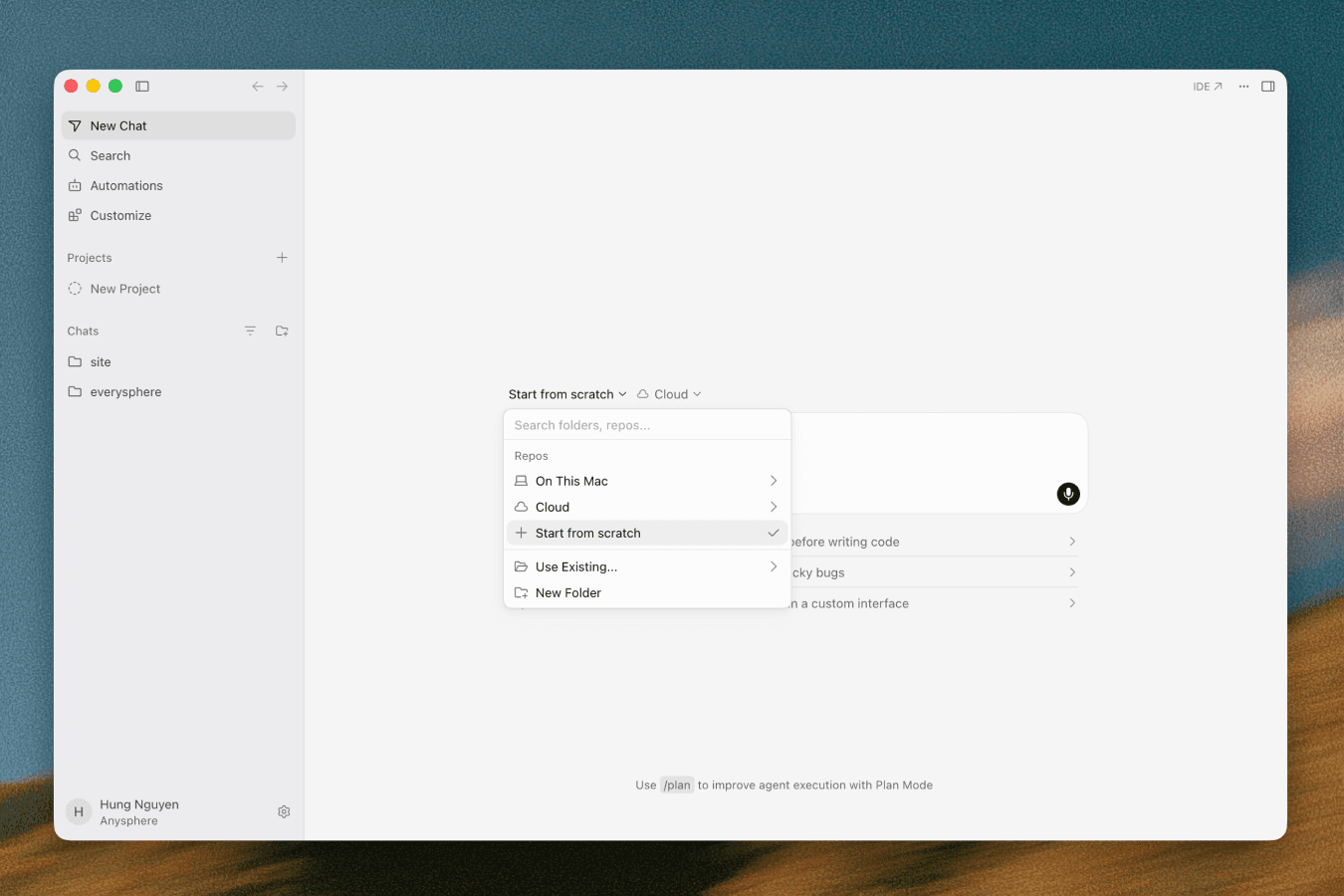
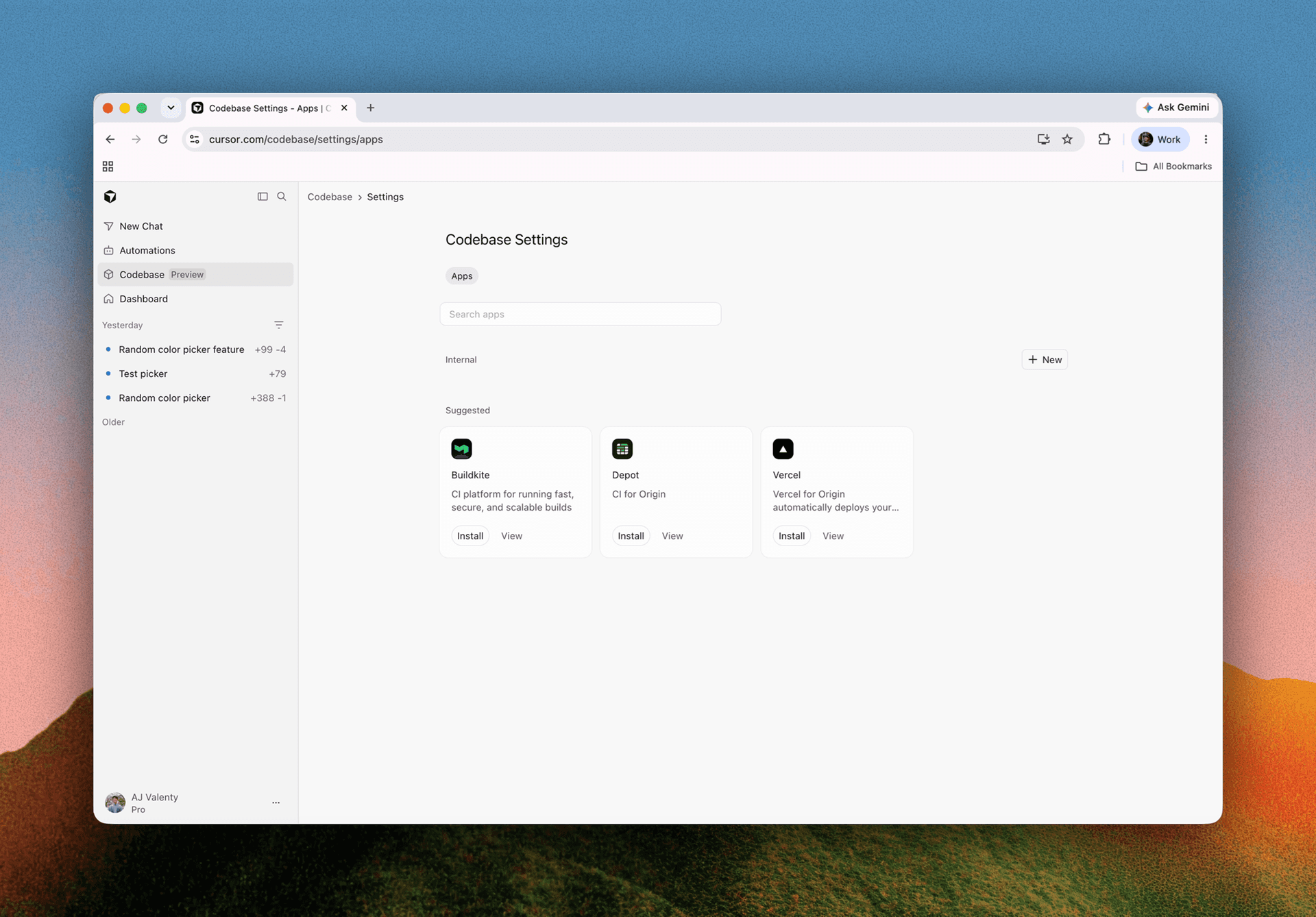
Introduces Origin, a built-in code hosting service with repos, pull requests, code browsing, and GitHub sync, available in early beta on all paid plans. Adds a Codebase tab as the home for Origin repos with a +New button to create repos whose names become part of every repo URL at cursor.com/codebase/<name>, and lets Cloud Agents start without a connected GitHub or third-party SCM provider via 'Start from scratch' in the repo picker, saving work to a Cursor Origin repo. Adds pull request sync between Origin and GitHub so comments, reactions, and replies made in either surface appear in the other within seconds, app extensions (Vercel, Depot, Buildkite) to Origin repos via a per-repo Apps tab enabling preview deployments and CI on every PR, and per-repo Settings for managing GitHub sync status, access control, and connected apps.
— Names URL scheme, tabs, and specific app integrationssnapshot-20260907
0202
Self-hosted machines and execution infrastructureNEW80how completely this was documenteddepth35/40specificity30/30actionability15/3080 / 100
Introduces self-hosted machines so tool execution, codebase, build outputs, and secrets stay entirely within your own network. Adds dynamic pool scheduling via My Machines (single laptop/VM) and Team Pools (named queues of workers) that auto-scale and hibernate idle machines, plus support for running cloud agents on pre-existing sandbox infrastructure including AWS Lambda, Coder, Cloudflare, Daytona, Modal, Namespace, Vercel, and E2B. Also enables computer use (click, type, screenshot, browser control) on Linux and Mac for self-hosted workers, with live desktop viewing and takeover from Cursor.
— Many named integrations and mechanisms, no exact commandssnapshot-20260907
0303
Skill sync and team marketplace for Cloud AgentsNEW75how completely this was documenteddepth30/40specificity25/30actionability20/3075 / 100
Adds a Sync Skills for Cloud Agents toggle under Settings → Agents → Context and Tools that lets individuals enable their personal skills for use in Cloud Agents, and a team admin control under Team Settings → Security & Identity to disable this org-wide for Teams and Enterprise plans. Also adds a team skill marketplace where members publish personal skills from ~/.cursor/skills/ to a shared Default marketplace via Customize → Skills → Publish, an Allow Members to Publish toggle in Dashboard → Plugins that restricts who can publish, and the ability for admins to mark a published plugin 'Default On' or 'Required' to control installation across the team.
Enable your local personal skills for use in Cloud Agents without sharing them with your team.
📍Settings → Agents → Context and Tools → turn on 'Sync Skills for Cloud Agents' → Confirm
As a Teams or Enterprise admin, prevent all members from syncing personal skills to Cloud Agents.
📍Team Settings → Security & Identity → turn off 'Sync Skills for Cloud Agents'
Share a personal skill with your team so teammates can discover and install it from the team marketplace.
📍Go to Customize → Skills, open the personal skill you want to share from ~/.cursor/skills/, choose Publish, and confirm. The skill becomes available in your team's Default marketplace.
Restrict skill publishing to admins only, so members cannot add unapproved skills to the team marketplace.
📍Go to Dashboard → Plugins, open the team marketplace, and turn Allow Members to Publish off.
— Names exact UI paths and toggles, no API surfaceproduct docs
0404
Long-lived goals via /goal commandNEW70how completely this was documenteddepth25/40specificity20/30actionability25/3070 / 100
Adds /goal command to give a cloud agent a long-lived objective that it pursues until fully complete — pair with a custom mode or /loop for recurring check-ins.
Give a cloud agent a persistent, long-running objective — such as eliminating all flaky tests — so it keeps working toward the goal across sessions without you re-prompting.
📍In a new chat, type: /goal fix all flaky tests and make CI green
— Exact runnable command with pairing options namedsnapshot-20260907
0505
Custom Modes pin skills as always-onNEW65how completely this was documenteddepth20/40specificity20/30actionability25/3065 / 100
Adds Custom Modes, which pin any skill as an always-on mode in chat, activated via ⌥⏎ (Mac) or Alt+Enter (Windows) from the skill picker.
Pin a skill as a Custom Mode so every new chat automatically follows a specific playbook — useful for always enforcing a code-review or security-audit workflow.
📍In the chat panel, open the skill picker with / , select the skill you want to pin, then press Alt+Enter (Windows) or Option+Return (Mac) to activate it as a Custom Mode.
Builds for faster Cloud Agent startsNEW65how completely this was documenteddepth30/40specificity20/30actionability15/3065 / 100
Introduces Builds for Cloud Agents: pre-prepared environment snapshots (repos cloned, dependencies installed) that make agents start 3x faster, with a Builds tab in the Cloud Agents dashboard for inspecting build status, logs, and commit SHAs.
— Concrete speedup and dashboard location, no commandsnapshot-20260907
0700
Non-interrupting steering messagesIMPROVED60how completely this was documenteddepth25/40specificity15/30actionability20/3060 / 100
Adds steering improvements allowing mid-run follow-up messages that wait for the next tool call rather than interrupting the agent — send via 'Send now' or by pressing ⏎ twice.
Isolated-VM subagentsNEW45how completely this was documenteddepth20/40specificity10/30actionability15/3045 / 100
Enables subagents to run on their own isolated virtual machines, each with a clean copy of the project and an independent cloud environment.
Spin up a swarm of subagents to independently test a parent agent's changes in fresh, isolated environments — useful for parallel regression or security smoke-testing without environment collisions.
📍In the chat panel, prompt: run a swarm of subagents to test my app for bugs, each in its own environment
Live preview and publishing for Cloud AgentsNEW45how completely this was documenteddepth20/40specificity15/30actionability10/3045 / 100
Adds in-browser live port-forwarding of a cloud agent's environment for real-time preview and design mode tooling, plus a Publish feature that connects a Vercel account and produces a live URL from a built project.
Diagram Design is a Claude Code skill that generates editorial HTML and SVG diagrams and imports draw.io or Mermaid sources.
Diagram Design 2.6 ships ten new diagram types, native Droid packaging, named client profiles, animated semantic patterns, and a live gallery.
└──▷ GET THIS VERSION
$ git clone --branch commits-2026-08-12 https://github.com/cathrynlavery/diagram-design.git
# already have the repo? check out this version:$ git checkout commits-2026-08-12
└──▷ TRY IT
Run the new rendered-lint pass against all examples to catch SVG clipping and runtime errors that source-level linting cannot see.
$ python3 scripts/lint-render.py
Verify beeswarm geometric invariants (value-axis accuracy, no overprint) after editing or generating a beeswarm example.
$ python3 scripts/verify-beeswarm.py
Run adversarial Sankey contract tests to confirm the checker fires on known mutations and stays quiet on clean files.
$ python3 scripts/test-verify-sankey.py
›Adds role="img", aria-labelledby, and first-child <title> / <desc> slots to template.html, template-dark.html, template-full.html, and template-terminal.html, and adds an a11y category to scripts/lint-skin.py that rejects a diagram SVG without a resolvable accessible name.
›Adds scripts/test-lint-a11y.py covering nine rejection and seven acceptance cases for the accessible-SVG contract.
›Adds scripts/verify-beeswarm.py to enforce nine geometric invariants — shared value scale, no overprint, and others — that lint-skin.py and verify-geometry.py cannot catch.
›Adds scripts/lint-render.py to lint diagram examples as rendered in headless Chromium, catching clipped SVG viewports, collapsed SVGs, page overflow, and runtime errors that source-level linting misses.
›Adds scripts/test-verify-sankey.py with adversarial fixtures testing both passing and failing polarities of the Sankey geometric contract.
+13 moreshow less
›Adds treemap diagram type for part-of-whole by area (feat #87).
›Ships ten editorial diagram types in a single release (feat #118).
›Adds dumbbell as a Bar variant (feat #107).
›Adds slopegraph variant to the line diagram type for showing change between two states (feat #106).
›Adds example-queue-animated.html for Semantic Pattern #1 (Fan-in Queue / Bottleneck) and example-paved-road-animated.html for Semantic Pattern #5 (Secure Paved Road).
›Adds native Droid plugin packaging via scripts/factory (feat #120).
›Adds named client profiles (#61).
›Adds a GitHub Actions CI workflow (.github/workflows/ci.yml) running lint-skin.py --all --baseline, verify-sequence-oauth.py, verify-drawio-import.py, and build-icons.py on push and pull request to main.
›Adds multi-OS CI testing matrix for Linux, Windows, and macOS with OS-aware Playwright browser provisioning and a GitHub Step Summary table for matrix run results.
›Adds automated visual artifact packaging and upload on linter failures.
›Deploys a live gallery to GitHub Pages.
›Adds automatic plugin updates via native marketplaces and a version gate.
›Emits aria-hidden="true" from scripts/build-icons.py so decorative specimen icons remain exempt through regeneration.
›Adds role="img", aria-labelledby, and first-child <title> / <desc> slots to template.html, template-dark.html, template-full.html, and template-terminal.html, and adds an a11y category to scripts/lint-skin.py that rejects a diagram SVG without a resolvable accessible name.
›Adds scripts/test-lint-a11y.py covering nine rejection and seven acceptance cases for the accessible-SVG contract.
›Adds scripts/verify-beeswarm.py to enforce nine geometric invariants — shared value scale, no overprint, and others — that lint-skin.py and verify-geometry.py cannot catch.
›Adds scripts/lint-render.py to lint diagram examples as rendered in headless Chromium, catching clipped SVG viewports, collapsed SVGs, page overflow, and runtime errors that source-level linting misses.
›Adds scripts/test-verify-sankey.py with adversarial fixtures testing both passing and failing polarities of the Sankey geometric contract.
+12 moreshow less
›Adds treemap diagram type for part-of-whole by area (feat #87).
›Ships ten editorial diagram types in a single release (feat #118).
›Adds dumbbell as a Bar variant (feat #107).
›Adds slopegraph variant to the line diagram type for showing change between two states (feat #106).
›Adds example-queue-animated.html for Semantic Pattern #1 (Fan-in Queue / Bottleneck) and example-paved-road-animated.html for Semantic Pattern #5 (Secure Paved Road).
›Adds native Droid plugin packaging via scripts/factory (feat #120).
›Adds named client profiles (#61).
›Adds a GitHub Actions CI workflow (.github/workflows/ci.yml) running lint-skin.py --all --baseline, verify-sequence-oauth.py, verify-drawio-import.py, and build-icons.py on push and pull request to main.
›Adds multi-OS CI testing matrix for Linux, Windows, and macOS with OS-aware Playwright browser provisioning and a GitHub Step Summary table for matrix run results.
›Adds automated visual artifact packaging and upload on linter failures.
›Deploys a live gallery to GitHub Pages.
›Adds automatic plugin updates via native marketplaces and a version gate.
Arcade's biggest release in this window adds ten new third-party toolkits (Power BI, Postman, Insightly, Fireflies.ai, OneDrive, Freshdesk, Ashby, Vercel, Datadog, and Nimble) alongside stateless MCPMCPModel Context Protocol, an open standard from Anthropic that lets an AI model call external tools and data sources through a uniform interface, so cyber tools can expose capabilities directly to LLM-based agents. protocol support, new platform RBACRBACRole-Based Access Control, a permissions model where rights are assigned to roles rather than individuals, letting tools enforce least-privilege by granting users only the access their role requires./org APIs, and a wide set of additions to existing Google Workspace, Linear, Telegram, X and Google Slides toolkits.
Arcade provides an actions runtime that lets AI agents securely call external services with authorization and governance controls.
Arcade's biggest release in this window adds ten new third-party toolkits (Power BI, Postman, Insightly, Fireflies.ai, OneDrive, Freshdesk, Ashby, Vercel, Datadog, and Nimble) alongside stateless MCPMCPModel Context Protocol, an open standard from Anthropic that lets an AI model call external tools and data sources through a uniform interface, so cyber tools can expose capabilities directly to LLM-based agents. protocol support, new platform RBACRBACRole-Based Access Control, a permissions model where rights are assigned to roles rather than individuals, letting tools enforce least-privilege by granting users only the access their role requires./org APIs, and a wide set of additions to existing Google Workspace, Linear, Telegram, X and Google Slides toolkits.
└──▷ WHAT SHIPPED ·
12 FEATURES7 OF 12 FEATURESmost completely described firstwhat's the number?
Each feature carries 0–100 for how completely the vendor documented
it — not how big or important the work is. A major capability
described in eight words scores low, and that is the finding.
depth0–40what it does and how it works or what changed
specificity0–30names real surfaces — APIs, flags, formats, limits, numbers
actionability0–30enough to go use it — a named endpoint, flag, or config key tops this; a UI path is a starting point
Code and config rank first by construction: a documented endpoint,
flag or config key scores at the top of specificity and actionability,
so it sorts above a feature described only in prose. Under
60 the notes go thin — everything below the “thinner
coverage” line is thinner documentation, not smaller work.
Hover any meter for that feature's three sub-scores.
0101
Stateless MCP protocol supportNEW83how completely this was documenteddepth30/40specificity28/30actionability25/3083 / 100
Arcade's /mcp path now supports per-request protocol-version dispatch and a stateless server/discover endpoint, plus stateless tools/list and tools/call against the real catalog. The MCP /list page size is now configurable, and MRTR url-mode elicitation was added for tool OAuth challenges on the stateless MCP path.
Discover the stateless MCP server catalog without establishing a session, useful for lightweight integrations.
$ curl -X GET 'https://api.arcade.dev/mcp/server/discover' \
  -H 'Authorization: Bearer <token>'
— Named endpoints with a runnable curl example against server/discover.snapshot-20260907
0202
Ten new toolkits for third-party servicesNEW68how completely this was documenteddepth25/40specificity28/30actionability15/3068 / 100
Arcade adds the microsoft_powerbi toolkit for Power BI integrations, a Postman API toolkit with 30 tools and API-key authentication, an Insightly CRM toolkit with 29 tools for sales and account management, a Fireflies.ai meeting-intelligence toolkit with 17 functionalities, a Microsoft OneDrive toolkit with 16 tools for file management, a Freshdesk customer-support toolkit with API-key authentication, an Ashby recruiting/ATS toolkit for core recruiting operations (including a pipeline exit tool to archive applications), a Vercel toolkit for managing accounts via the REST API, a Datadog observability toolkit for log management, and Nimble as a Partner MCP Server for real-time web data in the search integrations catalog.
— Names ten toolkits with counts and auth types but no invocation examples.snapshot-20260907
0303
Google Workspace toolkit tool additionsNEW63how completely this was documenteddepth20/40specificity28/30actionability15/3063 / 100
Google Workspace toolkits gain new tools: GetSpreadsheetEditHistory in the google_sheets toolkit, a secure Gmail unsubscribe tool with multiple flow outcomes and enhanced validation, new Gmail tools for label lifecycle management and conversation trash status handling, a search_directory_people tool for resolving coworkers' emails, a search_drive tool to search the user's entire Google Drive, and a check_file_access pre-flight probe plus a file_types picker filter for Drive access.
— Names every new tool across Sheets, Gmail and Drive without usage examples.snapshot-20260907
thinner coverage below
0404
Builtin agent tooling and model selectionNEW57how completely this was documenteddepth20/40specificity22/30actionability15/3057 / 100
Adds an Arcade.ListApps builtin that prefixes apps into the MCP prompt, MCP behavior annotations on Arcade builtin tools, an Agent Capability Gap self-report MCP builtin tool with a master switch and LLM instruction integration, a configurable chat-model selector for choosing from a curated catalog, and VS Code chat host support in agent mode for attachment capabilities.
— Named builtins and features, but no configuration details shown.snapshot-20260907
0505
RBAC and org management APIsNEW55how completely this was documenteddepth20/40specificity20/30actionability15/3055 / 100
New platform APIs add a project-scoped tool execution list and detail endpoint for tool-execution history, surface can_invite on org endpoints for RBAC-aware UI, add a CLI command for operator authorization, enable default RBAC for new Cloud signups, and let project members leave projects voluntarily.
— Names endpoints and a field but no exact CLI syntax or paths.snapshot-20260907
0600
Dashboard UI for MCP gateways and Tools pageIMPROVED53how completely this was documenteddepth20/40specificity18/30actionability15/3053 / 100
The dashboard gains dedicated create/edit pages for MCP gateways with new routing and tool selection, a catalog-driven server-side search with lazy loading on the Tools page, and an undo toast notification for destructive picker edits.
— Describes UI changes with clear navigation targets but no exact paths.snapshot-20260907
0706
Linear toolkit new toolsNEW45how completely this was documenteddepth15/40specificity18/30actionability12/3045 / 100
The Linear toolkit adds a resolve_comment tool for managing comment resolution state and a read tool to retrieve project status updates with pagination.
ⓘSourcesRelease notes →1 RELEASE · 2026-09-06NOTES ↗leadWhy this ranktop features scored 80/75/75, +15 breaking change, +6 runnable example — 97.67How ranking works →
OpenBot runs self-hosted AI coworkers that each get their own browser, files, and gated tools, with every action decided and recorded.
OpenBot v0.0.8 ships a cross-platform desktop shell and a production serve script, alongside a new computer.action_stopped audit event and a broad pass of startup and input validation hardening across config variables, the audit endpoint, and the component catalogue.
└──▷ WHAT SHIPPED ·
8 FEATURES5 OF 8 FEATURESmost completely described firstwhat's the number?
Each feature carries 0–100 for how completely the vendor documented
it — not how big or important the work is. A major capability
described in eight words scores low, and that is the finding.
depth0–40what it does and how it works or what changed
specificity0–30names real surfaces — APIs, flags, formats, limits, numbers
actionability0–30enough to go use it — a named endpoint, flag, or config key tops this; a UI path is a starting point
Code and config rank first by construction: a documented endpoint,
flag or config key scores at the top of specificity and actionability,
so it sorts above a feature described only in prose. Under
60 the notes go thin — everything below the “thinner
coverage” line is thinner documentation, not smaller work.
Hover any meter for that feature's three sub-scores.
0101
Startup configuration validation hardeningBREAKING80how completely this was documenteddepth30/40specificity30/30actionability20/3080 / 100
Validates SERVER_INTERNAL_URL at worker startup and requires an http or https URL, refusing to start and naming the variable when wrong. Validates HostPort with digit and range checks, refusing supervisor startup on an invalid port. Treats an empty PORT value on agent-bot and agent-langgraph as the shipped default rather than parsing it as NaN and binding an ephemeral port. Refuses malformed IPv6 entries in AGENT_ENDPOINT_ALLOWED_HOSTS at boot instead of silently accepting entries that never match. Reads durationMs units case-insensitively, accepting 30S alongside 30s.
— Names every affected variable and its exact validation rulev0.0.8
0200
`DATABASE_URL` password and parse validationIMPROVED75how completely this was documenteddepth30/40specificity25/30actionability20/3075 / 100
Reports a malformed DATABASE_URL password containing a bare % with a structured error naming the variable and the required %25 encoding, instead of crashing with URIError: URI error, and refuses any DATABASE_URL value that cannot be parsed without echoing the password into the log.
— Gives exact before/after error behaviour and the fixv0.0.8
0302
`COMPUTER_MEMORY_BYTES` validationBREAKING75how completely this was documenteddepth30/40specificity25/30actionability20/3075 / 100
Validates COMPUTER_MEMORY_BYTES at supervisor startup and refuses non-integer values, preventing a misconfigured cap such as 512m — previously parsed via parseInt into 512 bytes — from ever reaching a container.
— Concrete before/after example of the bug it fixesv0.0.8
0400
Strict audit endpoint parameter validationIMPROVED75how completely this was documenteddepth25/40specificity25/30actionability25/3075 / 100
Validates from, to, and limit parameters on the audit endpoint strictly, returning HTTP 400 for an unparseable date or non-integer limit instead of coercing and querying.
Query the audit log for a specific time window when building a dashboard that needs to distinguish deliberate stops from real outages — filter by the new computer.action_stopped type.
— Names endpoint params, status code, and includes a runnable queryv0.0.8
0503
`serve` script for production deploymentNEW65how completely this was documenteddepth25/40specificity20/30actionability20/3065 / 100
Adds a serve script that builds the app once and serves the bundle, replacing the dev-only dev script as the path to a production deployment.
— Names the exact script and what it replacesv0.0.8
0604
`computer.action_stopped` audit event typeBREAKING65how completely this was documenteddepth28/40specificity22/30actionability15/3065 / 100
Adds the computer.action_stopped audit event type to distinguish a user-initiated Stop from a genuine computer-unreachable failure, enabling accurate outage monitoring by type. Previously all stops were recorded under computer.action_failed, so monitoring that counts failures by that type will no longer count deliberate stops after upgrading.
— Names the event type and the migration impact clearlyv0.0.8
0700
Whitespace sanitization in component catalogueIMPROVED65how completely this was documenteddepth25/40specificity25/30actionability15/3065 / 100
Refuses titles, slugs, and IDs that are entirely whitespace in sandboxed components, skills, custom servers, and the component catalogue, and trims name, title, kind, and description fields before storing them in the catalogue, so a component with a stray space in its name is treated as the same component rather than creating a duplicate row.
— Names affected areas and fields but no direct commandv0.0.8
thinner coverage below
0805
Cross-platform desktop shellNEW50how completely this was documenteddepth25/40specificity15/30actionability10/3050 / 100
Introduces a desktop shell for macOS, Windows, and Linux that fetches, pins, and raises the full OpenBot stack in a single window, no browser tab required.
— Describes mechanism but no install command or config path givenv0.0.8
└──▷ BREAKING ON UPGRADE
!The audit event type for a user-initiated Stop is now computer.action_stopped; anything counting failures by type using computer.action_failed will no longer count deliberate stops.
!SERVER_INTERNAL_URL must be a valid http or https URL; the worker refuses to start if the value is any other string.
!COMPUTER_MEMORY_BYTES must be a whole number of bytes; values like 512m that previously parsed silently via parseInt now cause the supervisor to refuse to start.
!IPv6 entries in AGENT_ENDPOINT_ALLOWED_HOSTS that are not parseable as a valid address are refused at boot; previously malformed entries were accepted and silently never matched.
Perplexity enriched its gateway chat completions responses with moderation results and deeper usage/audio metadata, and shipped a standalone Search API alongside an API key rotation mechanism.
Perplexity API Platform - build with the Router, Agent, Search, and Embeddings APIs. Real-time, web-wide research and Q&A capabilities for your products.
Perplexity enriched its gateway chat completions responses with moderation results and deeper usage/audio metadata, and shipped a standalone Search API alongside an API key rotation mechanism.
└──▷ WHAT SHIPPED ·
4 FEATURES3 OF 4 FEATURESmost completely described firstwhat's the number?
Each feature carries 0–100 for how completely the vendor documented
it — not how big or important the work is. A major capability
described in eight words scores low, and that is the finding.
depth0–40what it does and how it works or what changed
specificity0–30names real surfaces — APIs, flags, formats, limits, numbers
actionability0–30enough to go use it — a named endpoint, flag, or config key tops this; a UI path is a starting point
Code and config rank first by construction: a documented endpoint,
flag or config key scores at the top of specificity and actionability,
so it sorts above a feature described only in prose. Under
60 the notes go thin — everything below the “thinner
coverage” line is thinner documentation, not smaller work.
Hover any meter for that feature's three sub-scores.
0101
Moderation results in chat completionsNEW75how completely this was documenteddepth25/40specificity25/30actionability25/3075 / 100
Adds a moderation object to POST /router/v1/chat/completions responses, with input and output sub-objects each carrying type, model, flagged, categories, category_scores, and category_applied_input_types fields for content moderation results.
Check whether the model flagged your prompt or its own output for policy violations, using the new moderation fields in the gateway response.
— Names endpoint and every field, runnable curl example givenproduct docs
0200
Expanded chat completion response metadataIMPROVED68how completely this was documenteddepth20/40specificity28/30actionability20/3068 / 100
The POST /router/v1/chat/completions response gains reasoning_content on message for chain-of-thought exposure, an annotations array with url_citation entries (start_index, end_index, url, title) for inline source attribution, and an audio object (id, expires_at, data, transcript). usage gains completion_tokens_details (accepted_prediction_tokens, audio_tokens, reasoning_tokens, rejected_prediction_tokens) and prompt_tokens_details (audio_tokens, cached_tokens, cache_write_tokens), plus top-level service_tier and system_fingerprint fields.
Inspect token-level cost breakdown — including cached, reasoning, and audio tokens — to optimise latency and billing for high-volume pipelines.
— Every added field named; example queries usage breakdownproduct docs
thinner coverage below
0302
Standalone Search APINEW55how completely this was documenteddepth25/40specificity20/30actionability10/3055 / 100
A standalone Search API endpoint returns raw, ranked search results from Perplexity's index without any LLM processing, supporting all existing filters including domain, date range, and academic sources.
— Explains behaviour and filters but no endpoint path or examplesnapshot-20260907
0403
API key rotation mechanismNEW35how completely this was documenteddepth20/40specificity10/30actionability5/3035 / 100
Introduces an API key rotation mechanism allowing seamless replacement of API keys without service interruption, and supports automated rotation workflows.
Darkbloom's v0.9.0 release adds an operator-controlled idle-memory policy for provider nodes, per-model hardware eligibility checks in the model catalog, international payout support for providers, and a round of inference performance and UI improvements.
Private Inference Network on Idle Macs
Darkbloom's v0.9.0 release adds an operator-controlled idle-memory policy for provider nodes, per-model hardware eligibility checks in the model catalog, international payout support for providers, and a round of inference performance and UI improvements.
└──▷ WHAT SHIPPED ·
6 FEATURES3 OF 6 FEATURESmost completely described firstwhat's the number?
Each feature carries 0–100 for how completely the vendor documented
it — not how big or important the work is. A major capability
described in eight words scores low, and that is the finding.
depth0–40what it does and how it works or what changed
specificity0–30names real surfaces — APIs, flags, formats, limits, numbers
actionability0–30enough to go use it — a named endpoint, flag, or config key tops this; a UI path is a starting point
Code and config rank first by construction: a documented endpoint,
flag or config key scores at the top of specificity and actionability,
so it sorts above a feature described only in prose. Under
60 the notes go thin — everything below the “thinner
coverage” line is thinner documentation, not smaller work.
Hover any meter for that feature's three sub-scores.
0101
Idle-memory policy for provider nodesNEW86how completely this was documenteddepth30/40specificity28/30actionability28/3086 / 100
Operators choosely how models are kept in memory at darkbloom start: 'Always ready' keeps models loaded, 'Free when idle' unloads them after 60 minutes (the default), or 'Custom' lets the user define their own idle window.
Start a provider node interactively to be prompted for your idle-memory policy — choose between 'Always ready', 'Free when idle', or 'Custom' timeout.
$ darkbloom start
— Names exact command, all three modes, and the default timeout.v0.9.0
0202
Hardware eligibility verdicts in model catalogNEW83how completely this was documenteddepth28/40specificity30/30actionability25/3083 / 100
darkbloom models catalog now surfaces required_provider_capabilities per model and prints eligibility verdicts based on detected hardware, e.g. requires: Apple M5, NAX runtime or 'not eligible on this machine (missing: apple_m5, mlx_nax)'.
Check which catalog models your Apple Silicon Mac is eligible to serve before downloading, including any M5/NAX-gated models.
$ darkbloom models catalog
— Names the command, field, and sample verdict text verbatim.v0.9.0
thinner coverage below
0303
International bank withdrawals for providersNEW41how completely this was documenteddepth15/40specificity18/30actionability8/3041 / 100
Providers can now withdraw earnings via international bank transfer using Stripe Global Payouts.
— Names the payout mechanism but no UI path or limits given.v0.9.0
0400
Pinned model downloads with R2 fallbackIMPROVED41how completely this was documenteddepth18/40specificity15/30actionability8/3041 / 100
Model fetching now prefers pinned Hugging Face artifact downloads, falling back to a verified R2 mirror when needed.
— Names the mechanism but no command or config surface given.v0.9.0
0500
Inference performance improvementsIMPROVED38how completely this was documenteddepth15/40specificity18/30actionability5/3038 / 100
Adds paged attention and SSD caching for Qwen models, and accelerates GPT-OSS prefill and decode performance with measured controls.
— Names techniques and target models but no benchmarks or mechanism detail.v0.9.0
0600
Console, onboarding, and stats dashboard redesignIMPROVED27how completely this was documenteddepth10/40specificity12/30actionability5/3027 / 100
Redesigns the console entry point, the provider onboarding flow, and the network stats dashboard.
— Names three UI areas but gives no detail on the changes.v0.9.0
vMLX 1.6.55 sharpened tool-call validation and warning surfacing across API lanes, refined native MTP sampling-policy adoption, and added ordered replay of tool-step reasoning in chat history.
The vMLX server runs compressed MLX models on Apple Silicon with disk caching, paged memory, continuous batching, and hybrid SSM scheduling.
vMLX 1.6.55 sharpened tool-call validation and warning surfacing across API lanes, refined native MTP sampling-policy adoption, and added ordered replay of tool-step reasoning in chat history.
└──▷ WHAT SHIPPED ·
3 FEATURES1 OF 3 FEATURESmost completely described firstwhat's the number?
Each feature carries 0–100 for how completely the vendor documented
it — not how big or important the work is. A major capability
described in eight words scores low, and that is the finding.
depth0–40what it does and how it works or what changed
specificity0–30names real surfaces — APIs, flags, formats, limits, numbers
actionability0–30enough to go use it — a named endpoint, flag, or config key tops this; a UI path is a starting point
Code and config rank first by construction: a documented endpoint,
flag or config key scores at the top of specificity and actionability,
so it sorts above a feature described only in prose. Under
60 the notes go thin — everything below the “thinner
coverage” line is thinner documentation, not smaller work.
Hover any meter for that feature's three sub-scores.
0100
Tool-call validation and warnings across API lanesIMPROVED55how completely this was documenteddepth25/40specificity20/30actionability10/3055 / 100
Surfaces tool-call drop and schema warnings on every API lane (OpenAI, Anthropic, Ollama), and separates tool-call presence validation and schema validation into independent checks rather than one combined check.
— Names the three API lanes but no config or flag to act on.v1.6.55
0200
MTP sampling-policy adoptionIMPROVED40how completely this was documenteddepth20/40specificity15/30actionability5/3040 / 100
Native MTP adoption now keeps the live engine's sampling policy and depth, governed by one sidecar evidence rule.
— Mechanism named but no exposed setting or command.v1.6.55
0301
Ordered tool-step reasoning replay in chat historyNEW35how completely this was documenteddepth20/40specificity10/30actionability5/3035 / 100
Chat history now replays persisted tool-step reasoning ordered by step rank.
— Behavior described but no interface or command shown.v1.6.55
Pinecone is a managed vector database that stores and queries embeddings for AI applications.
Pinecone shipped a GA schema-based Documents API combining BM25 full-text, dense-vector, and sparse-vector search, introduced egress metering on read operations across all plans, and moved BYOCBYOCBring Your Own Cloud — a deployment model where the end user supplies the cloud infrastructure and the software runs inside it, letting vendors avoid touching customer data. cluster metadata storage in-cluster via FoundationDBFoundationDBA distributed key-value store maintained by Apple, offering ACID transactions across a cluster. Cyber tools use it as a reliable, scalable backend when they need consistent storage under high concurrency..
└──▷ WHAT SHIPPED ·
3 FEATURES2 OF 3 FEATURESmost completely described firstwhat's the number?
Each feature carries 0–100 for how completely the vendor documented
it — not how big or important the work is. A major capability
described in eight words scores low, and that is the finding.
depth0–40what it does and how it works or what changed
specificity0–30names real surfaces — APIs, flags, formats, limits, numbers
actionability0–30enough to go use it — a named endpoint, flag, or config key tops this; a UI path is a starting point
Code and config rank first by construction: a documented endpoint,
flag or config key scores at the top of specificity and actionability,
so it sorts above a feature described only in prose. Under
60 the notes go thin — everything below the “thinner
coverage” line is thinner documentation, not smaller work.
Hover any meter for that feature's three sub-scores.
0101
Schema-based Documents API with BM25 and metadata operationsBREAKING95how completely this was documenteddepth35/40specificity30/30actionability30/3095 / 100
On API version 2026-07, POST /indexes now creates schema-based document indexes: a schema object combines BM25 full-text, dense-vector, and sparse-vector ranking fields in a single index, replacing the previous top-level dimension, metric, vector_type, and spec fields (which will break existing index-creation code on 2026-07). The Documents API supports BM25 token matching, Lucene query syntax, and vector similarity queries with metadata and text-match filters, and adds fetch, update, and delete of documents by metadata filter in addition to by ID.
Create a document index combining BM25 full-text and dense-vector fields in a single index using the new 2026-07 API version.
Egress metering on read operationsNEW70how completely this was documenteddepth30/40specificity30/30actionability10/3070 / 100
Reads via query, fetch, list, and search are now metered for egress, with monthly allowances of 1 GB (Starter), 10 GB (Builder), and 100 GB (Standard and Enterprise). Standard and Enterprise plans continue serving reads beyond the allowance at an overage rate, while Starter and Builder reads are blocked until the next billing period.
In-cluster metadata storage for BYOCIMPROVED45how completely this was documenteddepth20/40specificity20/30actionability5/3045 / 100
BYOC deployments now run FoundationDB inside the customer's Kubernetes cluster to store cluster metadata, eliminating the need for a separately managed database.
— Describes the architectural change but gives no configuration or migration stepschangelog-20260907-be541c1b
└──▷ BREAKING ON UPGRADE
!On API version 2026-07, POST /indexes is schema-only: the top-level dimension, metric, vector_type, and spec fields are replaced by a schema field. Code that passes those top-level fields when creating indexes on 2026-07 will break.
Routing and monitoring for reliable AI apps - the LLMOps platform behind the fastest-growing AI companies.
Helicone's biggest release this window is the open-source Rust-based AI Gateway (with self-hosting via docker compose), alongside Prompt Management V2, a new Go SDK, and broad cost-tracking and context-window expansions across GPT-5, GPT-OSS, Claude and Grok models.
└──▷ WHAT SHIPPED ·
11 FEATURES9 OF 11 FEATURESmost completely described firstwhat's the number?
Each feature carries 0–100 for how completely the vendor documented
it — not how big or important the work is. A major capability
described in eight words scores low, and that is the finding.
depth0–40what it does and how it works or what changed
specificity0–30names real surfaces — APIs, flags, formats, limits, numbers
actionability0–30enough to go use it — a named endpoint, flag, or config key tops this; a UI path is a starting point
Code and config rank first by construction: a documented endpoint,
flag or config key scores at the top of specificity and actionability,
so it sorts above a feature described only in prose. Under
60 the notes go thin — everything below the “thinner
coverage” line is thinner documentation, not smaller work.
Hover any meter for that feature's three sub-scores.
0101
Open-source AI Gateway proxy launchNEW95how completely this was documenteddepth35/40specificity30/30actionability30/3095 / 100
Helicone AI Gateway is a new open-source Rust-based proxy available via docker run -p 8080:8080 helicone/ai-gateway at github.com/helicone/ai-gateway, supporting smart load balancing, semantic caching, automatic failover, and rate limiting across OpenAI, Anthropic, Azure, and more providers.
Spin up the self-hosted Helicone AI Gateway locally to proxy LLM traffic without sending data to third-party servers.
Prompt Management V2 with AI Gateway referencesNEW88how completely this was documenteddepth35/40specificity28/30actionability25/3088 / 100
Prompt Management V2 adds version control, typed variables in system prompts, messages, and tool schemas, and instant deployment through the AI Gateway. AI Gateway API calls now accept prompt_id and inputs fields, enabling prompt references by ID with runtime variable substitution (e.g., {{hc:customer_name:string}}) so prompts can be updated in the dashboard without code changes.
— Named fields and variable syntax, but no full endpoint specsnapshot-20260907
0303
Go SDK for Helicone HelpersNEW75how completely this was documenteddepth20/40specificity25/30actionability30/3075 / 100
Introduces a Go SDK for the Helicone Helpers Package, installable via go get github.com/helicone/go-helicone-helpers, enabling custom LLM integration with the Go Manual Logger.
Install the Go Helicone Helpers Package to instrument a custom LLM with the Manual Logger in a Go service.
One-command self-hosting deploymentNEW75how completely this was documenteddepth20/40specificity25/30actionability30/3075 / 100
Adds self-hosting support via a single docker compose up -d command from the github.com/Helicone/helicone repository, keeping all LLM interactions and analytics within your own infrastructure.
Cost tracking for new LLM modelsNEW70how completely this was documenteddepth25/40specificity30/30actionability15/3070 / 100
Adds cost tracking for GPT-5, GPT-5-Mini, GPT-5-Nano, and GPT-5-Chat-Latest models across multiple providers with Playground support; for GPT-OSS models (accounts/fireworks/models/gpt-oss-20b, accounts/fireworks/models/gpt-oss-120b, openai/gpt-oss-20b, openai/gpt-oss-120b) across Fireworks, Groq, and OpenRouter; for Claude Opus 4.1 (claude-opus-4-1-20250805, anthropic/claude-opus-4.1 on OpenRouter) and grok-4 / x-ai/grok-4; and for gpt-4o-search with automatic pricing detection.
— Every model id named verbatim, tracking mechanism itself thinsnapshot-20260907
0606
Country-based request filteringNEW65how completely this was documenteddepth20/40specificity25/30actionability20/3065 / 100
Adds a country_code:<ISO> filter (e.g., country_code:US) to the requests dashboard advanced filters section for geographic analytics on LLM usage.
1M token context for Claude Sonnet on AI GatewayIMPROVED60how completely this was documenteddepth25/40specificity25/30actionability10/3060 / 100
Extends Claude Sonnet 4 and Sonnet 4.5 on the AI Gateway to support a 1M token context window by default across Anthropic API, AWS Bedrock, and Google Vertex AI.
— Specific limit and providers named, no config stepssnapshot-20260907
thinner coverage below
0807
Reasoning effort control in PlaygroundNEW55how completely this was documenteddepth20/40specificity20/30actionability15/3055 / 100
Adds reasoning effort control in the Playground with minimal, low, medium, and high reasoning levels for supported thinking models.
ⓘSourcesRelease page →1 RELEASE · 2026-08-10NOTES ↗alsoWhy this ranktop features scored 90/60/35, +15 breaking change, +6 runnable example — 82.67How ranking works →
LangSmith's latest release changes bulk export compression defaults, adds pre-save testing for thread evaluators, reworks trace sharing to operate at the trace root, and ships several breaking API and logging changes.
LangSmith provides tracing, evaluation, and deployment tools for LLM applications.
LangSmith's latest release changes bulk export compression defaults, adds pre-save testing for thread evaluators, reworks trace sharing to operate at the trace root, and ships several breaking API and logging changes.
└──▷ WHAT SHIPPED ·
5 FEATURES4 OF 5 FEATURESmost completely described firstwhat's the number?
Each feature carries 0–100 for how completely the vendor documented
it — not how big or important the work is. A major capability
described in eight words scores low, and that is the finding.
depth0–40what it does and how it works or what changed
specificity0–30names real surfaces — APIs, flags, formats, limits, numbers
actionability0–30enough to go use it — a named endpoint, flag, or config key tops this; a UI path is a starting point
Code and config rank first by construction: a documented endpoint,
flag or config key scores at the top of specificity and actionability,
so it sorts above a feature described only in prose. Under
60 the notes go thin — everything below the “thinner
coverage” line is thinner documentation, not smaller work.
Hover any meter for that feature's three sub-scores.
0101
Thread evaluator pre-save testing and turn-count filterNEW90how completely this was documenteddepth30/40specificity30/30actionability30/3090 / 100
The thread evaluator config now shows a locked 'Trace count >= 2' filter for managed thread evaluators, making explicit that they only run on threads with multiple turns. Evaluators can be validated against a real conversation before saving via POST /runs/rules/validate with test_thread_id, session_id, and rule parameters, catching misconfiguration early.
Test a multi-turn thread evaluator against a real conversation before saving it to catch misconfiguration early.
— Names endpoint, method, and parameters with a runnable curl example.snapshot-20260907
0202
Dataset comparison helpers removed from public APIBREAKING60how completely this was documenteddepth25/40specificity20/30actionability15/3060 / 100
Legacy dataset comparison helpers are removed from the public OpenAPI spec and generated SDKs; existing HTTP routes continue to work only for LangSmith UI clients, so integrations relying on the SDK methods must migrate.
— Names the removed surface and migration constraint clearly.snapshot-20260907
thinner coverage below
0303
Trace-root scoped sharingBREAKING35how completely this was documenteddepth20/40specificity10/30actionability5/3035 / 100
Sharing, viewing, or unsharing any run in a trace now operates on the trace root, meaning every run in a shared trace becomes publicly viewable rather than just the individual run that was shared.
— Explains behavior change but no config or opt-out named.snapshot-20260907
0404
Dataset split chips in Examples tableNEW35how completely this was documenteddepth15/40specificity10/30actionability10/3035 / 100
Each example's dataset splits now render as chips in the dataset Examples table, with a clickable +N overflow menu for examples belonging to many splits.
— UI change described but no exact navigation path given.snapshot-20260907
0500
ABAC-aware access denial messagingIMPROVED30how completely this was documenteddepth15/40specificity10/30actionability5/3030 / 100
Thread pages now show an explicit access-control message when trace loading is denied by ABAC, instead of a generic retrieval error.
— Describes the change but no mechanism or navigation detail.snapshot-20260907
└──▷ BREAKING ON UPGRADE
!Legacy dataset comparison helpers are removed from the public OpenAPI spec and generated SDKs; existing HTTP routes continue to work only for LangSmith UI clients.
!The batched-run ingestion log now emits run_verbs as a list of run_id and verbs objects instead of a map keyed by run UUID, which will break any structured-log aggregators that parse the old map format.
Braintrust provides evaluation, tracing, and improvement workflows for AI applications.
Braintrust's biggest additions this window are two new investigation tools—Patterns for automated cross-trace analysis and Debugger for single-trace failure diagnosis—plus an upgraded Loop agent with a managed runtime, project-wide write access, and built-in GPT-5.6 models. Smaller additions cover a new gateway model, OpenAI Batch API tracing, GitHub eval action filtering, Pydantic AIPydantic AIA Python library that wraps Pydantic's data-validation models around LLM interactions, giving developers structured, type-safe inputs and outputs when building AI-powered agents or pipelines. span metadata, blind human reviews, and Agno auto-instrumentation.
└──▷ WHAT SHIPPED ·
7 FEATURES5 OF 7 FEATURESmost completely described firstwhat's the number?
Each feature carries 0–100 for how completely the vendor documented
it — not how big or important the work is. A major capability
described in eight words scores low, and that is the finding.
depth0–40what it does and how it works or what changed
specificity0–30names real surfaces — APIs, flags, formats, limits, numbers
actionability0–30enough to go use it — a named endpoint, flag, or config key tops this; a UI path is a starting point
Code and config rank first by construction: a documented endpoint,
flag or config key scores at the top of specificity and actionability,
so it sorts above a feature described only in prose. Under
60 the notes go thin — everything below the “thinner
coverage” line is thinner documentation, not smaller work.
Hover any meter for that feature's three sub-scores.
0101
Tracing for OpenAI Batch API requestsNEW90how completely this was documenteddepth30/40specificity30/30actionability30/3090 / 100
TypeScript SDK v3.30.0 adds openaiFilesCreateTraced, openaiBatchesRetrieveTraced, and completeOpenAIBatchTrace to trace asynchronous OpenAI Batch API requests end-to-end, so batch inference jobs appear as spans in Braintrust experiments.
Trace async OpenAI Batch requests end-to-end so batch inference jobs appear as first-class spans in your Braintrust experiments.
Loop managed runtime and built-in modelsIMPROVED85how completely this was documenteddepth35/40specificity30/30actionability20/3085 / 100
Loop now runs in a Braintrust-managed runtime, persists threads, and operates across logs, experiments, and datasets project-wide. It can create and edit prompts, scorers, datasets, facets, custom views, dashboards, and automations, with a per-write approval step unless auto-accept is enabled. Loop also runs built-in on GPT-5.6 Sol, GPT-5.6 Terra, and GPT-5.6 Luna models with no AI provider configuration required.
— Describes mechanism, objects, and built-in modelssnapshot-20260907
0302
Auto-instrumentation for Agno eval typesNEW80how completely this was documenteddepth25/40specificity25/30actionability30/3080 / 100
Calling auto_instrument() automatically instruments all Agno eval types (AccuracyEval, AgentAsJudgeEval, ReliabilityEval, PerformanceEval) so their runs appear as Braintrust experiments without manual tracing setup.
Automatically instrument all Agno eval types so their runs appear as Braintrust experiments without manual tracing setup.
python
from braintrust import auto_instrument
from agno.evals import AccuracyEval, AgentAsJudgeEval, ReliabilityEval, PerformanceEval

auto_instrument()

eval_suite = [
    AccuracyEval(agent=my_agent, questions=questions),
    AgentAsJudgeEval(agent=my_agent, rubric=rubric),
    ReliabilityEval(agent=my_agent, scenarios=scenarios),
    PerformanceEval(agent=my_agent, tasks=tasks),
]
for e in eval_suite:
    e.run()
— Runnable example, not mentioned in changelog prosesnapshot-20260907
0403
PR comment filtering in GitHub eval actionNEW75how completely this was documenteddepth25/40specificity30/30actionability20/3075 / 100
GitHub eval action v2.1.0 adds report_scores and report_metrics inputs, each accepting a comma- or newline-separated list of names to filter what appears in the PR comment.
— Named inputs and version, no full workflow examplesnapshot-20260907
0504
Patterns automated trace investigationNEW70how completely this was documenteddepth35/40specificity20/30actionability15/3070 / 100
Patterns is a scheduled automated investigation of traces that surfaces recurring failure modes, cost trends, and cohort-level problems. Each finding includes supporting traces and a suggested fix, and can be used to create a scorer, continue in Loop, or copy as a prompt.
Debugger trace failure analysisNEW65how completely this was documenteddepth30/40specificity20/30actionability15/3065 / 100
Debugger reports likely failure modes for a single trace, citing spans, tool calls, and model outputs, and groups a run into 'Work' sections via 'Analyze trace' to explain what the agent did.
Invocation parameters in Pydantic AI span metadataIMPROVED60how completely this was documenteddepth25/40specificity25/30actionability10/3060 / 100
Python SDK v0.37.0 adds invocation parameters (temperature, max_tokens, and similar model settings) to Pydantic AI LLM span metadata when model settings are provided.
Promptfoo expanded its provider ecosystem with new integrations for Docker Model Runner, MCPMCPModel Context Protocol, an open standard from Anthropic that lets an AI model call external tools and data sources through a uniform interface, so cyber tools can expose capabilities directly to LLM-based agents. servers, and several models and vision providers, while also adding enterprise-grade mutual TLS support for the HTTP provider.
Promptfoo tests, evaluates, and red-teams LLM applications to detect vulnerabilities and compare model outputs.
Promptfoo expanded its provider ecosystem with new integrations for Docker Model Runner, MCPMCPModel Context Protocol, an open standard from Anthropic that lets an AI model call external tools and data sources through a uniform interface, so cyber tools can expose capabilities directly to LLM-based agents. servers, and several models and vision providers, while also adding enterprise-grade mutual TLS support for the HTTP provider.
└──▷ WHAT SHIPPED ·
5 FEATURES4 OF 5 FEATURESmost completely described firstwhat's the number?
Each feature carries 0–100 for how completely the vendor documented
it — not how big or important the work is. A major capability
described in eight words scores low, and that is the finding.
depth0–40what it does and how it works or what changed
specificity0–30names real surfaces — APIs, flags, formats, limits, numbers
actionability0–30enough to go use it — a named endpoint, flag, or config key tops this; a UI path is a starting point
Code and config rank first by construction: a documented endpoint,
flag or config key scores at the top of specificity and actionability,
so it sorts above a feature described only in prose. Under
60 the notes go thin — everything below the “thinner
coverage” line is thinner documentation, not smaller work.
Hover any meter for that feature's three sub-scores.
0101
MCP provider and red-team agent exampleNEW65how completely this was documenteddepth25/40specificity25/30actionability15/3065 / 100
Adds an MCP (Model Context Protocol) provider to connect Promptfoo evals to MCP servers, plus an MCP Agent example for red team testing that demonstrates how to test AI systems using tool call results via MCP.
— Names provider and example but no exact config shownsnapshot-20260907
thinner coverage below
0202
JKS and PFX client certificates for HTTP providerNEW55how completely this was documenteddepth20/40specificity20/30actionability15/3055 / 100
The HTTP provider now supports JKS and PFX client certificate formats, enabling mutual TLS authentication against enterprise endpoints.
— Names cert formats but no config key or flag shownsnapshot-20260907
0303
New model and provider integrationsNEW55how completely this was documenteddepth15/40specificity30/30actionability10/3055 / 100
Adds the Google Imagen provider for generating images in multimodal testing scenarios, the AIMLAPI provider for unified access to various AI models, support for OpenAI's o3-deep-research and o4-mini-deep-research models, Grok-4 model support via the xAI provider, LiteLLM embeddings support for similarity testing and semantic search evaluations, and a Google Vision provider for image understanding in multimodal evaluations.
— Six providers named but each described in one line onlysnapshot-20260907
0404
Docker Model Runner providerNEW50how completely this was documenteddepth20/40specificity20/30actionability10/3050 / 100
Adds a Docker Model Runner provider to run models in isolated Docker containers for improved security and reproducibility.
— Names the provider but no setup command or config givensnapshot-20260907
0500
System prompt support in Azure providerIMPROVED25how completely this was documenteddepth10/40specificity10/30actionability5/3025 / 100
The Azure provider now supports system prompts for better control over model behavior.
— Thin description with no mechanism or config detailsnapshot-20260907
ⓘSourcesRelease notes →1 RELEASE · 2026-09-07NOTES ↗leadWhy this ranktop features scored 95/85/80, +15 breaking change, +6 runnable example — 107.67How ranking works →
Docker Sandboxes runs AI agents in isolated Docker environments with controlled filesystem, network, and tool access.
Docker Sandboxes v0.42.0 adds machine-readable JSON output across read-only commands, scoped MCPMCPModel Context Protocol, an open standard from Anthropic that lets an AI model call external tools and data sources through a uniform interface, so cyber tools can expose capabilities directly to LLM-based agents. OAuth authorization, Git-based skills, a full argument system for kits and environment files, and a Windows MSI installer — alongside several breaking changes to port defaults, built-in agents, and environment-file semantics.
└──▷ WHAT SHIPPED ·
23 FEATURES16 OF 23 FEATURESmost completely described firstwhat's the number?
Each feature carries 0–100 for how completely the vendor documented
it — not how big or important the work is. A major capability
described in eight words scores low, and that is the finding.
depth0–40what it does and how it works or what changed
specificity0–30names real surfaces — APIs, flags, formats, limits, numbers
actionability0–30enough to go use it — a named endpoint, flag, or config key tops this; a UI path is a starting point
Code and config rank first by construction: a documented endpoint,
flag or config key scores at the top of specificity and actionability,
so it sorts above a feature described only in prose. Under
60 the notes go thin — everything below the “thinner
coverage” line is thinner documentation, not smaller work.
Hover any meter for that feature's three sub-scores.
0101
Kit arguments (`--kit-arg`, `args:` block)NEW95how completely this was documenteddepth35/40specificity30/30actionability30/3095 / 100
Kits can now declare arguments in an args: block and receive values with --kit-arg name=value or --kit-arg kit.name=value to target a specific kit; a kits: entry in sbxenv.yaml can carry per-kit arguments under kits[].args.
Pass parameterized values into a kit at launch time — useful when a kit exposes configurable targets or modes.
$ sbx run docker.io/myorg/pentest-kit:latest --kit-arg target=192.168.1.0/24 --kit-arg mode=aggressive
Pin per-kit arguments in an environment file so the same values are applied every time the environment is started.
— Full flag and config key with runnable examplesv0.42.0
0202
JSON output for read-only commandsNEW85how completely this was documenteddepth25/40specificity30/30actionability30/3085 / 100
Adds a --json flag to sbx secret ls, sbx version, sbx mcp ls, sbx skills ls, sbx policy inspect, and the sbx kit verification commands for machine-readable output; sbx version --json also reports a server.state field (running or unavailable) so scripts can check daemon reachability without parsing error text.
Check daemon reachability in CI scripts without parsing human-readable error text.
$ sbx version --json | jq '.server.state'
— Names every affected command and field, with a runnable jq examplev0.42.0
0303
Default TCP4 port publishingBREAKING80how completely this was documenteddepth30/40specificity25/30actionability25/3080 / 100
sbx ports --publish and kit-declared ports now default to tcp4 instead of dual-stack tcp, so published ports no longer listen on ::1; pass the protocol explicitly (e.g. --publish 8080:3000/tcp) to restore dual-stack behavior.
— Exact flag and migration example providedv0.42.0
0400
Scoped MCP OAuth authorizationIMPROVED75how completely this was documenteddepth30/40specificity25/30actionability20/3075 / 100
sbx mcp auth now requests only the chosen scopes (or those the resource requires) instead of a broad default set, accepts a new --no-scope flag to suppress server-required scopes, explains refused scopes with a narrower retry command, and reports granted/requested/supported scope sets in sbx mcp auth status.
— Mechanism and flag named but no runnable example givenv0.42.0
0504
Optional workspace bind mountsBREAKING75how completely this was documenteddepth30/40specificity25/30actionability20/3075 / 100
sbx create can now omit the workspace path to create a sandbox with no workspace bind mount; correspondingly, an environment file that declares no workspace: now creates a sandbox with no bind mount instead of mounting the directory holding the file — add workspace: . to restore the previous behavior.
— Behavior change and explicit migration note includedv0.42.0
0605
Environment-file arguments (`args:` block)BREAKING75how completely this was documenteddepth30/40specificity25/30actionability20/3075 / 100
Environment files (sbxenv.yaml) can now declare their own arguments in an args: block, referenced as ${{ env.args.NAME }} and supplied with sbx env --env-arg; this replaces the previous ${VAR} interpolation syntax, which is no longer expanded.
— Config syntax and breaking migration named, no examplev0.42.0
0706
Built-in agents removed in favor of community kitsBREAKING75how completely this was documenteddepth25/40specificity25/30actionability25/3075 / 100
The built-in droid, copilot, and kiro agents are removed and must now be run as community kits, e.g. sbx run docker.io/sbx/droid-kit:latest, sbx run docker.io/sbx/copilot-kit:latest, or sbx run docker.io/sbx/kiro-kit:latest.
— Exact migration commands given for each removed agentv0.42.0
0807
sbx env plan-and-confirm workflowNEW70how completely this was documenteddepth30/40specificity20/30actionability20/3070 / 100
sbx env now shows a plan of all changes an environment file will make to the host (lifecycle commands, credentials, bindings, MCP servers, workspaces, kits, ports) and prompts for approval unless env.rememberHostCommands is set.
— Names the config key and scope of the plan, no examplev0.42.0
0908
Sandbox default disk size reducedBREAKING70how completely this was documenteddepth25/40specificity25/30actionability20/3070 / 100
Sandbox default Docker volume size is reduced to 10 GB (from 50 GB); configurable via the sandbox.disk.dockerVolume setting or the DOCKER_SANDBOXES_DOCKER_SIZE environment variable.
sbx mcp add flag rename and address flexibilityIMPROVED65how completely this was documenteddepth20/40specificity25/30actionability20/3065 / 100
sbx mcp add gains a --skip-auth flag (replacing --skip_auth) and now allows --url values pointing at private, loopback, or cloud-metadata addresses, printing a warning instead of refusing.
— Flag rename and behavior change named, no example commandv0.42.0
1100
Kit reference as positional run argumentIMPROVED60how completely this was documenteddepth20/40specificity20/30actionability20/3060 / 100
Adds an sbx run <sandbox-kit-ref> positional form so kit references can be passed directly as the agent argument; the --kit flag is now reserved for mixins.
— Names the new syntax and repurposed flag, no examplev0.42.0
thinner coverage below
1200
Environment file resolution and defaultsIMPROVED55how completely this was documenteddepth20/40specificity20/30actionability15/3055 / 100
sbx env now reads a non-hidden sbxenv.yaml in preference to .sbxenv.yaml when both exist in a directory, and merges a sbxenv.yaml from the home directory as project-wide defaults.
— File precedence and merge behavior named clearlyv0.42.0
1309
CPU and memory limits via kit specNEW55how completely this was documenteddepth20/40specificity20/30actionability15/3055 / 100
Kits can now set a sandbox's CPU and memory limits via the sandbox.resources block in their spec.
Registry mirror applied inside sandboxesIMPROVED55how completely this was documenteddepth20/40specificity20/30actionability15/3055 / 100
A registry mirror configured with platform.images.registryMirror is now also applied to Docker running inside a sandbox when the value is a bare host.
— Config key and condition named, no examplev0.42.0
1510
Audit records for declined MCP approval promptsNEW55how completely this was documenteddepth25/40specificity20/30actionability10/3055 / 100
Declined @requireApproval prompts on a local MCP server now produce their own audit record with policy attribution and a context digest.
— Mechanism named but no command to inspect the recordv0.42.0
1611
Cloud sandbox port publishingNEW55how completely this was documenteddepth20/40specificity20/30actionability15/3055 / 100
sbx --cloud run and sbx --cloud create now publish a kit's declared TCP ports and print their public URLs.
— Commands and behavior named, no worked examplev0.42.0
1712
Git-based sandbox skills managementNEW45how completely this was documenteddepth15/40specificity15/30actionability15/3045 / 100
Adds an sbx skills subcommand to add, update, list, and remove sandbox skills directly from Git repositories.
— Names the subcommand but no flags or example shownv0.42.0
1800
Governance resolution visibilityIMPROVED45how completely this was documenteddepth15/40specificity15/30actionability15/3045 / 100
Governance resolution issues are now shown in sbx policy output and the dashboard.
— Names the command surface but not the mechanismv0.42.0
1900
Terminal display fixesIMPROVED45how completely this was documenteddepth20/40specificity15/30actionability10/3045 / 100
sbx terminal output now adapts colours for light terminal backgrounds and uses a distinct pink spinner glyph; CJK and combining-mark column widths in table output are now measured correctly.
— Cosmetic fixes described, no config surface involvedv0.42.0
2013
Relative kit path resolution changedBREAKING45how completely this was documenteddepth20/40specificity15/30actionability10/3045 / 100
Relative kit paths in an environment file now resolve against the file's directory instead of the directory sbx was run from.
— Behavior change named, no example or migration commandv0.42.0
2114
sbx env create display, GPU, and USB optionsNEW40how completely this was documenteddepth15/40specificity15/30actionability10/3040 / 100
sbx env create now accepts display, GPU, and USB options in sbxenv.yaml and shares imported skills by default.
— Options named generically, no exact keys givenv0.42.0
2215
Automatic diagnostics bundle uploadNEW35how completely this was documenteddepth15/40specificity10/30actionability10/3035 / 100
Docker Sandboxes can now upload a diagnostics bundle automatically when the daemon hits an error, after opt-in.
— No detail on the opt-in mechanism or commandv0.42.0
2316
Windows MSI installerNEW30how completely this was documenteddepth10/40specificity10/30actionability10/3030 / 100
Provides a machine-wide Windows MSI installer for administrator-managed installations.
— Bare description with no options or install stepsv0.42.0
└──▷ BREAKING ON UPGRADE
!sbx ports --publish and kit-declared ports now default to tcp4 instead of dual-stack tcp, so published ports no longer listen on ::1; pass the protocol explicitly (e.g. --publish 8080:3000/tcp) to restore dual-stack behavior.
!The built-in droid, copilot, and kiro agents are removed; existing workflows that invoke them directly must be updated to sbx run docker.io/sbx/droid-kit:latest, sbx run docker.io/sbx/copilot-kit:latest, or sbx run docker.io/sbx/kiro-kit:latest.
!${VAR} interpolation in .sbxenv.yaml is no longer expanded; use the new ${{ env.args.NAME }} syntax with an args: block instead.
!An environment file that declares no workspace: now creates a sandbox with no workspace bind mount instead of mounting the directory holding the file; add workspace: . to restore the previous behavior.
!Relative kit paths in an environment file now resolve against the file's directory instead of the directory sbx was run from.
Anthropic provides Claude AI models and APIs for building applications that generate, analyze, and automate work.
Anthropic shipped Claude Fable 5.1 and Claude Mythos 5.1 with 1M-token context and always-on adaptive thinking, alongside an ant apply subcommand for infrastructure-as-code agent deployments, a full Admin API in the CLI and SDKs, expanded Compliance API coverage, and several breaking changes to tool_choice, thinking-block replay, and beta SDK clients.
└──▷ WHAT SHIPPED ·
15 FEATURES13 OF 15 FEATURESmost completely described firstwhat's the number?
Each feature carries 0–100 for how completely the vendor documented
it — not how big or important the work is. A major capability
described in eight words scores low, and that is the finding.
depth0–40what it does and how it works or what changed
specificity0–30names real surfaces — APIs, flags, formats, limits, numbers
actionability0–30enough to go use it — a named endpoint, flag, or config key tops this; a UI path is a starting point
Code and config rank first by construction: a documented endpoint,
flag or config key scores at the top of specificity and actionability,
so it sorts above a feature described only in prose. Under
60 the notes go thin — everything below the “thinner
coverage” line is thinner documentation, not smaller work.
Hover any meter for that feature's three sub-scores.
0101
Admin API in CLI and SDKsNEW95how completely this was documenteddepth35/40specificity30/30actionability30/3095 / 100
The Admin API is now available in the ant CLI and Python, TypeScript, C#, Go, Java, PHP, and Ruby SDKs under client.beta.organization, covering organization info, members, invites, workspaces, API keys, rate limits, service accounts, workload identity federation issuers and rules, and customer-managed encryption keys; it reads credentials from ANTHROPIC_API_KEY or ANTHROPIC_AUTH_TOKEN.
— Names the client path, env vars, and every covered resource.snapshot-20260907
0202
Mid-conversation effort control betaNEW90how completely this was documenteddepth30/40specificity30/30actionability30/3090 / 100
With the mid-conversation-output-config-2026-07-01 beta header, a role: "system" message inside messages can include output_config.effort to change effort mid-conversation on Claude Fable 5.1, Claude Mythos 5.1, and Claude Opus 5 while preserving the prompt cache.
— Exact header and JSON field make this runnable as described.snapshot-20260907
0303
Turn-scoped system messages betaNEW90how completely this was documenteddepth30/40specificity30/30actionability30/3090 / 100
The mid-conversation-system-clear-at-2026-08-21 beta header lets a mid-conversation role: "system" message set clear_at: "next_user_message" so it applies only to the current turn and remains in history at no token cost.
— Exact header and field value give a runnable configuration.snapshot-20260907
0404
`ant apply` subcommand for agent infrastructure-as-codeNEW85how completely this was documenteddepth30/40specificity25/30actionability30/3085 / 100
The ant CLI (v1.30.0) adds ant apply to create and update agents, environments, skills, memory stores, and deployments directly from repository files, writing a claude-lock.json lockfile to keep CI runs reproducible.
— Names exact subcommand, CLI version, and lockfile file.snapshot-20260907
0505
Thinking block binding controls beta headerNEW85how completely this was documenteddepth30/40specificity30/30actionability25/3085 / 100
The thinking-binding-controls-2026-08-01 beta header reports dropped thinking blocks in an input_transformations response field and adds thinking.block_binding.prefix_mismatch_behavior to choose between rejecting or dropping blocks whose conversation history changed.
— Named header, response field, and config key are directly usable.snapshot-20260907
0600
Compliance API session coverage expands and exits beta for Cowork/CodeIMPROVED85how completely this was documenteddepth30/40specificity30/30actionability25/3085 / 100
The Compliance API's local session endpoints (beta, Claude Enterprise) now return transcripts for Claude Science sessions (product_surface value claude_science) and Claude for Microsoft 365 sessions in Excel, PowerPoint, Word, and Outlook (product_surface values beginning with office_agents), using the existing Compliance Access Key and read:compliance_user_data scope; the same session endpoints for Cowork and Claude Code sessions are promoted out of beta.
— Names product_surface values, scope, and beta status change.snapshot-20260907
0706
Beta files/skills SDK client changesBREAKING85how completely this was documenteddepth30/40specificity30/30actionability25/3085 / 100
In Python SDK 1.2.0, TypeScript SDK 0.122.0, Go SDK 1.68.0, Java SDK 2.59.0, Ruby SDK 1.67.0, and C# SDK 12.44.0, client.beta.files and client.beta.skills no longer send the files-api-2025-04-14 and skills-2025-10-02 beta headers and return the same response shapes as client.files and client.skills; client.beta.skills.delete() now deletes a Skill together with all of its versions, and the beta Messages type BetaSkill is renamed BetaContainerSkill.
— Names exact SDK versions, headers, methods, and type rename.snapshot-20260907
0807
Claude Fable 5.1 and Claude Mythos 5.1 launch with 1M contextNEW80how completely this was documenteddepth30/40specificity30/30actionability20/3080 / 100
claude-fable-5-1 launches with a 1M token context window, 128k max output tokens, always-on adaptive thinking, priced at $10/$50 per MTok input/output with prompt cache reads at $0.25 per MTok (0.025x base input price); claude-mythos-5-1 ships the same context, output, thinking, and pricing for Project Glasswing participants.
— Concrete specs and pricing but only a model id to call.snapshot-20260907
0908
`thinking.display` "updates" mode betaNEW80how completely this was documenteddepth25/40specificity30/30actionability25/3080 / 100
With the thinking-display-updates-2026-08-18 beta header, thinking.display accepts the value "updates", returning short progress updates Claude writes between tool calls as text, with at most one thinking block before each tool call.
— Named header and field value with a stated behavioural limit.snapshot-20260907
1000
Computer and browser use toolsets on Google CloudIMPROVED70how completely this was documenteddepth20/40specificity30/30actionability20/3070 / 100
The computer_toolset_20260801 and browser_toolset_20260801 toolsets are now available on Google Cloud for Claude Fable 5, Claude Mythos 5, Claude Opus 5, Claude Sonnet 5, and Claude Opus 4.8.
— Names exact toolsets and model availability, no mechanism detail.snapshot-20260907
1109
`tool_choice` restrictions on Fable/Mythos 5.1BREAKING65how completely this was documenteddepth20/40specificity25/30actionability20/3065 / 100
On Claude Fable 5.1 and Claude Mythos 5.1, tool_choice types any and tool are not supported and return a 400 error; only auto and none are accepted.
Thinking block replay restrictionsBREAKING65how completely this was documenteddepth25/40specificity25/30actionability15/3065 / 100
For accounts created on or after August 31, 2026, replaying a thinking block on Claude Fable 5.1 after the system prompt, tools, or an earlier message has changed now returns a 400 error, and thinking blocks produced by Claude Fable 5.1 and Claude Mythos 5.1 are dropped by the API if replayed to an earlier model.
`anthropic-version` header now required for Enterprise APIsBREAKING55how completely this was documenteddepth15/40specificity20/30actionability20/3055 / 100
The Claude Enterprise Admin API endpoints, Claude Enterprise Analytics API, and Compliance API now require the anthropic-version header on every request.
— Exact header and affected APIs named, minimal further detail.snapshot-20260907
1412
Automatic content watermarkingNEW50how completely this was documenteddepth25/40specificity20/30actionability5/3050 / 100
Text output from Claude Fable 5.1 and Claude Mythos 5.1 automatically carries Anthropic's text watermark; image, video, and audio files produced via the code execution tool carry C2PA Content Credentials when retrieved through the Files API, with no request or response changes required.
— Automatic behaviour with nothing for a reader to configure.snapshot-20260907
1513
Personal and service account API keys in ConsoleNEW40how completely this was documenteddepth15/40specificity10/30actionability15/3040 / 100
The Console adds personal keys and service account keys that can be scoped to a specific workspace or made active across any workspace or admin endpoints the linked account can access.
— Describes scope options but only a UI starting point.snapshot-20260907
└──▷ BREAKING ON UPGRADE
!On Claude Fable 5.1 and Claude Mythos 5.1, tool_choice types any and tool are not supported and return a 400 error; only auto and none are accepted.
!For accounts created on or after August 31, 2026, replaying a thinking block on Claude Fable 5.1 after the system prompt, tools, or an earlier message has changed returns a 400 error.
!Thinking blocks produced by Claude Fable 5.1 and Claude Mythos 5.1 are dropped by the API if replayed to an earlier model.
!In Python SDK 1.2.0, TypeScript SDK 0.122.0, Go SDK 1.68.0, Java SDK 2.59.0, Ruby SDK 1.67.0, and C# SDK 12.44.0, client.beta.files and client.beta.skills no longer send the files-api-2025-04-14 and skills-2025-10-02 beta headers and return the same response shapes as client.files and client.skills.
!In the SDK versions above, client.beta.skills.delete() now deletes a Skill together with all of its versions, and the beta Messages type BetaSkill (the container Skill reference) is renamed BetaContainerSkill.
!The Claude Enterprise Admin API endpoints, Claude Enterprise Analytics API, and Compliance API now require the anthropic-version header on every request.
 THE AI TOOLCHAIN