The daily firehose — everything the toolchain shipped today, already filtered.
// HOW THIS ISSUE IS MADE
We read every release from the 354 tools on our watchlist at the source — GitHub and GitLab release notes, vendor release pages and changelogs, project blogs and feeds, vendor press releases, and the source code behind the tag. Bug-fix-only releases and non-product newsroom noise are dropped; what's left is summarized down to the new capability, how to try it, and any screenshots or videos the release itself published. Every entry links to the sources it was built from.
VIEW
ISSUE VIEWfull issue
Do you prefer full issue?
▾
↕
filter by tool name…
$ tct list# 28 tools matched
Same issue, same prompt, two writers:
What stands out across today's releases, grouped by what it lets you do. Every tool named links to its entry below.
Three unrelated things stand out. mlx-serve now spills prefix caches to disk, so a long system prompt survives restarts instead of being recomputed. Braintrust runs evals concurrently, turning a serial suite into something you can leave in CI. Fireworks AI adds per-user spend limits and BYO provider keys, so a runaway agent hits a ceiling instead of an invoice.
deploy
Serve a long system prompt without paying for it on every request
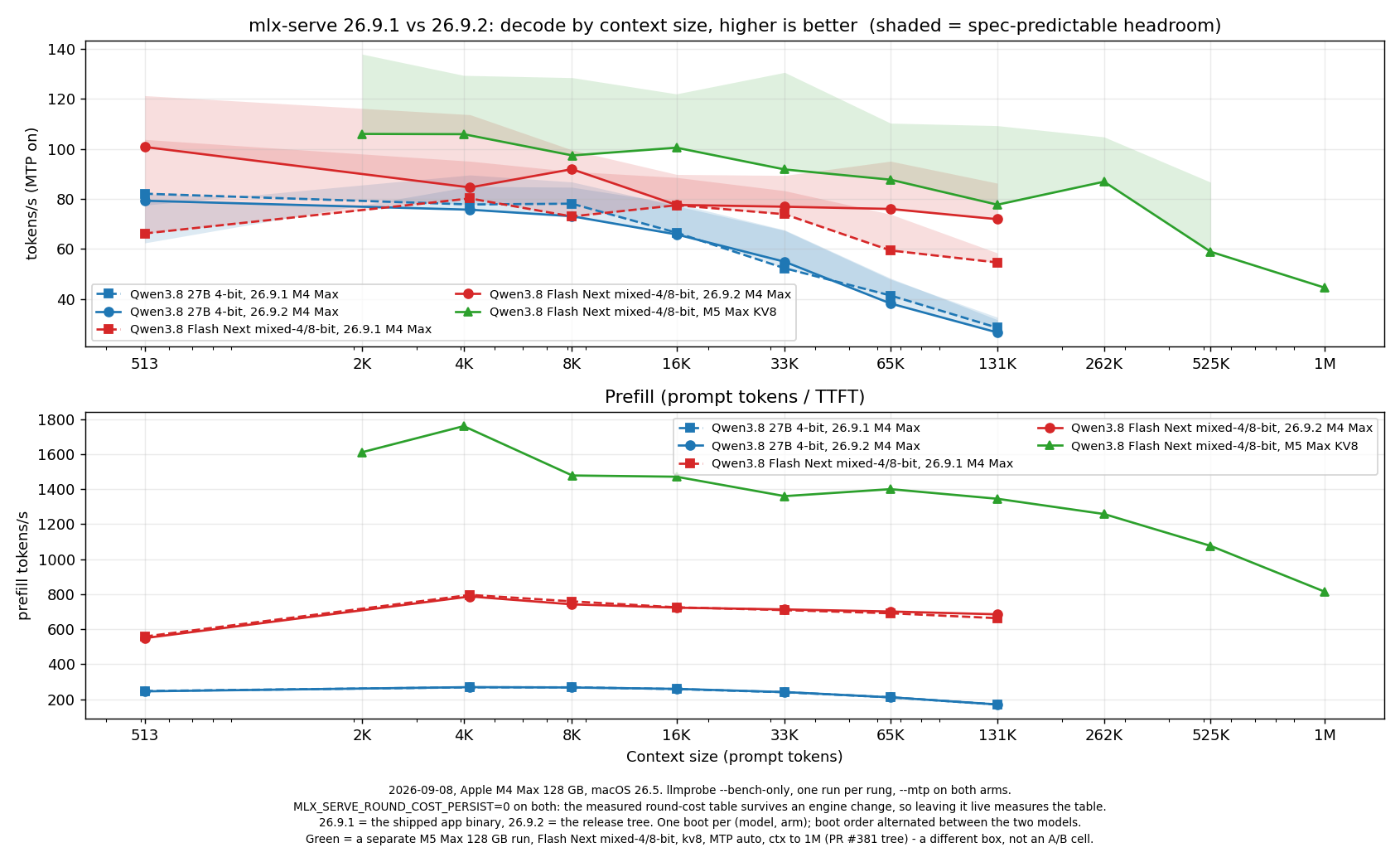
mlx-serve backs prefix caching with disk and adds speculative-decoding controls, so cached prefixes outlive process restarts and drafted tokens can be tuned per model rather than left at defaults. XGrammar's cached Lark compilation removes grammar-compile latency from the first constrained request, and its NPUNPUA Network Processing Unit, a dedicated chip designed to handle packet parsing, classification, and forwarding at wire speed, offloading those tasks from the CPU so cyber tools can process traffic at high throughput with low latency. backend and Windows ARM64Windows ARM64A build target for Windows running on ARM64 processors, such as those in Snapdragon-powered laptops; cyber tools targeting it can run natively on that hardware without emulation overhead. wheels put structured decoding on hardware that previously had none.
Run a full eval suite in wall-clock time short enough to gate a merge
Braintrust executes evals concurrently with new tuning and lifecycle APIs; the practical change is that a suite that took an hour serially can finish inside a build. LangSmith lets you define an LLM-as-judge evaluator from the CLI and page through experiment comparisons via API, so scoring config lives in the repo instead of being clicked together in the UI.
Cap what one user or one team can spend before finance finds out
Fireworks AI adds per-user spending limits, bring-your-own provider keys and custom SSO/SCIMSCIMAn open standard protocol (RFC 7642–7644) for automating user and group provisioning between identity providers and applications, letting cyber tools sync accounts without custom integration code., which means an agent loop that runs away is bounded at the platform rather than discovered on the bill. Devin Desktop's CLI takes enterprise-wide config for model access, defaults, MCPMCPModel Context Protocol, an open standard from Anthropic that lets an AI model call external tools and data sources through a uniform interface, so cyber tools can expose capabilities directly to LLM-based agents. servers and web search, so an org sets the allowed surface once instead of trusting every developer's local settings.
Three unrelated things stand out today: mlx-serve can reuse prompt prefixes from disk and draft tokens speculatively to cut local serving latency; LangSmith can create judge evaluators and queue mixed traces for review from APIs; Pinecone Nexus turns curated sources into cited answers.
deploy
Serve local models with less repeated prompt work
Disk-backed prefix caching lets repeated long prompts reuse prior computation instead of paying the full prefill cost on every request, while speculative-decoding controls let a draft path propose tokens for verification by the serving model. Teams running local or edge inference get new levers for latency without changing the application contract.
Turn traces into evaluator and annotation workflows without hand-building the glue
LangSmith added CLI creation of LLM-as-judge evaluators plus an annotation-queue API that can mix RUN and THREAD batches, so failed or suspicious production behavior can be pushed into review and scoring workflows programmatically. Braintrust added concurrent eval execution, which makes larger regression suites less dependent on serial test runs before a release.
Build retrieval answers with citations from curated sources
Nexus adds a retrieval subsystem that curates sources into grounded, cited answers, including BYOC deployment support. That moves teams closer to returning source-backed responses directly from the retrieval layer instead of separately stitching passages, citations, and answer generation in application code.
Keep coding agents working across sessions and machines
Qwen Code added multi-modal SDK input plus session resume/export, while Cline can summarize imported sessions from other coding agents. Both reduce the cost of moving an in-progress agent task between contexts without forcing the user to reconstruct state from chat history.
Bolt.new is an AI-powered web development platform that builds websites and applications from prompts.
Bolt.new adds a visual editor in the preview pane — edit text, colors, and styles before committing any tokens.
└──▷ HOW TO FIND IT
Iterate on UI appearance without spending tokens — use the Select tool to tweak colors and text, review all changes in the batch, then commit once when satisfied.
📍In the chatbox, click the Select tool, then click any element in the preview to edit its text, color, font size, formatting, or alignment. Review the collected edits above the chatbox, then click 'Save changes' to apply them to your project code.
›Adds a Select tool in the chatbox for making visual edits — text, colors, font size, formatting, and alignment — directly in the preview, with changes batched and applied to project code only when 'Save changes' is clicked.
Cline's desktop app adds authenticated remote Hub SDK connectivity, default web search, imported-session summarization from other coding agents, and a string of reliability and performance fixes to checkpoints, patching, and session history.
Autonomous coding agent as an SDK, IDE extension, or CLI assistant.
Cline's desktop app adds authenticated remote Hub SDK connectivity, default web search, imported-session summarization from other coding agents, and a string of reliability and performance fixes to checkpoints, patching, and session history.
└──▷ WHAT SHIPPED ·
8 FEATURES3 OF 8 FEATURESmost completely described firstwhat's the number?
Each feature carries 0–100 for how completely the vendor documented
it — not how big or important the work is. A major capability
described in eight words scores low, and that is the finding.
depth0–40what it does and how it works or what changed
specificity0–30names real surfaces — APIs, flags, formats, limits, numbers
actionability0–30enough to go use it — a named endpoint, flag, or config key tops this; a UI path is a starting point
Code and config rank first by construction: a documented endpoint,
flag or config key scores at the top of specificity and actionability,
so it sorts above a feature described only in prose. Under
60 the notes go thin — everything below the “thinner
coverage” line is thinner documentation, not smaller work.
Hover any meter for that feature's three sub-scores.
0101
Imported session summaries from other coding agentsNEW62how completely this was documenteddepth30/40specificity22/30actionability10/3062 / 100
Sessions imported from Claude Code, Codex, and opencode now display their source in chat and summarize the foreign history on the first resumed turn, showing a 'Summarizing the imported <tool> history...' indicator while running.
— Names sources and exact indicator text with mechanismdesktop-v0.0.24
thinner coverage below
0200
apply_patch Add File no longer overwrites silentlyIMPROVED58how completely this was documenteddepth20/40specificity20/30actionability18/3058 / 100
apply_patch 'Add File' now refuses to overwrite an existing file instead of silently replacing it.
— Names exact tool and action, clear before/after behaviordesktop-v0.0.24
0300
Checkpoint hashing performance overhaulIMPROVED55how completely this was documenteddepth32/40specificity15/30actionability8/3055 / 100
Checkpoints no longer re-hash every untracked file before each message; a single snapshot index is kept per session, so from the second turn cost drops to roughly git process overhead.
— Clear before/after mechanism and performance claim, no user action neededdesktop-v0.0.24
0400
Web search on by default outside YOLO modeIMPROVED50how completely this was documenteddepth25/40specificity15/30actionability10/3050 / 100
Web search is now enabled by default outside YOLO mode, and tool settings fail closed if they cannot be loaded.
— Explains behavior change but no config key to toggle itdesktop-v0.0.24
0502
Custom title bar on WindowsNEW50how completely this was documenteddepth20/40specificity15/30actionability15/3050 / 100
Adds a custom title bar on Windows with caption controls that follow the compact title-bar height in narrow windows and stay above overlays.
— Describes UI behavior across window sizes, no config surfacedesktop-v0.0.24
0600
@ mention no longer indexes home or filesystem rootIMPROVED43how completely this was documenteddepth18/40specificity15/30actionability10/3043 / 100
Typing an @ mention no longer indexes the home directory or filesystem root.
— Names exact trigger and fixed scope, minimal further detaildesktop-v0.0.24
0700
Session-history token counts and costs backfilledIMPROVED42how completely this was documenteddepth22/40specificity12/30actionability8/3042 / 100
Token counts and costs now fill in for every visible session-history page, hydrated on demand with reads re-run when session status changes.
— Explains mechanism but no UI path or command givendesktop-v0.0.24
0803
SDK support for authenticated remote HubsNEW33how completely this was documenteddepth15/40specificity10/30actionability8/3033 / 100
Adds SDK support for connecting to authenticated remote Hubs.
— Names the capability but no connection mechanism or API detaildesktop-v0.0.24
Codex CLI's alpha channel added live WebRTCWebRTCA browser-native, open standard for real-time peer-to-peer audio, video, and data exchange without plugins. Cyber tools use it to tunnel traffic or enable covert communication channels through firewalls via its built-in NAT traversal. voice conversations to the terminal UI with macOS and MCPMCPModel Context Protocol, an open standard from Anthropic that lets an AI model call external tools and data sources through a uniform interface, so cyber tools can expose capabilities directly to LLM-based agents. user verification, introduced an isolated memory v2 architecture, and expanded app-server daemon update controls, alongside a raised Guardian review limit and new telemetry.
OpenAI Codex CLI runs an agent in the terminal that reads, changes, and tests code in local repositories.
Codex CLI's alpha channel added live WebRTCWebRTCA browser-native, open standard for real-time peer-to-peer audio, video, and data exchange without plugins. Cyber tools use it to tunnel traffic or enable covert communication channels through firewalls via its built-in NAT traversal. voice conversations to the terminal UI with macOS and MCPMCPModel Context Protocol, an open standard from Anthropic that lets an AI model call external tools and data sources through a uniform interface, so cyber tools can expose capabilities directly to LLM-based agents. user verification, introduced an isolated memory v2 architecture, and expanded app-server daemon update controls, alongside a raised Guardian review limit and new telemetry.
└──▷ WHAT SHIPPED ·
12 FEATURES10 OF 12 FEATURESmost completely described firstwhat's the number?
Each feature carries 0–100 for how completely the vendor documented
it — not how big or important the work is. A major capability
described in eight words scores low, and that is the finding.
depth0–40what it does and how it works or what changed
specificity0–30names real surfaces — APIs, flags, formats, limits, numbers
actionability0–30enough to go use it — a named endpoint, flag, or config key tops this; a UI path is a starting point
Code and config rank first by construction: a documented endpoint,
flag or config key scores at the top of specificity and actionability,
so it sorts above a feature described only in prose. Under
60 the notes go thin — everything below the “thinner
coverage” line is thinner documentation, not smaller work.
Hover any meter for that feature's three sub-scores.
0101
App-server daemon update managementNEW83how completely this was documenteddepth30/40specificity28/30actionability25/3083 / 100
Adds an app-server daemon update subcommand to update the standalone installation and restart the managed daemon. Makes app-server daemon automatic updates and the managed app-server shutdown grace period configurable, warns when the connected Codex service is older than the CLI, makes those older-version notices configurable in the TUI, and shows the configured updater settings (auto_update_enabled, update_interval_minutes) in codex doctor output.
Trigger an immediate update of the standalone Codex installation and restart the managed daemon without waiting for the automatic update cycle.
Live voice conversations in the TUINEW69how completely this was documenteddepth32/40specificity22/30actionability15/3069 / 100
Adds live WebRTC voice conversations to the TUI, including a dedicated composer strip for voice controls, a voice mute shortcut (now configurable) with recording activity indicators, and live voice transcripts animated with split-flap tiles. Signed voice resources are now bundled in macOS releases to support this.
Telemetry metrics for voice sessions and TUI startupNEW60how completely this was documenteddepth22/40specificity28/30actionability10/3060 / 100
Records voice session lifecycle metrics under codex.voice.session.* (starts, connections, failures, endings, active duration), and tags codex.tui.start metrics with terminal_name and multiplexer attributes (tmux, zellij, or none).
Worktree delete action in managed worktree browserNEW58how completely this was documenteddepth25/40specificity18/30actionability15/3058 / 100
Adds a worktree delete action with a confirmation dialog in the managed worktree browser, including owner thread titles, relative update times, and archived/unavailable status.
Memory v2 with isolated storageNEW56how completely this was documenteddepth28/40specificity18/30actionability10/3056 / 100
Adds configurable memory versions with isolated storage (memory v2), including dual writing, dedicated consolidation and read prompts, and summary-only extraction.
— Names the mechanism but no config key or command to enable itrust-v0.154.0-alpha.7
0606
User verification for macOS and MCPNEW52how completely this was documenteddepth22/40specificity20/30actionability10/3052 / 100
Adds macOS user verification with Secure Enclave signing and MCP user verification in the TUI, restricted to the host-owned apps MCP server.
OpenCode v1.18.30 introduces a new system prompt for GPT-6 models and adds configurable reasoning effort for GitLab-hosted GPT and Claude models.
OpenCode is an open-source AI coding agent for terminal-based development tasks.
OpenCode v1.18.30 introduces a new system prompt for GPT-6 models and adds configurable reasoning effort for GitLab-hosted GPT and Claude models.
└──▷ WHAT SHIPPED ·
2 FEATURES2 OF 2 FEATURESmost completely described firstwhat's the number?
Each feature carries 0–100 for how completely the vendor documented
it — not how big or important the work is. A major capability
described in eight words scores low, and that is the finding.
depth0–40what it does and how it works or what changed
specificity0–30names real surfaces — APIs, flags, formats, limits, numbers
actionability0–30enough to go use it — a named endpoint, flag, or config key tops this; a UI path is a starting point
Code and config rank first by construction: a documented endpoint,
flag or config key scores at the top of specificity and actionability,
so it sorts above a feature described only in prose. Under
60 the notes go thin — everything below the “thinner
coverage” line is thinner documentation, not smaller work.
Hover any meter for that feature's three sub-scores.
0101
Reasoning effort variants for GitLab-hosted modelsNEW60how completely this was documenteddepth15/40specificity25/30actionability20/3060 / 100
Adds reasoning effort variants for GitLab-hosted GPT models via reasoningEffort and for Claude models via adaptive thinking.
— Names exact config surfaces but no usage detail or defaultsv1.18.30
thinner coverage below
0202
Astra system prompt for GPT-6 modelsNEW23how completely this was documenteddepth8/40specificity10/30actionability5/3023 / 100
Adds the Astra system prompt for GPT-6 models.
— Only named in summary, no mechanism or usage givenv1.18.30
Claude Code v2.1.265 adds directory-based plugin loading with hot-reload, a 1 GB cap on saved tool results, faster worktree startup, and improved workflow and slash-command UIs, plus VS Code session archiving.
Claude Code is Anthropic's terminal coding agent that plans, edits, and tests code in local repositories.
Claude Code v2.1.265 adds directory-based plugin loading with hot-reload, a 1 GB cap on saved tool results, faster worktree startup, and improved workflow and slash-command UIs, plus VS Code session archiving.
└──▷ WHAT SHIPPED ·
7 FEATURES2 OF 7 FEATURESmost completely described firstwhat's the number?
Each feature carries 0–100 for how completely the vendor documented
it — not how big or important the work is. A major capability
described in eight words scores low, and that is the finding.
depth0–40what it does and how it works or what changed
specificity0–30names real surfaces — APIs, flags, formats, limits, numbers
actionability0–30enough to go use it — a named endpoint, flag, or config key tops this; a UI path is a starting point
Code and config rank first by construction: a documented endpoint,
flag or config key scores at the top of specificity and actionability,
so it sorts above a feature described only in prose. Under
60 the notes go thin — everything below the “thinner
coverage” line is thinner documentation, not smaller work.
Hover any meter for that feature's three sub-scores.
0101
Plugin directory loading with hot-reloadNEW85how completely this was documenteddepth30/40specificity25/30actionability30/3085 / 100
Pointing --plugin-dir at a folder of plugins loads each child folder containing a manifest automatically, and plugins added or removed while Claude Code is running are picked up live without a restart.
Point Claude Code at a plugins directory so all sub-plugins load at once and any you drop in or remove are picked up without restarting.
$ claude --plugin-dir ./my-plugins/
— Named flag with clear mechanism and runnable examplev2.1.265
0200
Richer /workflows agent detail viewIMPROVED60how completely this was documenteddepth25/40specificity20/30actionability15/3060 / 100
In /workflows, tool calls are now marked running, failed, or done, the subagent's task list is shown when available, and pressing Enter unfolds listed calls to show their inputs and results.
— Names command and exact interaction (Enter key)v2.1.265
thinner coverage below
0300
Expanded telemetry fields for gateway sessionsIMPROVED55how completely this was documenteddepth20/40specificity25/30actionability10/3055 / 100
Claude Desktop and Cowork now send user.email and user.groups in the telemetry pushed through a Claude apps gateway, matching what terminal sessions already report.
— Names exact fields but no user action possiblev2.1.265
0400
Faster worktree startup on large reposIMPROVED55how completely this was documenteddepth25/40specificity20/30actionability10/3055 / 100
--worktree startup is improved on large repositories: the new worktree is now checked out in parallel, requiring git 2.32 or later.
— Names flag, mechanism and version requirementv2.1.265
0500
Improved slash command and skill matchingIMPROVED55how completely this was documenteddepth20/40specificity20/30actionability15/3055 / 100
Slash commands typed mid-prompt now show matches in a list, with Tab opening the list outside fullscreen instead of only showing a single suggestion, and a plugin skill is now findable by its bare name.
— Names Tab behavior but limited mechanism detailv2.1.265
0602
Auto-archive inactive sessions in VS CodeNEW55how completely this was documenteddepth20/40specificity20/30actionability15/3055 / 100
A new 'Archive inactive sessions' setting in the VS Code extension automatically archives sessions inactive for a set period, defaulting to 14 days.
— Names the setting and default but no path givenv2.1.265
0700
1 GB cap on saved tool resultsIMPROVED45how completely this was documenteddepth20/40specificity20/30actionability5/3045 / 100
Tool results saved to disk are now capped at 1 GB, and the in-conversation preview indicates when a saved file was truncated due to hitting this cap.
— Concrete limit named but no configurable surfacev2.1.265
Diagram Design is a Claude Code skill that generates editorial HTML and SVG diagrams and imports draw.io or Mermaid sources.
Diagram Design adds ten editorial diagram types, native Droid plugin packaging, named client profiles, accessible-SVG contract, and animated semantic-pattern examples.
└──▷ GET THIS VERSION
$ git clone --branch commits-2026-08-12 https://github.com/cathrynlavery/diagram-design.git
# already have the repo? check out this version:$ git checkout commits-2026-08-12
└──▷ TRY IT
Catch SVGs that will fail screen-reader accessibility — for example before merging a PR that adds a new diagram — by running the a11y lint gate locally.
$ python scripts/lint-skin.py --all--baseline
›Adds role="img", a resolving aria-labelledby, and first-child <title> / <desc> slots to template.html, template-dark.html, template-full.html, and template-terminal.html as an enforced accessible-SVG contract.
›Adds an a11y category to scripts/lint-skin.py that rejects a diagram SVG without a resolvable accessible name.
›Adds scripts/verify-beeswarm.py to verify that every beeswarm dot sits at its declared value on the shared linear scale and that no two dots overlap.
›Adds scripts/test-verify-sankey.py with adversarial fixtures covering ribbon narrowing, node volume loss, stage-flow shrinkage, label/bar mismatches, and missing shipped variants.
›Ships ten editorial diagram types in one release (feat(types): ship ten editorial diagram types).
›Adds example-queue-animated.html for Semantic Pattern #1 (Fan-in Queue / Bottleneck).
›Adds example-paved-road-animated.html for Semantic Pattern #5 (Secure Paved Road).
›Extends CI with a multi-OS testing matrix covering Linux, Windows, and macOS.
›Adds a GitHub Step Summary table generated from matrix run results.
›Adds role="img", a resolving aria-labelledby, and first-child <title> / <desc> slots to template.html, template-dark.html, template-full.html, and template-terminal.html as an enforced accessible-SVG contract.
›Adds scripts/verify-beeswarm.py to verify that every beeswarm dot sits at its declared value on the shared linear scale and that no two dots overlap.
›Adds scripts/test-verify-sankey.py with adversarial fixtures covering ribbon narrowing, node volume loss, stage-flow shrinkage, label/bar mismatches, and missing shipped variants.
›Ships ten editorial diagram types in one release (feat(types): ship ten editorial diagram types).
Goose v1.50.0 expands model provider support with GPT-6 Astra and AIML API, splits out ACP npm packages, and adds Kotlin GDKGDKGNOME Development Kit, a library maintained by the GNOME Project that sits between application code and the underlying windowing system, giving GUI tools a portable drawing and event-handling layer. configuration for Databricks AI Gateway.
Goose is an open-source AI agent with a desktop app and CLI for coding and other automated tasks.
Goose v1.50.0 expands model provider support with GPT-6 Astra and AIML API, splits out ACP npm packages, and adds Kotlin GDKGDKGNOME Development Kit, a library maintained by the GNOME Project that sits between application code and the underlying windowing system, giving GUI tools a portable drawing and event-handling layer. configuration for Databricks AI Gateway.
└──▷ WHAT SHIPPED ·
4 FEATURES2 OF 4 FEATURESmost completely described firstwhat's the number?
Each feature carries 0–100 for how completely the vendor documented
it — not how big or important the work is. A major capability
described in eight words scores low, and that is the finding.
depth0–40what it does and how it works or what changed
specificity0–30names real surfaces — APIs, flags, formats, limits, numbers
actionability0–30enough to go use it — a named endpoint, flag, or config key tops this; a UI path is a starting point
Code and config rank first by construction: a documented endpoint,
flag or config key scores at the top of specificity and actionability,
so it sorts above a feature described only in prose. Under
60 the notes go thin — everything below the “thinner
coverage” line is thinner documentation, not smaller work.
Hover any meter for that feature's three sub-scores.
0100
Separate npm packages for ACP client and binaryIMPROVED50how completely this was documenteddepth15/40specificity20/30actionability15/3050 / 100
The goose ACP client and the acp binary are now published as separate npm packages.
— Names exact packages, no install instructionsv1.50.0
0201
New provider support: GPT-6 Astra and AIML APINEW35how completely this was documenteddepth10/40specificity15/30actionability10/3035 / 100
Goose adds GPT-6 Astra models as a selectable provider and integrates AIML API as a new provider option.
— Names two providers but no config detailsv1.50.0
0302
Kotlin GDK configuration for Databricks AI Gateway pathNEW30how completely this was documenteddepth10/40specificity15/30actionability5/3030 / 100
Enables Kotlin callers in the GDK to configure the Databricks AI Gateway path.
— States capability but no config key or examplev1.50.0
0400
Upgraded MCP version preferenceIMPROVED10how completely this was documenteddepth5/40specificity5/30actionability0/3010 / 100
Upgrades MCP version preference to the latest available.
— Bare statement with no version number or mechanismv1.50.0
Letta Code is a terminal coding agent with persistent memory and identity across development sessions.
Letta Code shipped a single small update in this window: the ability to cancel Monitors from connected clients via the listener.
└──▷ WHAT SHIPPED ·
1 FEATURE1 OF 1 FEATUREmost completely described firstwhat's the number?
Each feature carries 0–100 for how completely the vendor documented
it — not how big or important the work is. A major capability
described in eight words scores low, and that is the finding.
depth0–40what it does and how it works or what changed
specificity0–30names real surfaces — APIs, flags, formats, limits, numbers
actionability0–30enough to go use it — a named endpoint, flag, or config key tops this; a UI path is a starting point
Code and config rank first by construction: a documented endpoint,
flag or config key scores at the top of specificity and actionability,
so it sorts above a feature described only in prose. Under
60 the notes go thin — everything below the “thinner
coverage” line is thinner documentation, not smaller work.
Hover any meter for that feature's three sub-scores.
0101
Cancel Monitors from connected clientsNEW30how completely this was documenteddepth10/40specificity10/30actionability10/3030 / 100
Connected clients can now cancel Monitors through the listener.
— No mechanism, command, or config detail given, just a bare capability.v0.31.14
ⓘSourcesRelease notes →3 RELEASES · 2026-09-08NOTES ↗RankWhy this ranktop features scored 81/81/80, +15 breaking change, +6 runnable example — 101.67How ranking works →
An open-source AI coding agent that lives in your terminal.
Qwen Code's SDK matured with multi-modal input, session resume/export, and Agent Skills promoted to stable, while the core CLI (v0.23.1) shipped a large batch of workflow, channel, and web-shell session-management features alongside two breaking removals: the read_many_files tool and the @qwen-code/webui package.
└──▷ WHAT SHIPPED ·
43 FEATURES34 OF 43 FEATURESmost completely described firstwhat's the number?
Each feature carries 0–100 for how completely the vendor documented
it — not how big or important the work is. A major capability
described in eight words scores low, and that is the finding.
depth0–40what it does and how it works or what changed
specificity0–30names real surfaces — APIs, flags, formats, limits, numbers
actionability0–30enough to go use it — a named endpoint, flag, or config key tops this; a UI path is a starting point
Code and config rank first by construction: a documented endpoint,
flag or config key scores at the top of specificity and actionability,
so it sorts above a feature described only in prose. Under
60 the notes go thin — everything below the “thinner
coverage” line is thinner documentation, not smaller work.
Hover any meter for that feature's three sub-scores.
0101
`extra_body` pass-through for OpenAI-compatible providersNEW81how completely this was documenteddepth25/40specificity28/30actionability28/3081 / 100
Adds extra_body support so OpenAI-compatible providers can receive pass-through of provider-specific request fields, e.g. passing an extended-thinking budget via {"extra_body": {"thinking": {"type": "enabled", "budget_tokens": 8000}}}.
Pass provider-specific parameters (e.g. extended thinking budget) through to an OpenAI-compatible endpoint that supports them.
`ui.showToolCallArgs` inline tool-call argumentsNEW81how completely this was documenteddepth25/40specificity28/30actionability28/3081 / 100
Adds ui.showToolCallArgs config setting to render tool-call arguments inline in the UI, so you can audit exactly what the agent invokes during a session.
Render tool-call arguments inline in the transcript so you can audit exactly what the agent is invoking during a session.
yaml
ui:
  showToolCallArgs: true
— Exact config key with working YAML examplev0.23.1
0303
Environment variables via `settings.env`NEW80how completely this was documenteddepth25/40specificity25/30actionability30/3080 / 100
Adds a settings.env field for configuring environment variables directly in the settings file, letting provider API keys or proxy variables (e.g. OPENAI_API_KEY, HTTPS_PROXY) be set for a session without exporting them to the shell.
Set provider API keys or proxy variables for a session without exporting them to the shell environment.
Managed memory gated by `memory.enableManagedAutoMemory`IMPROVED70how completely this was documenteddepth30/40specificity25/30actionability15/3070 / 100
Managed memory availability now respects the memory.enableManagedAutoMemory setting, so hosts that disable managed auto memory no longer see remember/dream requests admitted or managed-memory instructions injected into the system prompt.
Web-shell UI: navigation, context, and workflow visibilityNEW68how completely this was documenteddepth28/40specificity25/30actionability15/3068 / 100
Adds continuous history and compact turn navigation to the web-shell transcript, a context usage tab to the right sidebar, headless global turn navigation, the ability to bridge a browser-granted local directory into a session, visualization and management of dynamic workflow runs, live status for running subagents in the transcript, customizable artifact icons, and a display of Goal token spend against its allowed window.
— Enumerates eight UI additions, no exact pathsv0.23.1
1009
Channel and worktree lifecycle managementNEW62how completely this was documenteddepth25/40specificity25/30actionability12/3062 / 100
Adds worktree-isolated named tasks to channels, implements named-session worktree reset for channels, adds a shared multiline instructions field to channel management, adds message prefix filtering to channels, and reaps owned worktrees automatically when daemon sessions are deleted.
— Enumerates five channel/worktree additions, no config keysv0.23.1
1110
Replaces `read_many_files` tool with `readManyFiles` utilityBREAKING60how completely this was documenteddepth20/40specificity25/30actionability15/3060 / 100
Removes the read_many_files tool and replaces it with a readManyFiles utility, available only as a user @-command.
Size-triggered microcompaction with low watermarkIMPROVED56how completely this was documenteddepth28/40specificity20/30actionability8/3056 / 100
Size-triggered microcompaction now clears old tool results toward a low watermark, preserving provider prompt-cache reuse across long tool-heavy sessions.
External-context memory: Mem0 recall and daemon writesNEW52how completely this was documenteddepth20/40specificity22/30actionability10/3052 / 100
Adds opt-in auto recall for administrator-owned Mem0 dialects in external-context, and adds daemon memory writes and daemon memory deletion to external-context.
— Names Mem0 integration, thin on mechanismv0.23.1
1714
`contextWindowSize` configuration keyNEW50how completely this was documenteddepth15/40specificity20/30actionability15/3050 / 100
Adds a contextWindowSize configuration key to control the model's context window size.
Session concurrency and controlNEW50how completely this was documenteddepth22/40specificity18/30actionability10/3050 / 100
Allows concurrent standalone daemons with session fencing, fences Conversations writers with mandatory session leases, and adds a user-minted controller token to drive a session without per-message review.
— Describes three control mechanisms, no API surface namedv0.23.1
2100
TPM throttling retry handlingIMPROVED46how completely this was documenteddepth20/40specificity18/30actionability8/3046 / 100
Adds TPM throttling error handling with a 1-minute retry delay.
DeepSeek Harness v0.1.5-alpha.1 overhauls file handling with a new resource-addressing system and byte-range reads, reworks the sidebar and docking UI, and adds profile templates plus Playwright video support in its GIF skill.
DeepSeek Harness is an open-source agent harness for building coding agents with plugins.
DeepSeek Harness v0.1.5-alpha.1 overhauls file handling with a new resource-addressing system and byte-range reads, reworks the sidebar and docking UI, and adds profile templates plus Playwright video support in its GIF skill.
└──▷ WHAT SHIPPED ·
7 FEATURES4 OF 7 FEATURESmost completely described firstwhat's the number?
Each feature carries 0–100 for how completely the vendor documented
it — not how big or important the work is. A major capability
described in eight words scores low, and that is the finding.
depth0–40what it does and how it works or what changed
specificity0–30names real surfaces — APIs, flags, formats, limits, numbers
actionability0–30enough to go use it — a named endpoint, flag, or config key tops this; a UI path is a starting point
Code and config rank first by construction: a documented endpoint,
flag or config key scores at the top of specificity and actionability,
so it sorts above a feature described only in prose. Under
60 the notes go thin — everything below the “thinner
coverage” line is thinner documentation, not smaller work.
Hover any meter for that feature's three sub-scores.
0101
Bounded byte-range file reads in fs-local and fs-e2bNEW70how completely this was documenteddepth25/40specificity25/30actionability20/3070 / 100
Adds bounded byte-range reads across local and E2B sandbox filesystems (fs-local and fs-e2b), enabling partial file access without loading full file content.
File resource addressing systemNEW70how completely this was documenteddepth30/40specificity25/30actionability15/3070 / 100
Adds a dual-face file API with Host-resolved resources and a Client resource registry with retained subscriptions for workspace file operations, plus Session and absolute file resource addresses under workspace-path for addressing files within agent sessions.
Sidebar file tree navigationIMPROVED65how completely this was documenteddepth30/40specificity20/30actionability15/3065 / 100
Adds a Sidebar with tab navigation, lazy workspace file tree tabs, paged file tabs with retained reader state, and fullscreen shell — replacing the former Details panel for file navigation.
— Describes mechanism and UI change, no exact navigation path givendsh-v0.1.5-alpha.1
0400
Playwright video support in GIF recording skillIMPROVED65how completely this was documenteddepth20/40specificity25/30actionability20/3065 / 100
Adds support for encoding Playwright video (WebM) input — in addition to ordered screenshots — in the encode_gif.py GIF recording skill.
PydanticAI v2.42.0 adds support for GitHub Copilot as a model provider and tightens validation of deferred tool approvals.
PydanticAI is a framework that builds type-safe Python agents with dependency injection, model integrations, tools, and structured outputs.
PydanticAI v2.42.0 adds support for GitHub Copilot as a model provider and tightens validation of deferred tool approvals.
└──▷ WHAT SHIPPED ·
2 FEATURES2 OF 2 FEATURESmost completely described firstwhat's the number?
Each feature carries 0–100 for how completely the vendor documented
it — not how big or important the work is. A major capability
described in eight words scores low, and that is the finding.
depth0–40what it does and how it works or what changed
specificity0–30names real surfaces — APIs, flags, formats, limits, numbers
actionability0–30enough to go use it — a named endpoint, flag, or config key tops this; a UI path is a starting point
Code and config rank first by construction: a documented endpoint,
flag or config key scores at the top of specificity and actionability,
so it sorts above a feature described only in prose. Under
60 the notes go thin — everything below the “thinner
coverage” line is thinner documentation, not smaller work.
Hover any meter for that feature's three sub-scores.
0101
GitHub Copilot provider integrationNEW50how completely this was documenteddepth15/40specificity20/30actionability15/3050 / 100
Adds GitHubCopilotProvider to connect agents to GitHub Copilot's OpenAI-compatible API.
— Names the class but no usage example or config detail.v2.42.0
0202
Stricter validation of deferred tool approvalsBREAKING50how completely this was documenteddepth20/40specificity20/30actionability10/3050 / 100
Invalid DeferredToolResults.approvals values are now rejected, whereas previously they were accepted silently.
— Explains before/after behaviour but no migration steps.v2.42.0
└──▷ BREAKING ON UPGRADE
!Invalid DeferredToolResults.approvals values are now rejected (previously accepted silently).
Vercel AI SDK 7.0.94 adds per-request model overrides for batch calls and refines retry behavior for empty image results.
The Vercel AI SDK provides TypeScript APIs for model generation, structured output, tool use, and streaming application interfaces.
Vercel AI SDK 7.0.94 adds per-request model overrides for batch calls and refines retry behavior for empty image results.
└──▷ WHAT SHIPPED ·
2 FEATURES1 OF 2 FEATURESmost completely described firstwhat's the number?
Each feature carries 0–100 for how completely the vendor documented
it — not how big or important the work is. A major capability
described in eight words scores low, and that is the finding.
depth0–40what it does and how it works or what changed
specificity0–30names real surfaces — APIs, flags, formats, limits, numbers
actionability0–30enough to go use it — a named endpoint, flag, or config key tops this; a UI path is a starting point
Code and config rank first by construction: a documented endpoint,
flag or config key scores at the top of specificity and actionability,
so it sorts above a feature described only in prose. Under
60 the notes go thin — everything below the “thinner
coverage” line is thinner documentation, not smaller work.
Hover any meter for that feature's three sub-scores.
0100
Smarter retry classification for empty image resultsIMPROVED55how completely this was documenteddepth25/40specificity20/30actionability10/3055 / 100
Unclassified empty image results are now retried using provider-independent retryability classification, while Google and Google Vertex prompt blocks are marked terminal (non-retryable) so they no longer trigger useless retries.
— Explains mechanism and named providers but no code/flag to act on[email protected]
0201
Per-request model overrides in batch callsNEW50how completely this was documenteddepth20/40specificity15/30actionability15/3050 / 100
The batch call API now supports per-request model overrides, letting each item within a single batch target a different model instead of sharing one model for the whole batch.
— Names the surface (`batch`) but no example or config shown[email protected]
ⓘSourcesRelease notes →2 RELEASES · 2026-09-08NOTES ↗RankWhy this ranktop features scored 78/75/73, +15 breaking change, +6 runnable example — 96.33How ranking works →
Strands Agents is AWS's open-source SDK for production agents in Python and TypeScript, with a model-driven loop, tool integration, and deployment targets.
Strands Agents shipped parallel Python (v1.55.0) and TypeScript (v1.17.0) releases that deepen MCP 2.x protocol support, add in-process agent-to-agent communication via a new LocalAgent protocol, introduce background task execution, and extend model caching to six providers, while dropping Node.js 20 support in favor of Node.js 22+.
└──▷ WHAT SHIPPED ·
15 FEATURES13 OF 15 FEATURESmost completely described firstwhat's the number?
Each feature carries 0–100 for how completely the vendor documented
it — not how big or important the work is. A major capability
described in eight words scores low, and that is the finding.
depth0–40what it does and how it works or what changed
specificity0–30names real surfaces — APIs, flags, formats, limits, numbers
actionability0–30enough to go use it — a named endpoint, flag, or config key tops this; a UI path is a starting point
Code and config rank first by construction: a documented endpoint,
flag or config key scores at the top of specificity and actionability,
so it sorts above a feature described only in prose. Under
60 the notes go thin — everything below the “thinner
coverage” line is thinner documentation, not smaller work.
Hover any meter for that feature's three sub-scores.
0101
MCP server loading controls in load_serversNEW78how completely this was documenteddepth25/40specificity25/30actionability28/3078 / 100
load_servers MCP calls now accept prefix_with_server_name and continue_on_error options, letting callers namespace tool names per originating server and tolerate a failed server load without aborting the whole session. Shipped identically in both the Python and TypeScript SDKs.
Prevent tool-name collisions when loading multiple MCP servers by prefixing each tool name with its originating server name.
MCP 2.x protocol support expansionNEW73how completely this was documenteddepth30/40specificity28/30actionability15/3073 / 100
MCP 2.x support was expanded with call_tool, server/discover for SEP-2575 server discovery, MRTR (MCP Request/Response) extended to prompts and resources, MRTR input-required support, automatic tool refresh on list-changed notifications, and, in Python, SEP-2663 task support.
cache_config support for new model providersNEW67how completely this was documenteddepth20/40specificity25/30actionability22/3067 / 100
cache_config support was added to the Ollama, Writer, SageMaker, llama.cpp, Vercel, and Mistral model providers, extending provider-level tool/response caching to backends that previously had none.
Enable caching on a SageMaker-backed agent to reduce redundant inference costs on repeated tool definitions.
python
from strands import Agent
from strands.models import SageMakerModel
from strands.models.cache import CacheConfig

model = SageMakerModel(
    endpoint_name='my-endpoint',
    cache_config=CacheConfig(tools_ttl=300)
)
agent = Agent(model=model)
agent('Summarize the threat report.')
web_fetch vended toolNEW60how completely this was documenteddepth20/40specificity15/30actionability25/3060 / 100
A new web_fetch vended tool lets agents perform HTTP retrieval directly during a session.
Use the new web_fetch vended tool so an agent can retrieve live threat intel or CVE details during a session.
python
from strands import Agent
from strands_tools import web_fetch

agent = Agent(tools=[web_fetch])
agent('Fetch https://nvd.nist.gov/feeds/json/cve/1.1/recent.json and summarise the top 5 critical CVEs.')
— Named tool with a runnable usage examplepython/v1.55.0
thinner coverage below
0600
Reconnect support for bidirectional streaming adaptersIMPROVED52how completely this was documenteddepth20/40specificity20/30actionability12/3052 / 100
The OpenAI and Gemini Google Live bidirectional streaming model adapters gained a reconnect() method to recover dropped streaming sessions, and bidirectional sessions now support proactive reconnect ahead of drops.
Background task execution in Python and TypeScriptNEW52how completely this was documenteddepth20/40specificity22/30actionability10/3052 / 100
Python agents gained an internal in-process task engine and manager, and the TypeScript Agent class gained a backgroundTasks option backed by a new BackgroundTaskManager interface and InProcessTaskManager implementation.
— Names classes and field but no usage shownpython/v1.55.0
0806
Context manager offloading and stash supportNEW48how completely this was documenteddepth20/40specificity20/30actionability8/3048 / 100
The context manager gained an L1 stash for durable storage of offloaded content and session support for the L1 context manager (TypeScript); Python ported the offloading strategies and stash integration; context manager types are now exported as experimental.
LocalAgent protocol for in-process agent-to-agent callsNEW45how completely this was documenteddepth20/40specificity15/30actionability10/3045 / 100
A new LocalAgent protocol and implementation support in-process, bidirectional (bidi) streaming communication between agents, added to both the Python and TypeScript SDKs.
Agno v3.0.8 adds bounded full-page reads to Knowledge, PostgreSQL engine factories with pool and serialization defaults, and a shared Markdown code-fence utility.
Agno is an agent framework and runtime that orchestrates and runs multi-agent systems.
Agno v3.0.8 adds bounded full-page reads to Knowledge, PostgreSQL engine factories with pool and serialization defaults, and a shared Markdown code-fence utility.
└──▷ WHAT SHIPPED ·
3 FEATURES3 OF 3 FEATURESmost completely described firstwhat's the number?
Each feature carries 0–100 for how completely the vendor documented
it — not how big or important the work is. A major capability
described in eight words scores low, and that is the finding.
depth0–40what it does and how it works or what changed
specificity0–30names real surfaces — APIs, flags, formats, limits, numbers
actionability0–30enough to go use it — a named endpoint, flag, or config key tops this; a UI path is a starting point
Code and config rank first by construction: a documented endpoint,
flag or config key scores at the top of specificity and actionability,
so it sorts above a feature described only in prose. Under
60 the notes go thin — everything below the “thinner
coverage” line is thinner documentation, not smaller work.
Hover any meter for that feature's three sub-scores.
0101
Full-page reads for KnowledgeNEW83how completely this was documenteddepth30/40specificity28/30actionability25/3083 / 100
Adds Knowledge.read_full_page and aread_full_page methods that return an entire published page from a single bounded SQL read, supporting revision pinning, character limits, and deadlines; oversized pages return None.
— Named methods with clear mechanism and bounds, but no usage example.v3.0.8
0202
PostgreSQL engine factory functionsNEW81how completely this was documenteddepth28/40specificity28/30actionability25/3081 / 100
Adds create_postgres_engine and create_async_postgres_engine factory functions that expose Agno's connection-pool and JSON serialization defaults with configurable SQLAlchemy options; plain postgres:// and postgresql:// URLs automatically select Psycopg 3.
— Named functions and driver-selection behaviour, no runnable example given.v3.0.8
thinner coverage below
0303
Shared Markdown code-fence tracking utilityNEW58how completely this was documenteddepth18/40specificity22/30actionability18/3058 / 100
Exposes agno.utils.markdown.advance_code_fence to share the page chunker's fence-tracking rules with application transforms that need to preserve code examples.
— Names the exact utility path but describes purpose only briefly.v3.0.8
Personal AI assistant platform that connects messaging channels, tools, and model providers through a gateway.
OpenClaw v2026.9.3 ships public session transcript sharing, a searchable meeting library, an optional Team Reports plugin, and default bounded recursive session spawning, alongside a wide set of CLI, config, and client platform additions plus several breaking SDK and Node version changes.
└──▷ WHAT SHIPPED ·
27 FEATURES25 OF 27 FEATURESmost completely described firstwhat's the number?
Each feature carries 0–100 for how completely the vendor documented
it — not how big or important the work is. A major capability
described in eight words scores low, and that is the finding.
depth0–40what it does and how it works or what changed
specificity0–30names real surfaces — APIs, flags, formats, limits, numbers
actionability0–30enough to go use it — a named endpoint, flag, or config key tops this; a UI path is a starting point
Code and config rank first by construction: a documented endpoint,
flag or config key scores at the top of specificity and actionability,
so it sorts above a feature described only in prose. Under
60 the notes go thin — everything below the “thinner
coverage” line is thinner documentation, not smaller work.
Hover any meter for that feature's three sub-scores.
0101
Plugin SDK breaking API changesBREAKING90how completely this was documenteddepth35/40specificity30/30actionability25/3090 / 100
The execution-policy SDK moves retired exec-mode and comparator helpers from infra-runtime to execPolicy on openclaw/plugin-sdk/agent-harness-runtime; callers must use resolveExecModePolicy and select only the returned fields they need. The approval SDK requires importing approval account-resolution helpers from approval-native-runtime, adapting session filtering to the full matchesApprovalRequestFilters contract, and replacing the retired generic forwarding evaluator with native channel route gates and shared predicates. SDK alias channel-inbound.buildChannelTurnMediaPayload is replaced by buildChannelInboundMediaPayload, and the named type AbortAndDrainAgentHarnessRunResult is removed — infer the result of the retained abortAndDrainAgentHarnessRun callable instead. Search result callbacks must read bounded Find/Grep text from details.content instead of the retired details.truncation.content (the outer tool-message content is unchanged), and directory result callbacks must use LsToolDetails.content and optional nextAfter in place of the retired truncation and entryLimitReached fields, passing nextAfter as after to continue listing.
— Names every retired and replacement API surface verbatim.v2026.9.3
0202
Workshop skills migrated to per-agent collectionsBREAKING86how completely this was documenteddepth30/40specificity28/30actionability28/3086 / 100
Workshop skills ownership moves from workspace-owned to one writable collection per agent; the config key skills.workshop.allowSymlinkTargetWrites is retired. Running openclaw doctor --fix migrates proven legacy skills automatically, leaving skills with ambiguous ownership in place for manual review.
Migrate legacy workspace-owned Workshop skills to the new per-agent collection after upgrading.
$ openclaw doctor --fix
— Names exact migration command and retired config key.v2026.9.3
0303
Node version support requirements raisedBREAKING83how completely this was documenteddepth30/40specificity28/30actionability25/3083 / 100
Node 22, Node 25, and earlier 24.x/26.x builds are no longer supported; upgrade to Node 24.16.0 or newer on the 24.x line, or Node 26.1.0 or newer, before upgrading OpenClaw, or SQLite text will be silently truncated. Node-based CLI/Gateway installs on macOS 11–13.4 or official Linux ARMv7 no longer have a supported host.
— Gives exact version thresholds and consequence of ignoring them.v2026.9.3
0404
`gateway.cliAgents.enabled` config keyNEW81how completely this was documenteddepth25/40specificity28/30actionability28/3081 / 100
New config key gateway.cliAgents.enabled (default true) controls whether supported CLI agents appear in the new-session model picker; set gateway.cliAgents.enabled: false to disable CLI agents and native CLI session creation.
Disable CLI agents on a shared Gateway where only UI-created sessions should be allowed.
yaml
gateway.cliAgents.enabled: false
— Names exact config key, default, and effect.v2026.9.3
0505
Team Reports pluginNEW78how completely this was documenteddepth35/40specificity28/30actionability15/3078 / 100
Optional Team Reports plugin generates authenticated daily, weekly, and monthly GitHub reports and explicitly selected Discord sources, with stored history, optional summaries, people timelines and calendars, coverage warnings, scheduler/source health, and theme-aware report pages.
— Rich feature list but no config keys or commands given.v2026.9.3
0606
Searchable meeting libraryNEW75how completely this was documenteddepth30/40specificity25/30actionability20/3075 / 100
Adds a searchable meeting library: browse paginated saved notes, search full transcripts, export complete Markdown or JSONL archives, and edit capture sources in Communications settings.
— Names export formats and settings location.v2026.9.3
0707
Code Mode sandboxed encoding and TypeScript diagnosticsNEW75how completely this was documenteddepth32/40specificity28/30actionability15/3075 / 100
Code Mode adds sandboxed TextEncoder and TextDecoder instances that survive wait/resume for local text and byte transformations, TypeScript checks against available tools, a running JavaScript environment retained across fast tool replies, and error reporting with original-source locations and bounded console output.
— Names exact APIs and behaviours added to Code Mode.v2026.9.3
0808
`openclaw docs --limit` flagNEW73how completely this was documenteddepth20/40specificity25/30actionability28/3073 / 100
Adds a --limit flag to openclaw docs to cap the number of displayed terminal or JSON documentation results returned by the CLI, e.g. openclaw docs --limit 20.
Limit CLI doc output to a manageable number of results when piping plugin documentation into another tool.
$ openclaw docs --limit 20
— Names exact flag and shows runnable command.v2026.9.3
0900
Typed MCP GetPromptResult from getPromptIMPROVED65how completely this was documenteddepth25/40specificity25/30actionability15/3065 / 100
SessionMcpRuntime.getPrompt now returns the typed MCP GetPromptResult shape, preserving messages and image content, and validates external responses instead of returning arbitrary unknown values.
— Names exact API and type, no usage example given.v2026.9.3
1009
Public session transcript sharingNEW65how completely this was documenteddepth30/40specificity20/30actionability15/3065 / 100
Session owners and Gateway admins can publish existing and future conversation text to a public URL accessible to anyone, and revoke access later. The read-only public view omits tools, reasoning, files, images, and executable widgets.
— Clear scope and exclusions, no exact UI path given.v2026.9.3
1110
Runtime identity and GC duration metricsNEW65how completely this was documenteddepth25/40specificity25/30actionability15/3065 / 100
Adds Prometheus runtime identity metrics so operators can verify which process and build is serving a deployment, plus garbage-collection duration metrics that identify slow phases while opening agent databases.
— Names Prometheus and metric purpose, no metric names given.v2026.9.3
1211
Repository-backed cloud sessionsNEW63how completely this was documenteddepth28/40specificity20/30actionability15/3063 / 100
Supports creating cloud sessions from a repository URL and ref, including checkout, setup, and recoverable checkpoints owned by the cloud node.
— Explains mechanism, no command or config key named.v2026.9.3
1312
Native dashboard reports via `show_widget`NEW62how completely this was documenteddepth20/40specificity22/30actionability20/3062 / 100
Adds native dashboard report display through show_widget and dashboard authoring without an iframe.
— Names the exact `show_widget` surface used.v2026.9.3
1413
Provider account controls in Models settingsNEW60how completely this was documenteddepth25/40specificity20/30actionability15/3060 / 100
Models settings gains controls to add and remove individual provider accounts, manage supported account priority, and clear an agent's custom order without disconnecting accounts.
— Names UI area and controls, no exact command.v2026.9.3
1514
Live browser tab repainting for agent pagesNEW60how completely this was documenteddepth28/40specificity20/30actionability12/3060 / 100
Adds live browser tab repainting for agent pages, with screenshot fallback when streaming is unavailable; on macOS, external links open as native WebKit Mac tabs in the Browser panel that survive chat switches.
— Explains fallback and platform behaviour, no config surface.v2026.9.3
thinner coverage below
1615
Model fallback pickerNEW58how completely this was documenteddepth25/40specificity18/30actionability15/3058 / 100
A model fallback picker lets users choose ordered fallback models from a searchable dropdown, remove selections, and add custom model references.
— Describes UI mechanism without exact navigation path.v2026.9.3
1716
Bounded update repair and consent-based failure reportsNEW58how completely this was documenteddepth30/40specificity18/30actionability10/3058 / 100
Candidate-validation failures during updates can enter a bounded repair phase using configured inference in disposable rehearsal state, with failure or rollback outcomes retained when repair cannot recover. Update failure reports are submitted only after explicit consent, using the recorded update attempt and current owner.
— Explains mechanism in prose, no exact command or flag.v2026.9.3
1800
Telegram photo album groupingIMPROVED55how completely this was documenteddepth25/40specificity20/30actionability10/3055 / 100
Groups consecutive eligible Telegram photo attachments into native albums of up to ten while preserving order, captions, reply targets, and topics.
— Concrete limit of ten, but automatic behaviour with no user action.v2026.9.3
1917
Android folding layout supportNEW53how completely this was documenteddepth25/40specificity18/30actionability10/3053 / 100
Keeps content clear of hinges, shows navigation beside content on book folds, and splits transcript and composer across tabletop panes on Android foldables.
— Describes behaviour but no way to trigger manually.v2026.9.3
2018
ARM64 Linux AppImage and macOS Gateway cardsNEW52how completely this was documenteddepth20/40specificity20/30actionability12/3052 / 100
Adds ARM64 Linux AppImage packaging and live Gateway cards with direct window opening in the macOS Gateways menu.
— Names packaging format and menu location, thin on mechanism.v2026.9.3
2119
Bounded recursive session spawningNEW50how completely this was documenteddepth25/40specificity15/30actionability10/3050 / 100
Recursive session spawning is enabled by default, bounded by explicit depth and concurrency limits, with existing sandbox restrictions retained.
— Describes limits generally but no concrete numbers or flags.v2026.9.3
2220
Chrome extension setup on MacNEW50how completely this was documenteddepth20/40specificity15/30actionability15/3050 / 100
Adds Chrome extension setup on Mac: request the official Chrome Store extension from local Mac device settings or CLI once native setup is ready.
— Names two entry points but no exact command.v2026.9.3
2321
Device aliasing in Control UINEW45how completely this was documenteddepth15/40specificity15/30actionability15/3045 / 100
Adds device aliasing: rename paired devices directly from the Control UI Devices page.
Live activity session status displayNEW44how completely this was documenteddepth22/40specificity12/30actionability10/3044 / 100
Shows running and queued permitted sessions in Live activity on entry and reconnect, with a visible limit notice and connection status.
— Describes UI state, no exact navigation given.v2026.9.3
2624
Position rail for long conversationsNEW42how completely this was documenteddepth20/40specificity10/30actionability12/3042 / 100
Adds a previewable position rail for long conversations, including hover previews and direct jumps to points in the conversation.
— Thin UI description, no exact location named.v2026.9.3
2725
Instant path filtering in folder browserNEW30how completely this was documenteddepth12/40specificity8/30actionability10/3030 / 100
Adds instant path filtering in the folder browser as you type.
— Bare description of a small UI convenience.v2026.9.3
└──▷ BREAKING ON UPGRADE
!Node 22, Node 25, and earlier 24.x/26.x builds are no longer supported; upgrade to Node 24.16.0 or newer (on the 24.x line) or Node 26.1.0 or newer before upgrading OpenClaw, or SQLite text will be silently truncated. Node-based CLI/Gateway installs on macOS 11–13.4 or official Linux ARMv7 no longer have a supported host.
!Execution-policy SDK: the retired exec-mode and comparator helpers move from infra-runtime to execPolicy on openclaw/plugin-sdk/agent-harness-runtime; callers must use resolveExecModePolicy and select only the returned fields they need.
!Approval SDK: import approval account-resolution helpers from approval-native-runtime, adapt session filtering to the full matchesApprovalRequestFilters contract, and replace the retired generic forwarding evaluator with native channel route gates and shared predicates.
!SDK alias channel-inbound.buildChannelTurnMediaPayload is replaced by buildChannelInboundMediaPayload; the named type AbortAndDrainAgentHarnessRunResult is removed — infer the result of the retained abortAndDrainAgentHarnessRun callable instead of importing it.
!Search result callbacks: read bounded Find/Grep text from details.content instead of the retired details.truncation.content; the outer tool-message content is unchanged.
!Directory result callbacks: use LsToolDetails.content and optional nextAfter in place of the retired truncation and entryLimitReached fields; pass nextAfter as after to continue listing.
!Workshop skills: workspace ownership is replaced by one writable collection per agent; the config key skills.workshop.allowSymlinkTargetWrites is retired. Run openclaw doctor --fix to migrate proven legacy skills; ambiguous ownership is left in place for manual review.
Emisar v0.47.0 adds new Stripe and Braintree packs and extends the Airflow pack to cover both Airflow 2 and Airflow 3, alongside a round of access-control changes for Owners, SSOSSOSingle Sign-On: an authentication scheme where one login session grants access to multiple applications, sparing tools from managing their own credential stores and letting them delegate identity to a central provider. groups, and shared reads plus runner and console reliability fixes.
Emisar lets AI agents securely run infrastructure actions through MCP, with approval controls that protect production systems.
Emisar v0.47.0 adds new Stripe and Braintree packs and extends the Airflow pack to cover both Airflow 2 and Airflow 3, alongside a round of access-control changes for Owners, SSOSSOSingle Sign-On: an authentication scheme where one login session grants access to multiple applications, sparing tools from managing their own credential stores and letting them delegate identity to a central provider. groups, and shared reads plus runner and console reliability fixes.
└──▷ WHAT SHIPPED ·
12 FEATURES5 OF 12 FEATURESmost completely described firstwhat's the number?
Each feature carries 0–100 for how completely the vendor documented
it — not how big or important the work is. A major capability
described in eight words scores low, and that is the finding.
depth0–40what it does and how it works or what changed
specificity0–30names real surfaces — APIs, flags, formats, limits, numbers
actionability0–30enough to go use it — a named endpoint, flag, or config key tops this; a UI path is a starting point
Code and config rank first by construction: a documented endpoint,
flag or config key scores at the top of specificity and actionability,
so it sorts above a feature described only in prose. Under
60 the notes go thin — everything below the “thinner
coverage” line is thinner documentation, not smaller work.
Hover any meter for that feature's three sub-scores.
0100
Airflow 2 and 3 support in Airflow packIMPROVED70how completely this was documenteddepth30/40specificity25/30actionability15/3070 / 100
The Airflow pack now supports Airflow 2 (API v1) and Airflow 3 (API v2), with jobs, assets, and backfills requiring Airflow 3.
— States exact API versions and which features require Airflow 3v0.47.0
0201
Runner setup key 24-hour expirationBREAKING65how completely this was documenteddepth25/40specificity20/30actionability20/3065 / 100
Existing unused console-generated runner setup keys are assigned a 24-hour lifetime; any old expired key must be replaced with a new setup command.
— Gives exact lifetime and required remediation actionv0.47.0
0300
SSO group role and access management on provider pageIMPROVED60how completely this was documenteddepth25/40specificity20/30actionability15/3060 / 100
SSO groups now show role, runner, and pack access together on the provider page, with in-place role editing and member filtering.
— Names a UI location and specific controls addedv0.47.0
0400
Approval recovery error differentiationIMPROVED60how completely this was documenteddepth30/40specificity20/30actionability10/3060 / 100
Approval recovery distinguishes catalog failures, unavailable actions, and changed contracts, preserving entered notes, inputs, and unsaved runbook edits during runner/pack access changes.
— Details multiple failure cases and what state is preservedv0.47.0
thinner coverage below
0502
Stripe and Braintree billing packsNEW50how completely this was documenteddepth20/40specificity15/30actionability15/3050 / 100
Adds new Stripe and Braintree packs covering billing investigation, refunds, disputes, and related corrections.
— Names the two packs and use cases but no mechanismv0.47.0
0603
Owner-wide action access normalizationBREAKING50how completely this was documenteddepth25/40specificity15/30actionability10/3050 / 100
Owners always have workspace-wide action access; existing Owner scopes are normalized with an audit record. This normalization is audited and does not restore narrower grants on rollback.
— Explains behavior and rollback caveat but no config surfacev0.47.0
0700
Windows Hermes and Goose setup pathsIMPROVED40how completely this was documenteddepth15/40specificity15/30actionability10/3040 / 100
Windows Hermes and Goose setup uses native configuration paths, with setup guidance now including co:op.
— Names tools and a new guidance addition, no detail on mechanismv0.47.0
0800
Runner credential rotation and dispatch journal durabilityIMPROVED40how completely this was documenteddepth20/40specificity15/30actionability5/3040 / 100
Runner credential rotation uses the authenticated connection, and the dispatch journal appends durable transitions with periodic compaction.
— Describes mechanism but no exposed interfacev0.47.0
0900
Console runbook plan review retentionIMPROVED40how completely this was documenteddepth20/40specificity10/30actionability10/3040 / 100
Console runbook starts retain the release and plan reviewed; changed plans require another review.
— Describes behavior change with modest specificityv0.47.0
1004
Shared reads no longer authorize actionsBREAKING35how completely this was documenteddepth15/40specificity15/30actionability5/3035 / 100
Shared reads no longer authorize execution, cancellation, approval, or access changes.
— Clear restriction but no migration path givenv0.47.0
1105
Operational role workspace-wide activity visibilityNEW30how completely this was documenteddepth15/40specificity10/30actionability5/3030 / 100
Operational roles can inspect workspace-wide activity while actions remain limited by current runner and pack access.
— Single sentence with no mechanism or surface namedv0.47.0
1200
Credential-aware GCP project discoveryIMPROVED25how completely this was documenteddepth10/40specificity10/30actionability5/3025 / 100
GCP project discovery follows the current credentials.
The OpenAI TypeScript SDK provides typed JavaScript and TypeScript clients for OpenAI APIs and streaming responses.
This window's OpenAI TypeScript SDK updates added GPT Image 2.5 model support with new image options, plus API-level additions for prompt cache diagnostics, service-account key expiration, and web search call status handling.
└──▷ WHAT SHIPPED ·
4 FEATURES3 OF 4 FEATURESmost completely described firstwhat's the number?
Each feature carries 0–100 for how completely the vendor documented
it — not how big or important the work is. A major capability
described in eight words scores low, and that is the finding.
depth0–40what it does and how it works or what changed
specificity0–30names real surfaces — APIs, flags, formats, limits, numbers
actionability0–30enough to go use it — a named endpoint, flag, or config key tops this; a UI path is a starting point
Code and config rank first by construction: a documented endpoint,
flag or config key scores at the top of specificity and actionability,
so it sorts above a feature described only in prose. Under
60 the notes go thin — everything below the “thinner
coverage” line is thinner documentation, not smaller work.
Hover any meter for that feature's three sub-scores.
0100
Incomplete status for web search callsIMPROVED45how completely this was documenteddepth15/40specificity20/30actionability10/3045 / 100
Recognizes incomplete as a valid web search call status in streaming and response types.
— Names the exact status value and affected types.v7.11.0
0201
GPT Image 2.5 model supportNEW35how completely this was documenteddepth10/40specificity15/30actionability10/3035 / 100
Adds support for GPT Image 2.5 models along with new image options in the API.
— Names the model but not the new options or usage.v7.12.1
0302
Prompt cache diagnostics in responsesNEW30how completely this was documenteddepth15/40specificity10/30actionability5/3030 / 100
Adds prompt cache diagnostics to API responses, exposing cache performance data.
— Describes what was added but not the response fields or format.v7.11.0
0403
Service-account API key expiration fieldsNEW25how completely this was documenteddepth10/40specificity10/30actionability5/3025 / 100
Adds service-account API key expiration fields to the SDK.
— Only mentioned in summary, no field names or mechanism given.v7.11.0
XGrammar v0.2.6 adds new grammar constructs and format controls, a cached Lark compilation API, expanded structural tag support for more model families, and new backend/platform coverage including an NPU backend and Windows ARM64 wheels.
XGrammar constrains language-model output to grammars and schemas with optimized token-mask generation.
XGrammar v0.2.6 adds new grammar constructs and format controls, a cached Lark compilation API, expanded structural tag support for more model families, and new backend/platform coverage including an NPU backend and Windows ARM64 wheels.
└──▷ WHAT SHIPPED ·
6 FEATURES6 OF 6 FEATURESmost completely described firstwhat's the number?
Each feature carries 0–100 for how completely the vendor documented
it — not how big or important the work is. A major capability
described in eight words scores low, and that is the finding.
depth0–40what it does and how it works or what changed
specificity0–30names real surfaces — APIs, flags, formats, limits, numbers
actionability0–30enough to go use it — a named endpoint, flag, or config key tops this; a UI path is a starting point
Code and config rank first by construction: a documented endpoint,
flag or config key scores at the top of specificity and actionability,
so it sorts above a feature described only in prose. Under
60 the notes go thin — everything below the “thinner
coverage” line is thinner documentation, not smaller work.
Hover any meter for that feature's three sub-scores.
0101
Token and character limits for text/tokens formatsNEW81how completely this was documenteddepth25/40specificity28/30actionability28/3081 / 100
Adds max_tokens and max_chars support for AnyTextFormat and AnyTokensFormat, letting callers cap structured generation output length directly via these format parameters without post-processing.
Cap structured generation output by token count using the new max_tokens parameter on AnyTokensFormat to enforce a hard budget without post-processing.
python
import xgrammar as xgr

fmt = xgr.AnyTokensFormat(max_tokens=128)
— Named parameters and formats with a runnable examplev0.2.6
0202
Cached compile_lark API for Lark grammarsNEW75how completely this was documenteddepth25/40specificity22/30actionability28/3075 / 100
XGrammar adds a cached GrammarCompiler.compile_lark API so that compiling the same Lark grammar across requests reuses the cached result instead of recompiling, reducing latency in high-throughput serving.
Use the cached compile_lark API to avoid recompiling the same Lark grammar on every request, reducing latency in high-throughput serving.
python
import xgrammar as xgr

compiler = xgr.GrammarCompiler(tokenizer_info)
grammar = compiler.compile_lark(lark_grammar_str)
— Named API with runnable example, but caching mechanism only briefly describedv0.2.6
thinner coverage below
0303
Lark regex flags and structured substring expressionsNEW33how completely this was documenteddepth10/40specificity15/30actionability8/3033 / 100
XGrammar adds Lark regex flags and structured substring expressions to grammar definitions, expanding the expressiveness of Lark-based grammar syntax.
— Named additions but no mechanism or usage shownv0.2.6
0404
Structural tag support for Cohere XML, Kimi K3, EXAONE 4.0NEW33how completely this was documenteddepth10/40specificity18/30actionability5/3033 / 100
Adds structural tag support for Cohere XML, Kimi K3, and EXAONE 4.0 model formats.
— Names three supported formats but no detail on mechanism or usagev0.2.6
0505
Windows ARM64 wheel supportNEW28how completely this was documenteddepth8/40specificity10/30actionability10/3028 / 100
The OpenAI Python SDK provides typed Python clients for OpenAI model APIs, streaming, and asynchronous requests.
OpenAI Python SDK v3.10.0 adds support for GPT Image 2.5 models with new image options and introduces service-account API key expiration fields for programmatic key lifetime management.
└──▷ WHAT SHIPPED ·
2 FEATURES2 OF 2 FEATURESmost completely described firstwhat's the number?
Each feature carries 0–100 for how completely the vendor documented
it — not how big or important the work is. A major capability
described in eight words scores low, and that is the finding.
depth0–40what it does and how it works or what changed
specificity0–30names real surfaces — APIs, flags, formats, limits, numbers
actionability0–30enough to go use it — a named endpoint, flag, or config key tops this; a UI path is a starting point
Code and config rank first by construction: a documented endpoint,
flag or config key scores at the top of specificity and actionability,
so it sorts above a feature described only in prose. Under
60 the notes go thin — everything below the “thinner
coverage” line is thinner documentation, not smaller work.
Hover any meter for that feature's three sub-scores.
0101
Service-account API key expiration fieldsNEW45how completely this was documenteddepth20/40specificity15/30actionability10/3045 / 100
Adds service-account API key expiration fields to the API, enabling programmatic inspection and management of key lifetimes.
— Explains purpose but no field names or endpoint givenv3.10.0
0202
GPT Image 2.5 model supportNEW30how completely this was documenteddepth10/40specificity15/30actionability5/3030 / 100
The SDK adds support for new GPT Image 2.5 models, including new image options.
— Named only in summary, no options or mechanism detailedv3.10.0
HyperFrames v0.8.32 expands its linting and validation checks to catch more animation and rendering pitfalls before they reach production.
HyperFrames is an open-source HTML-to-video renderer that runs in AI-agent workflows.
HyperFrames v0.8.32 expands its linting and validation checks to catch more animation and rendering pitfalls before they reach production.
└──▷ WHAT SHIPPED ·
1 FEATURE1 OF 1 FEATUREmost completely described firstwhat's the number?
Each feature carries 0–100 for how completely the vendor documented
it — not how big or important the work is. A major capability
described in eight words scores low, and that is the finding.
depth0–40what it does and how it works or what changed
specificity0–30names real surfaces — APIs, flags, formats, limits, numbers
actionability0–30enough to go use it — a named endpoint, flag, or config key tops this; a UI path is a starting point
Code and config rank first by construction: a documented endpoint,
flag or config key scores at the top of specificity and actionability,
so it sorts above a feature described only in prose. Under
60 the notes go thin — everything below the “thinner
coverage” line is thinner documentation, not smaller work.
Hover any meter for that feature's three sub-scores.
0101
New lint and check rules for animation pitfallsNEW47how completely this was documenteddepth15/40specificity22/30actionability10/3047 / 100
Adds lint rules flagging autoAlpha on clip elements, hidden-style opacity guards, undefined GSAP color variables, and repeated fromTo state leaks, plus a new Check that detects connectors pointing at nothing and stylesheets that leak into the frame.
— Names each rule but no usage or config detail givenv0.8.32
ⓘSourcesRelease page →1 RELEASE · 2026-09-08NOTES ↗RankWhy this ranktop features scored 90/80/75, +15 breaking change, +6 runnable example — 102.67How ranking works →
Fireworks AI provides hosted inference, model fine-tuning, and deployment APIs for open-weight models.
Fireworks AI expanded its deployment and access-control surface this window, adding deployment tagging (with a new firectl CLI and a breaking custom/ annotation namespace requirement), per-user spending limits, bring-your-own provider keys, custom SSO/SCIM, and a new US-only serverless endpoint for GLM 5.3 Flash.
└──▷ WHAT SHIPPED ·
8 FEATURES8 OF 8 FEATURESmost completely described firstwhat's the number?
Each feature carries 0–100 for how completely the vendor documented
it — not how big or important the work is. A major capability
described in eight words scores low, and that is the finding.
depth0–40what it does and how it works or what changed
specificity0–30names real surfaces — APIs, flags, formats, limits, numbers
actionability0–30enough to go use it — a named endpoint, flag, or config key tops this; a UI path is a starting point
Code and config rank first by construction: a documented endpoint,
flag or config key scores at the top of specificity and actionability,
so it sorts above a feature described only in prose. Under
60 the notes go thin — everything below the “thinner
coverage” line is thinner documentation, not smaller work.
Hover any meter for that feature's three sub-scores.
0101
Deployment tags for dedicated deploymentsNEW90how completely this was documenteddepth30/40specificity30/30actionability30/3090 / 100
Adds Deployment Tags to attach customer-defined metadata to dedicated deployments, manageable via Fireworks Nexus UI (Deployments > select deployment > 'Deployment Tags'), and via firectl 1.8.3's deployment tag set, unset, and list subcommands, including atomic batch operations for managing tags.
Attach metadata to a dedicated deployment for cost attribution or environment tagging.
📍Navigate to Deployments, open a dedicated deployment, and add customer-defined key-value pairs under 'Deployment Tags'.
custom/ prefix now required for REST API annotationsBREAKING80how completely this was documenteddepth30/40specificity30/30actionability20/3080 / 100
The REST API now requires customer-managed annotation keys to be prefixed with custom/ (e.g. custom/environment); GetDeployment and ListDeployments now return only custom/* entries for regular account users, and writes using bare keys (e.g. environment) now return HTTP 403 PERMISSION_DENIED. Existing reads relying on bare keys will silently return no data for those keys.
US-only serverless endpoint for GLM 5.3 FlashNEW75how completely this was documenteddepth20/40specificity25/30actionability30/3075 / 100
Adds accounts/fireworks/routers/glm-5p3-flash-us as a new US-only serverless routing endpoint for the GLM 5.3 Flash model, for data-residency-compliant inference.
Route inference requests to GLM 5.3 Flash via the US-only serverless endpoint for data-residency compliance.
— Named model route with a runnable curl example.product docs
0404
Per-user spending limits via Fireworks NexusNEW70how completely this was documenteddepth25/40specificity20/30actionability25/3070 / 100
Adds per-user spending limits on serverless inference via Fireworks Nexus, supporting account-level defaults, group limits, and per-user overrides, configured under Usage Limits.
Enforce a spending cap for a specific end-user on serverless inference to prevent runaway costs in a multi-tenant application.
📍Navigate to Fireworks Nexus › Usage Limits, set an account-level default, then override for an individual user or group under 'Per-User Usage Limits'.
— UI navigation path given but no API or config key.product docs
0505
Bring Your Own provider keys for FireRouterNEW65how completely this was documenteddepth20/40specificity20/30actionability25/3065 / 100
Adds Provider Keys (Bring Your Own) support so FireRouter can call external providers using customer-supplied API keys, registered via Fireworks Nexus > Provider Keys.
Route inference requests through your own API keys for external providers via FireRouter without exposing them to end users.
📍Navigate to Fireworks Nexus › Provider Keys, select 'Bring Your Own', and enter your provider API key to register it for FireRouter use.
— UI steps given, no endpoint or key format named.product docs
thinner coverage below
0606
Custom SSO and SCIM provisioningNEW40how completely this was documenteddepth15/40specificity15/30actionability10/3040 / 100
Adds Custom SSO authentication and SCIM user and group provisioning for Fireworks AI accounts.
— Named capability only; no setup steps or config given.product docs
0707
Training cost estimator for Managed TrainingNEW35how completely this was documenteddepth15/40specificity15/30actionability5/3035 / 100
Adds a training cost estimator for Managed Training, with cost comparisons between Fireworks Serverless, Dedicated, and Tinker.
— Names comparison targets but no interface or usage detail.product docs
0808
RL rollout cost comparison toolNEW35how completely this was documenteddepth15/40specificity15/30actionability5/3035 / 100
Adds an RL rollout cost comparison tool for estimating multi-turn agentic RL inference costs between Fireworks and Tinker.
— Brief description with no steps or interface named.product docs
└──▷ BREAKING ON UPGRADE
!REST API writes using bare annotation keys (e.g. environment) now return HTTP 403 (PERMISSION_DENIED); keys must be migrated to the custom/ prefix (e.g. custom/environment).
!GetDeployment and ListDeployments now omit any annotation keys outside the custom/* namespace for regular account users — existing reads relying on bare keys will silently return no data for those keys.
The mlx-serve runtime provides Apple Silicon inference with OpenAI- and Anthropic-compatible APIs, chat, agent mode, and tool calling.
mlx-serve v26.9.2 adds per-model configuration, multi-provider model registration, disk-backed prefix caching, and new speculative-decoding controls, alongside faster constrained JSON decoding and a chat UI width toggle.
└──▷ WHAT SHIPPED ·
8 FEATURES7 OF 8 FEATURESmost completely described firstwhat's the number?
Each feature carries 0–100 for how completely the vendor documented
it — not how big or important the work is. A major capability
described in eight words scores low, and that is the finding.
depth0–40what it does and how it works or what changed
specificity0–30names real surfaces — APIs, flags, formats, limits, numbers
actionability0–30enough to go use it — a named endpoint, flag, or config key tops this; a UI path is a starting point
Code and config rank first by construction: a documented endpoint,
flag or config key scores at the top of specificity and actionability,
so it sorts above a feature described only in prose. Under
60 the notes go thin — everything below the “thinner
coverage” line is thinner documentation, not smaller work.
Hover any meter for that feature's three sub-scores.
0101
Multi-provider model registrationNEW83how completely this was documenteddepth30/40specificity28/30actionability25/3083 / 100
Adds ~/.mlx-serve/providers.json for configuring OpenAI-compatible external providers (cloud APIs, remote Macs, local runtimes), whose models appear in the picker as <model>@<name>; the same registration is available via Settings > Providers UI to register any OpenAI-compatible chat server with its key.
— Names config file, naming convention, and UI locationv26.9.2
0202
Disk-backed prefix cache spillNEW80how completely this was documenteddepth30/40specificity20/30actionability30/3080 / 100
Adds --prefix-cache-disk flag to spill inactive conversation prefix caches to SSD, keeping the active model and conversation in memory while restoring others in seconds.
Run a long-context Flash Next server where inactive conversations spill to disk and speculation is cut off past 32k tokens to avoid diminishing returns.
— Names flag and mechanism, no size limits givenv26.9.2
0303
Per-model settings for context, cache, speculationNEW80how completely this was documenteddepth30/40specificity25/30actionability25/3080 / 100
Adds ~/.mlx-serve/model-settings.json for per-model configuration of context size, KV cache precision, and speculative-decoding defaults, applied at load or hot-applied to a running model; the same settings are editable via right-click on a model in My Models > Model Settings.
— Names config file and exact UI path for all fieldsv26.9.2
0404
Default reply token budget flagNEW70how completely this was documenteddepth20/40specificity20/30actionability30/3070 / 100
Adds --max-tokens N serve-mode flag to set a default reply token budget for clients that omit max_tokens.
— Exact runnable flag but no default value statedv26.9.2
0505
Speculative decoding context cutoffNEW65how completely this was documenteddepth20/40specificity15/30actionability30/3065 / 100
Adds --max-mtp-ctx <n> flag to set a hard context-length cutoff beyond which speculative decoding is disabled.
Run a long-context Flash Next server where inactive conversations spill to disk and speculation is cut off past 32k tokens to avoid diminishing returns.
vMLX 1.6.56 adds MiniCPM5 native tool/reasoning support, per-request image/video controls with diagnostics, atomic safetensors alignment repair during model preflight, and a redesigned Console Amber UI with new navigation and settings grouping.
The vMLX server runs compressed MLX models on Apple Silicon with disk caching, paged memory, continuous batching, and hybrid SSM scheduling.
vMLX 1.6.56 adds MiniCPM5 native tool/reasoning support, per-request image/video controls with diagnostics, atomic safetensors alignment repair during model preflight, and a redesigned Console Amber UI with new navigation and settings grouping.
└──▷ WHAT SHIPPED ·
7 FEATURES3 OF 7 FEATURESmost completely described firstwhat's the number?
Each feature carries 0–100 for how completely the vendor documented
it — not how big or important the work is. A major capability
described in eight words scores low, and that is the finding.
depth0–40what it does and how it works or what changed
specificity0–30names real surfaces — APIs, flags, formats, limits, numbers
actionability0–30enough to go use it — a named endpoint, flag, or config key tops this; a UI path is a starting point
Code and config rank first by construction: a documented endpoint,
flag or config key scores at the top of specificity and actionability,
so it sorts above a feature described only in prose. Under
60 the notes go thin — everything below the “thinner
coverage” line is thinner documentation, not smaller work.
Hover any meter for that feature's three sub-scores.
0101
Atomic safetensors alignment repair in preflightNEW65how completely this was documenteddepth30/40specificity20/30actionability15/3065 / 100
Adds atomic on-disk safetensors alignment repair during local model preflight, including nested draft/media shards, with validation and unsafe-path protections.
— Clear mechanism and scope of the repair processv1.6.56
0200
Console Amber UI redesign and settings groupingIMPROVED60how completely this was documenteddepth20/40specificity25/30actionability15/3060 / 100
Adds new Chat & Images, Servers & API, and Models navigation sections in the Console Amber UI, with an updated app icon and General Preferences; server settings now group concurrent processing, SSD prefix caching, power, generation, MCP, and speculative decoding controls together.
— Names exact new nav sections and settings groupsv1.6.56
thinner coverage below
0302
MiniCPM5 native tool and reasoning supportNEW50how completely this was documenteddepth20/40specificity20/30actionability10/3050 / 100
Adds MiniCPM5 native tool/reasoning integration with guarded affine projection handling.
— Names model and mechanism but no usage pathv1.6.56
0403
Per-request image/video controls and diagnosticsNEW50how completely this was documenteddepth20/40specificity15/30actionability15/3050 / 100
Adds per-request image/video controls and typed strict-mode errors across API dialects, plus effective-setting diagnostics for image/video API requests.
— Describes new API behaviour but no exact field namesv1.6.56
0500
Hybrid cache corrections and SSD cleanupIMPROVED40how completely this was documenteddepth15/40specificity15/30actionability10/3040 / 100
Adds hybrid partial-prefix and media-position cache corrections, idle SSD cleanup, and capacity-only notices.
— Names cache mechanisms but no config surfacev1.6.56
0600
Tool/JSON parsing and Ollama streaming fixesIMPROVED35how completely this was documenteddepth15/40specificity15/30actionability5/3035 / 100
Tool/JSON parsing now preserves string data and terminal punctuation; Ollama generation streams retain final usage without repeating content.
— Describes fix behaviour but no reproduction stepsv1.6.56
0700
JANG model feed filteringIMPROVED25how completely this was documenteddepth10/40specificity10/30actionability5/3025 / 100
JANG model feeds now filter out non-JANG repositories.
— Single-line change with no further detailv1.6.56
Context Ontology Accelerator v0.3.0 adds a Databricks connector for Athena FederationAthena FederationAn AWS open-source framework that lets you query data in external sources—S3, databases, APIs—using standard SQL through Amazon Athena, without moving the data first., letting COA query Databricks Unity CatalogUnity CatalogAn open-source data governance layer maintained by Databricks that provides unified access control, auditing, and lineage tracking across tables, files, and ML models stored in a lakehouse. via federated SQL through a new CDKCDKA framework, maintained by AWS, for defining cloud infrastructure as code and synthesizing it into CloudFormation templates; tools use it to provision and manage AWS resources programmatically. construct.
Context Ontology Accelerator provides an open-source semantic layer that helps AI agents make consistent, explainable decisions using formal ontologies and knowledge graphs.
Context Ontology Accelerator v0.3.0 adds a Databricks connector for Athena FederationAthena FederationAn AWS open-source framework that lets you query data in external sources—S3, databases, APIs—using standard SQL through Amazon Athena, without moving the data first., letting COA query Databricks Unity CatalogUnity CatalogAn open-source data governance layer maintained by Databricks that provides unified access control, auditing, and lineage tracking across tables, files, and ML models stored in a lakehouse. via federated SQL through a new CDKCDKA framework, maintained by AWS, for defining cloud infrastructure as code and synthesizing it into CloudFormation templates; tools use it to provision and manage AWS resources programmatically. construct.
└──▷ WHAT SHIPPED ·
1 FEATURE1 OF 1 FEATUREmost completely described firstwhat's the number?
Each feature carries 0–100 for how completely the vendor documented
it — not how big or important the work is. A major capability
described in eight words scores low, and that is the finding.
depth0–40what it does and how it works or what changed
specificity0–30names real surfaces — APIs, flags, formats, limits, numbers
actionability0–30enough to go use it — a named endpoint, flag, or config key tops this; a UI path is a starting point
Code and config rank first by construction: a documented endpoint,
flag or config key scores at the top of specificity and actionability,
so it sorts above a feature described only in prose. Under
60 the notes go thin — everything below the “thinner
coverage” line is thinner documentation, not smaller work.
Hover any meter for that feature's three sub-scores.
0101
Databricks connector for Athena FederationNEW85how completely this was documenteddepth32/40specificity28/30actionability25/3085 / 100
A new AthenaFederationConnector CDK construct, shipped in the coa-connector-cdk package, lets you build and deploy COA connectors as Lambda-backed stacks using helper functions functionNamePrefix, optionalEnv, optionalIntEnv, queryRoleArns, and requiredEnv. It includes an InformationSchemaReader that reads Databricks Unity Catalog's information_schema to surface column comments and key constraints that standard JDBC metadata handlers omit, enabling federated SQL queries against Unity Catalog through Athena Federation.
— Names construct, package, and five helper functions but no usage example.v0.3.0
ⓘSourcesRelease page →1 RELEASE · 2026-08-20NOTES ↗RankWhy this ranktop features scored 95/90/90, +15 breaking change, +6 runnable example — 112.67How ranking works →
LangSmith provides tracing, evaluation, and deployment tools for LLM applications.
LangSmith's release centers on evaluator tooling and annotation workflows, adding CLI LLM-as-judge evaluator creation, a new annotation-queue items endpoint supporting mixed RUN/THREAD batches, and a paginated experiment-comparison API that retires legacy dataset-comparison helpers, alongside bulk dataset-split management in the experiment UI and new permission controls.
└──▷ WHAT SHIPPED ·
10 FEATURES7 OF 10 FEATURESmost completely described firstwhat's the number?
Each feature carries 0–100 for how completely the vendor documented
it — not how big or important the work is. A major capability
described in eight words scores low, and that is the finding.
depth0–40what it does and how it works or what changed
specificity0–30names real surfaces — APIs, flags, formats, limits, numbers
actionability0–30enough to go use it — a named endpoint, flag, or config key tops this; a UI path is a starting point
Code and config rank first by construction: a documented endpoint,
flag or config key scores at the top of specificity and actionability,
so it sorts above a feature described only in prose. Under
60 the notes go thin — everything below the “thinner
coverage” line is thinner documentation, not smaller work.
Hover any meter for that feature's three sub-scores.
0101
Annotation queue items endpoint for runs and threadsNEW95how completely this was documenteddepth35/40specificity30/30actionability30/3095 / 100
Adds POST /annotation-queues/<id>/items endpoint to add RUN items to a single annotation queue, with the server resolving runs via ClickHouse or SmithDB and returning a standards-shaped items envelope; the endpoint also supports item_type THREAD (with thread_id + session_id) so conversation threads can be queued, with mixed RUN and THREAD batches allowed in one request. Requests are capped at a maximum of 200 items per request, returning a clear validation error when the limit is exceeded.
Add a batch of conversation threads to an annotation queue for human review, mixing RUN and THREAD items in a single request.
— Endpoint, resolution mechanism, and item limit all namedsnapshot-20260909
0202
CLI evaluator creation and in-place updatesNEW90how completely this was documenteddepth30/40specificity30/30actionability30/3090 / 100
Adds langsmith evaluator create-llm CLI subcommand to define structured LLM-as-judge evaluator rules from a prompt, schema, and model config file, targeting a project or dataset. The evaluator upload --replace flag on the LangSmith CLI now updates existing code evaluator rules in place, avoiding a delete-before-create window if the replacement upload fails.
— Names exact CLI subcommand and flag with their behaviorsnapshot-20260909
0303
Thread evaluator testing before saveNEW90how completely this was documenteddepth30/40specificity30/30actionability30/3090 / 100
POST /runs/rules/validate now accepts test_thread_id and session_id to test a thread evaluator against a real conversation before saving. Multi-turn evaluators also gain a Test action in the UI to run the evaluator against a sample thread before committing the rule.
Test a multi-turn thread evaluator against a real conversation before committing the rule, to confirm it grades correctly on live data.
— Endpoint parameters and matching UI action both namedsnapshot-20260909
0404
Legacy feedback formula endpoints scheduled for removalDEPRECATED80how completely this was documenteddepth25/40specificity30/30actionability25/3080 / 100
The legacy feedback formula endpoints POST/GET /feedback/formulas and GET/PUT/DELETE /feedback/formulas/{feedback_formula_id} are scheduled for removal on 2026-08-20; existing feedback formulas must be migrated to composite evaluators before that date.
Paginated experiment comparison API replaces legacy helpersBREAKING75how completely this was documenteddepth25/40specificity25/30actionability25/3075 / 100
POST /v2/datasets/<id>/experiment-runs is now the supported public API for paginated experiment comparison; legacy dataset comparison helper endpoints are removed from the public OpenAPI spec and generated SDKs, requiring callers to migrate to the new endpoint.
— New and removed endpoints named, no migration steps givensnapshot-20260909
thinner coverage below
0606
Download datasets permissionNEW55how completely this was documenteddepth20/40specificity20/30actionability15/3055 / 100
Introduces a separate download datasets permission, enforced in the application and APIs; the download button is disabled in the UI for users who lack it.
Overflow dropdown for config chips in Experiments tableIMPROVED55how completely this was documenteddepth20/40specificity20/30actionability15/3055 / 100
Model, prompt, and tool chips in the Experiments table config cells now feature a clickable +N overflow badge dropdown exposing filter, group-by, open-in-playground, and details actions.
Image thumbnails and text truncation in tablesIMPROVED45how completely this was documenteddepth20/40specificity15/30actionability10/3045 / 100
Dataset and experiment tables now detect and render base64 images as small thumbnails with a delayed larger preview, and truncate long input and reference-output text, avoiding oversized hidden DOM content.
!The legacy feedback formula endpoints (POST/GET /feedback/formulas, GET/PUT/DELETE /feedback/formulas/{feedback_formula_id}) are scheduled for removal on 2026-08-20; migrate existing feedback formulas to composite evaluators before that date.
!Legacy dataset comparison helper endpoints are removed from the public OpenAPI spec and generated SDKs; use POST /v2/datasets/<id>/experiment-runs for paginated experiment comparison instead.
ⓘSourcesRelease notes →1 RELEASE · 2026-09-09NOTES ↗RankWhy this ranktop features scored 85/80/75, +15 breaking change, +6 runnable example — 101How ranking works →
Weights & Biases tracks experiments, sweeps, artifacts, and model versions for training runs, and hosts the registry teams promote models through.
Weights & Biases v0.30.0 adds a non-interactive login check, a new ARIA automation action, and several LEET TUITUIA text-based user interface that runs inside a terminal, using characters and ANSI escape codes to render menus, panes, and widgets without a graphical desktop, letting cyber tools ship rich interactivity with no GUI dependency. usability improvements, alongside breaking removals of legacy API classes and CLI sync flags.
└──▷ WHAT SHIPPED ·
7 FEATURES7 OF 7 FEATURESmost completely described firstwhat's the number?
Each feature carries 0–100 for how completely the vendor documented
it — not how big or important the work is. A major capability
described in eight words scores low, and that is the finding.
depth0–40what it does and how it works or what changed
specificity0–30names real surfaces — APIs, flags, formats, limits, numbers
actionability0–30enough to go use it — a named endpoint, flag, or config key tops this; a UI path is a starting point
Code and config rank first by construction: a documented endpoint,
flag or config key scores at the top of specificity and actionability,
so it sorts above a feature described only in prose. Under
60 the notes go thin — everything below the “thinner
coverage” line is thinner documentation, not smaller work.
Hover any meter for that feature's three sub-scores.
0101
Non-interactive login credential checkNEW85how completely this was documenteddepth30/40specificity25/30actionability30/3085 / 100
Adds wandb.login(prompt=False) to check whether the user is logged in using configured credentials, returning False without prompting for an API key or switching to offline mode — useful for guarding scripts in CI or automated pipelines.
Guard a script block that needs W&B credentials without blocking on an interactive prompt — useful in CI or automated pipelines.
python
import wandb

if not wandb.login(prompt=False):
    raise SystemExit("W&B credentials not configured. Set WANDB_API_KEY or run `wandb login`.")

with wandb.init(project="my-project") as run:
    run.log({"metric": 0.99})
— Runnable example shows exact usage and behaviorv0.30.0
0202
Console log filtering in LEET TUINEW80how completely this was documenteddepth30/40specificity25/30actionability25/3080 / 100
Adds console log filtering to the W&B LEET TUI: with the logs pane focused, press / and type a regex pattern, or press Tab then type a glob, to show only matching lines; new matches are followed live and ctrl+/ clears the filter.
— Exact key bindings and behavior given, no code examplev0.30.0
0303
wandb sync CLI flag changesBREAKING75how completely this was documenteddepth20/40specificity30/30actionability25/3075 / 100
The wandb sync --sync-all flag has been removed; run wandb sync with no arguments instead. The wandb sync --job_type flag (underscore) has been removed; use --job-type (hyphen) instead.
— Exact flag names and migration path givenv0.30.0
0404
Custom x-axis charts in LEET TUINEW70how completely this was documenteddepth25/40specificity25/30actionability20/3070 / 100
Adds support for charts with custom x-axes set via run.define_metric(...) in the W&B LEET TUI, including glob definitions such as run.define_metric('train/*', step_metric='train/step'); applies to runs opened from local .wandb files.
— Names the API call but no full walkthroughv0.30.0
0505
Removal of legacy Api classesBREAKING70how completely this was documenteddepth20/40specificity30/30actionability20/3070 / 100
wandb.InternalApi, wandb.PublicApi, wandb.apis.PublicApi, wandb.apis.internal, and wandb.sdk.internal.internal_api have been removed; replace all usages with wandb.Api().
— Names all removed classes and the replacementv0.30.0
0606
Persisted filters in LEET TUINEW65how completely this was documenteddepth25/40specificity25/30actionability15/3065 / 100
Persists metrics, system metrics, and runs filters per wandb directory in .wandb-leet.json, restoring them automatically the next time the directory is opened in either the workspace or single-run view.
— Names storage file but no interaction stepsv0.30.0
thinner coverage below
0707
SendPromptToAria automation actionNEW45how completely this was documenteddepth15/40specificity20/30actionability10/3045 / 100
Adds SendPromptToAria to the automations API, enabling sending a prompt to ARIA as an automation action.
— Named but no usage example or config shownv0.30.0
└──▷ BREAKING ON UPGRADE
!wandb.InternalApi, wandb.PublicApi, wandb.apis.PublicApi, wandb.apis.internal, and wandb.sdk.internal.internal_api have been removed; replace all usages with wandb.Api().
!The wandb sync --sync-all flag has been removed; run wandb sync with no arguments instead.
!The wandb sync --job_type flag (underscore) has been removed; use --job-type (hyphen) instead.
Arize Phoenix added error/latency filtering to its trace-retrieval APIs and expanded its integration and model-provider surface with AG2, MiniMax, ATIF/Harbor tracing, and Meta's Muse Spark models.
Arize Phoenix is an open-source platform that monitors LLM application traces and evaluates their outputs.
Arize Phoenix added error/latency filtering to its trace-retrieval APIs and expanded its integration and model-provider surface with AG2, MiniMax, ATIF/Harbor tracing, and Meta's Muse Spark models.
└──▷ WHAT SHIPPED ·
2 FEATURES2 OF 2 FEATURESmost completely described firstwhat's the number?
Each feature carries 0–100 for how completely the vendor documented
it — not how big or important the work is. A major capability
described in eight words scores low, and that is the finding.
depth0–40what it does and how it works or what changed
specificity0–30names real surfaces — APIs, flags, formats, limits, numbers
actionability0–30enough to go use it — a named endpoint, flag, or config key tops this; a UI path is a starting point
Code and config rank first by construction: a documented endpoint,
flag or config key scores at the top of specificity and actionability,
so it sorts above a feature described only in prose. Under
60 the notes go thin — everything below the “thinner
coverage” line is thinner documentation, not smaller work.
Hover any meter for that feature's three sub-scores.
0101
Error and latency filters on trace retrievalNEW91how completely this was documenteddepth33/40specificity30/30actionability28/3091 / 100
Adds error and latency filter parameters to get_traces in the Python and TypeScript clients for targeted trace retrieval. This was extended with error, minLatencyMs, and maxLatencyMs filter parameters on getTraces in the JS client, matching the query parameters on GET /v1/projects/{id}/traces (requires Phoenix server >= 20.8.0).
New integrations and model providersNEW55how completely this was documenteddepth20/40specificity25/30actionability10/3055 / 100
Phoenix added several new integration and provider surfaces: AG2 integration for tracing and observability within the platform, MiniMax as a supported LLM provider, ATIF tracing support added to the Harbor plugin, and META as a built-in OpenAI-compatible model provider enabling Meta Muse Spark models to be used directly in Phoenix without manual provider configuration.
PromptLayer added support for Google Gemini 3.8 Flash across three providers with configurable reasoning effort, and fixed video playback in the Playground's fullscreen view.
PromptLayer is a platform for managing, evaluating, and observing prompts and LLM applications.
PromptLayer added support for Google Gemini 3.8 Flash across three providers with configurable reasoning effort, and fixed video playback in the Playground's fullscreen view.
└──▷ WHAT SHIPPED ·
2 FEATURES1 OF 2 FEATURESmost completely described firstwhat's the number?
Each feature carries 0–100 for how completely the vendor documented
it — not how big or important the work is. A major capability
described in eight words scores low, and that is the finding.
depth0–40what it does and how it works or what changed
specificity0–30names real surfaces — APIs, flags, formats, limits, numbers
actionability0–30enough to go use it — a named endpoint, flag, or config key tops this; a UI path is a starting point
Code and config rank first by construction: a documented endpoint,
flag or config key scores at the top of specificity and actionability,
so it sorts above a feature described only in prose. Under
60 the notes go thin — everything below the “thinner
coverage” line is thinner documentation, not smaller work.
Hover any meter for that feature's three sub-scores.
0101
Gemini 3.8 Flash support with reasoning effort levelsNEW75how completely this was documenteddepth25/40specificity25/30actionability25/3075 / 100
PromptLayer added support for Google Gemini 3.8 Flash across Google AI Studio, Vertex AI, and OpenRouter, with configurable reasoning effort levels. In the Playground, users can select 'Gemini 3.8 Flash' under any of the three providers and set the reasoning effort level (e.g. 'high') in the model configuration panel before running a prompt.
Select Gemini 3.8 Flash with high reasoning effort in the Playground to tackle complex agent workflows requiring long-context reasoning.
📍In the Playground, open the model selector and choose 'Gemini 3.8 Flash' under the Google AI Studio, Vertex AI, or OpenRouter provider. Set the reasoning effort level to 'high' in the model configuration panel before running your prompt.
 THE AI TOOLCHAIN