The daily firehose — everything the toolchain shipped today, already filtered.
// HOW THIS ISSUE IS MADE
We read every release from the 174 tools on our watchlist at the source — GitHub and GitLab release notes, vendor release pages and changelogs, project blogs and feeds, vendor press releases, and the source code behind the tag. Bug-fix-only releases and non-product newsroom noise are dropped; what's left is summarized down to the new capability, how to try it, and any screenshots or videos the release itself published. Every entry links to the sources it was built from.
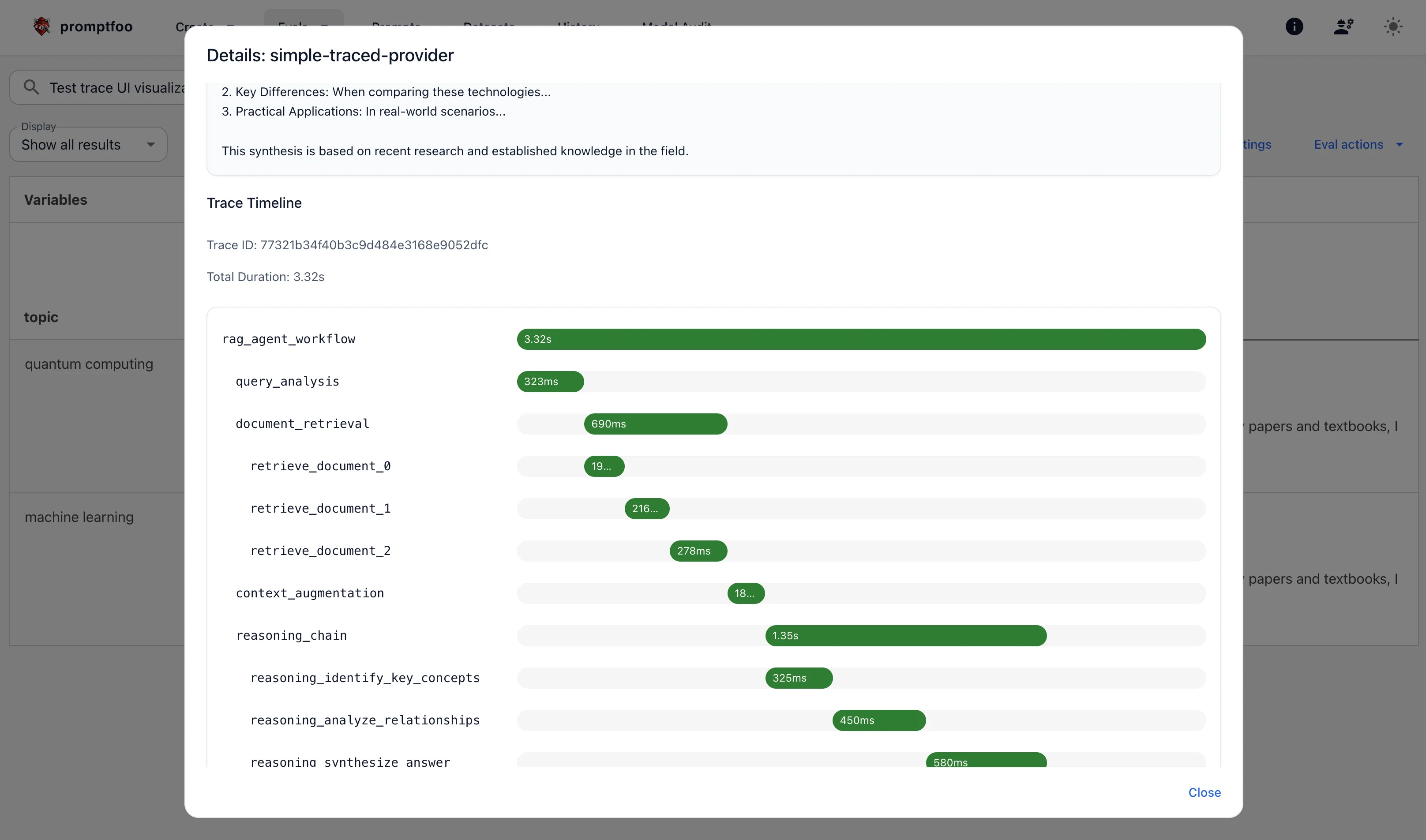
Promptfoo is a testing framework for evaluating and benchmarking language model prompts and applications across multiple providers.
Promptfoo's snapshot-20260823 release adds an adaptive rate limit scheduler, local inference via Transformers.js, new video and gateway providers, telecom and RAG-attribution red team plugins, plus multi-input red team scanning, alongside a broad set of CLI, config, and eval UI additions.
└──▷ WHAT SHIPPED · 12 FEATURESmost completely described firstwhat's the number?
Each feature carries 0–100 for how completely the vendor documented
it — not how big or important the work is. A major capability
described in eight words scores low, and that is the finding.
depth0–40what it does and how it works or what changed
specificity0–30names real surfaces — APIs, flags, formats, limits, numbers
actionability0–30enough to go use it — a named endpoint, flag, or config key tops this; a UI path is a starting point
Code and config rank first by construction: a documented endpoint,
flag or config key scores at the top of specificity and actionability,
so it sorts above a feature described only in prose. Under
60 the notes go thin — everything below the “thinner
coverage” line is thinner documentation, not smaller work.
Hover any meter for that feature's three sub-scores.
01
CLI and configuration usability improvementsNEW90how completely this was documenteddepth30/40specificity30/30actionability30/3090 / 100
Adds promptfoo logs command to view log files from the CLI; -d/--description flag on redteam generate for labeling generated scans; --share/--no-share flags for Model Audit to control cloud sharing; $VAR syntax support in file paths for referencing environment variables in configuration; support for multiple --env-file flags to load several environment files in one invocation; and an --extension flag to load extensions via the command line.
View Promptfoo runtime logs without digging through the filesystem — useful when debugging provider errors or rate limit behavior.
$ promptfoo logs
Cap test-case generation per strategy and label a red team run for tracking in CI.
— Six named CLI flags/commands with runnable examplessnapshot-20260823
02
Test configuration and assertion additionsNEW90how completely this was documenteddepth30/40specificity30/30actionability30/3090 / 100
Adds numTests config key to cap the number of test cases generated per red team strategy; metadata.sessionId surfaced as a variable column in eval result tables and exports; a word-count assertion type to validate response word counts; a __count variable for use in derived metrics to compute averages; and test-level prompts filter, providers filter, and per-test structured output configuration at the individual test case level.
Cap strategy test-case volume and assert word count in a single test config — useful for constraining long-running red team scans.
— Named config keys and assertion type with a working YAML examplesnapshot-20260823
03
xAI Voice provider config and function callsIMPROVED70how completely this was documenteddepth25/40specificity25/30actionability20/3070 / 100
Adds apiBaseUrl and websocketUrl override config and function call support to the xAI Voice provider.
— Named config keys but no runnable example providedsnapshot-20260823
04
New provider integrationsNEW65how completely this was documenteddepth20/40specificity30/30actionability15/3065 / 100
Adds a Transformers.js provider to run Hugging Face models locally in Node.js or the browser; Vercel AI Gateway and Cloudflare AI Gateway providers for routing requests; an AWS Bedrock Video provider supporting Nova Reel and Luma Ray 2 video generation; and an Azure AI Foundry Video provider for Sora video generation.
— Named providers and models but no setup detail shownsnapshot-20260823
thinner coverage below
05
OpenAI Codex provider tracing and collaboration modeIMPROVED55how completely this was documenteddepth20/40specificity20/30actionability15/3055 / 100
Adds collaboration_mode support and integrated tracing to the OpenAI Codex provider.
— Named config option, mechanism thin beyond namingsnapshot-20260823
06
New red team plugins for specialized testingNEW50how completely this was documenteddepth20/40specificity20/30actionability10/3050 / 100
Adds a Telecom red team plugin for industry-specific testing of telecommunications AI systems, and a RAG Source Attribution plugin to test whether RAG systems properly attribute sources in responses.
Adaptive rate limit scheduler for providersNEW50how completely this was documenteddepth25/40specificity15/30actionability10/3050 / 100
Adds an adaptive rate limit scheduler that automatically adjusts concurrency based on provider rate limits and response headers.
— Explains mechanism but no config surface or example givensnapshot-20260823
08
Eval results UI filtering and provider inspectionNEW45how completely this was documenteddepth15/40specificity15/30actionability15/3045 / 100
Adds a user-rated filter in the UI to show only manually rated eval results, and a provider config hover in the eval results UI to view provider configuration details inline.
— Names two UI features with a clear location to find themsnapshot-20260823
09
Code scanning for fork PRs and comment triggersIMPROVED40how completely this was documenteddepth15/40specificity15/30actionability10/3040 / 100
Code scanning adds support for fork pull requests and comment-triggered scans.
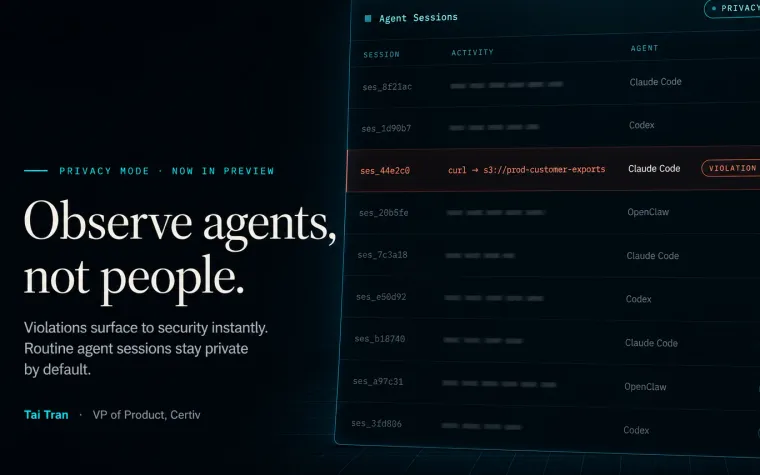
OpenShell is the safe, private runtime for autonomous AI agents.
OpenShell's biggest window changes are operational: sandboxes can now be stopped and started without deletion, Docker/Podman gain policy DNS correlation and transparent TCP enforcement, and headless OIDC device-flow login lands alongside new Go and TypeScript SDKs, OCSF-based AI inference event emission, and OTLP trace export spanning the Podman, VM, and gateway drivers.
└──▷ WHAT SHIPPED · 21 FEATURESmost completely described firstwhat's the number?
Each feature carries 0–100 for how completely the vendor documented
it — not how big or important the work is. A major capability
described in eight words scores low, and that is the finding.
depth0–40what it does and how it works or what changed
specificity0–30names real surfaces — APIs, flags, formats, limits, numbers
actionability0–30enough to go use it — a named endpoint, flag, or config key tops this; a UI path is a starting point
Code and config rank first by construction: a documented endpoint,
flag or config key scores at the top of specificity and actionability,
so it sorts above a feature described only in prose. Under
60 the notes go thin — everything below the “thinner
coverage” line is thinner documentation, not smaller work.
Hover any meter for that feature's three sub-scores.
01
JSON and YAML output for sandbox commandsNEW83how completely this was documenteddepth25/40specificity28/30actionability30/3083 / 100
Adds --output json and --output yaml flags to openshell sandbox get, openshell sandbox status, and openshell sandbox create for machine-readable output, e.g. openshell sandbox create --output json -- claude or openshell sandbox status --output yaml.
Parse sandbox creation output in CI pipelines or scripts that need the sandbox ID or status without scraping human-readable text.
$ openshell sandbox create --output json -- claude
Poll sandbox status in a script and process the result as structured data.
$ openshell sandbox status --output yaml
— Exact flags, subcommands, and two runnable examples given.v0.0.92
02
Stop and start operations for sandboxesNEW80how completely this was documenteddepth25/40specificity25/30actionability30/3080 / 100
Adds stop and start operations to the sandbox subcommand, enabling sandboxes to be suspended and resumed without deletion, e.g. openshell sandbox stop my-sandbox followed later by openshell sandbox start my-sandbox.
Suspend a running sandbox to free resources, then restart it later without losing the environment.
— Exact subcommands and a runnable example given.v0.0.105
03
Credential leak warning on --env valuesNEW78how completely this was documenteddepth25/40specificity25/30actionability28/3078 / 100
The CLI now warns when a value passed to --env at sandbox creation looks like a credential, helping prevent accidental secret exposure, e.g. openshell sandbox create --env API_KEY=sk-abc123secret -- claude.
Catch accidental credential exposure before a sandbox starts — the CLI warns when an --env value resembles a secret.
$ openshell sandbox create --env API_KEY=sk-abc123secret -- claude
— Exact flag and runnable example demonstrate the warning.v0.0.104
04
Kubernetes and Helm deployment configuration optionsNEW68how completely this was documenteddepth25/40specificity25/30actionability18/3068 / 100
The Helm chart gains cert-manager external issuer support and OpenShift passthrough Route support for deployment, plus a storageClassName configuration for workspace PVCs to control storage class selection in Kubernetes deployments.
— Names storageClassName config key and Route/cert-manager support.v0.0.106v0.0.96
05
OCSF ai_operation profile for AI inference eventsNEW65how completely this was documenteddepth25/40specificity28/30actionability12/3065 / 100
OpenShell now emits AI inference events using the OCSF ai_operation profile on ApiActivity events, with the OCSF schema bumped to v1.8.0 (OCSF class ID 6003).
— Exact OCSF profile, class ID and schema version named.v0.0.109
06
Policy DNS correlation and transparent TCP enforcementNEW64how completely this was documenteddepth30/40specificity22/30actionability12/3064 / 100
Adds a policy DNS correlation store linking DNS lookups to outbound TCP connections for richer network policy decisions, and enables Docker and Podman runtimes to enforce policy DNS and transparent TCP, extending L7 network controls to both container backends.
— Mechanism and scope described, no config keys named.v0.0.111
07
Go and TypeScript SDKs for OpenShellNEW62how completely this was documenteddepth25/40specificity22/30actionability15/3062 / 100
Adds a complete Go SDK with domain clients, authentication, and hardening, plus a TypeScript SDK published as @nvidia/openshell-sdk, enabling programmatic integration with OpenShell from both languages.
— Names the TypeScript package; Go SDK scope described only in prose.v0.0.106
thinner coverage below
08
OTLP trace export across Podman, VM, and gateway driversNEW59how completely this was documenteddepth25/40specificity22/30actionability12/3059 / 100
Adds OTLP trace export for the Podman driver, the VM driver, and the gateway, enabling observability pipelines to ingest driver and sandbox execution telemetry from OpenTelemetry-compatible backends.
Credential driver refresh and static bindingNEW53how completely this was documenteddepth25/40specificity18/30actionability10/3053 / 100
Credential drivers now store refresh credentials so providers can renew tokens without user intervention, and the proxy can bind static credentials to provider endpoints for gateway-managed credential injection at the network layer.
— Two credential driver mechanisms named, no config keys given.v0.0.103v0.0.110
10
OIDC device authorization grant for headless loginNEW50how completely this was documenteddepth25/40specificity15/30actionability10/3050 / 100
OpenShell CLI now supports the OIDC device authorization grant flow for headless (browserless) login, enabling CLI authentication in CI/CD and server environments without a local browser.
— Names the OAuth flow but shows no CLI command.v0.0.110
11
Bazel build system rolloutNEW50how completely this was documenteddepth22/40specificity20/30actionability8/3050 / 100
Prototypes a Bazel build system for the project, adds Bazel build targets for credential drivers, pulls the VM driver and runtime from GitHub via Bazel, and adds OpenTelemetry crate targets to the Bazel build, laying groundwork for reproducible, hermetic builds.
— Names build targets but no invocation commands shown.v0.0.97v0.0.101
12
OCI image working directory and policy-first identityIMPROVED48how completely this was documenteddepth22/40specificity18/30actionability8/3048 / 100
Sandboxes now honor the working directory declared in OCI container images, so containers start in the path their image specifies, and adopt policy-first OCI image identity, making policy the authoritative source for image identification.
— Behavior change described, no config surface named.v0.0.99v0.0.96
13
Expanded platform build support: glibc-static and WindowsNEW46how completely this was documenteddepth20/40specificity18/30actionability8/3046 / 100
Adds a glibc-static supervisor libc variant for environments where dynamic glibc linking is unavailable, and enables Windows native compilation support for the gateway and CLI.
— Named build variants but no build commands given.v0.0.104
14
Gateway compute driver negotiation and built-in driversNEW45how completely this was documenteddepth22/40specificity15/30actionability8/3045 / 100
Adds gateway callback listener negotiation in the compute layer, enabling the gateway to coordinate callback endpoints with sandbox compute drivers, and adds standalone first-party compute drivers so the gateway can use built-in drivers without external dependencies.
— Describes gateway/compute mechanism, no named flags.v0.0.97v0.0.111
15
System CA root mode for sandboxesNEW38how completely this was documenteddepth18/40specificity12/30actionability8/3038 / 100
Adds a system CA root mode allowing sandboxes to trust the host's CA certificate bundle for TLS verification.
— Describes mechanism but names no config flag.v0.0.99
16
Corporate HTTP proxy egress routing for sandboxesNEW38how completely this was documenteddepth18/40specificity12/30actionability8/3038 / 100
Routes sandbox egress traffic through a corporate HTTP proxy via the gateway, enabling use in enterprise network environments.
— Describes routing capability without config details.v0.0.92
17
Supervisor middleware content guard exampleNEW33how completely this was documenteddepth15/40specificity10/30actionability8/3033 / 100
Introduces a supervisor middleware content guard example, providing a reference implementation for enforcing content policies at the supervisor layer.
— Reference example named, no code path given.v0.0.96
18
Non-root identities inside sandboxesNEW30how completely this was documenteddepth15/40specificity10/30actionability5/3030 / 100
Sandboxes can now run under non-root identities, expanding the range of workloads and privilege models supported inside sandbox environments.
— States capability without configuration steps.v0.0.110
19
Canonical main process for sandbox supervisorNEW30how completely this was documenteddepth15/40specificity10/30actionability5/3030 / 100
Adds a canonical main process to the sandbox supervisor, providing a stable process anchor for sandbox lifecycle management.
— Bare description of an internal architecture change.v0.0.111
20
Authorization wired into workspace modelIMPROVED25how completely this was documenteddepth12/40specificity8/30actionability5/3025 / 100
Extends access control enforcement to workspace operations by wiring authorization into the workspace model.
— States the change without specifying enforced operations.v0.0.96
21
TCP_NODELAY latency reductionIMPROVED18how completely this was documenteddepth8/40specificity8/30actionability2/3018 / 100
Reduces sandbox network latency via TCP_NODELAY.
— Mentioned only in the release summary, no further detail.v0.0.99
safe execution paths for agents - zero trust, zero setup, zero latency.
nono's largest addition this window is remote session attach and listing via nono-console (nono connect, nono ps --remote), alongside new proxy-layer capabilities — SPIFFE/SPIRE workload identity, per-route rate limiting, Vault OIDC login mediation and JWT-shaped capture nonces — plus env-variable pass-through in sandbox command policy. Two breaking changes remove the openclaw/swival built-in profiles and the deprecated nono learn command.
└──▷ WHAT SHIPPED · 19 FEATURESmost completely described firstwhat's the number?
Each feature carries 0–100 for how completely the vendor documented
it — not how big or important the work is. A major capability
described in eight words scores low, and that is the finding.
depth0–40what it does and how it works or what changed
specificity0–30names real surfaces — APIs, flags, formats, limits, numbers
actionability0–30enough to go use it — a named endpoint, flag, or config key tops this; a UI path is a starting point
Code and config rank first by construction: a documented endpoint,
flag or config key scores at the top of specificity and actionability,
so it sorts above a feature described only in prose. Under
60 the notes go thin — everything below the “thinner
coverage” line is thinner documentation, not smaller work.
Hover any meter for that feature's three sub-scores.
01
Remote session connect and listing via nono-consoleNEW88how completely this was documenteddepth30/40specificity28/30actionability30/3088 / 100
Adds nono connect subcommand to attach a local terminal to a session hosted by nono-console, usable as nono connect for interactive discovery or nono connect <session-id> to attach directly by global session ID. Extends nono ps with a --remote flag to list sessions hosted by the enrolled tenant's nono-console, combinable with --all and --json for full remote session visibility.
List all live and exited sessions running on the enrolled nono-console tenant, in JSON for scripting or SIEM ingestion.
$ nono ps --remote--all--json
Attach your terminal directly to a specific remote session by its global session ID, useful for live incident inspection.
$ nono connect local:host:abc123
— Full command syntax and two worked examples givenv0.74.0
02
Env variable pass-through in sandbox command policyNEW88how completely this was documenteddepth35/40specificity28/30actionability25/3088 / 100
Adds export_env to tool-sandbox command policy config, letting callers declare specific environment variables to pass through to child tools verbatim, bypassing the allow_vars blocklist — supports exact names, trailing-* prefixes, or bare *. Adds session_export_env key to command_policies config for declaring env pass-through when the resolved caller is the session itself rather than a mediated command.
Allow a sandboxed tool to forward a specific interpreter env var (e.g. PYTHONPATH) to child processes it spawns, without opening the full allow_vars list.
— Both config keys named with matching syntax and examplev0.74.0
03
Vault OIDC login mediation in sandbox policyNEW86how completely this was documenteddepth30/40specificity28/30actionability28/3086 / 100
Adds mediation for vault login -method=oidc with support for a custom inject_header and a per-command open_port, so Vault OIDC flows can complete inside a sandboxed tool policy.
Mediate vault login -method=oidc inside a sandboxed tool policy, injecting the token via a custom header and opening a per-command port for the OIDC callback.
— Full config example with exact keys includedv0.70.0
04
External sandbox-policy now retains Landlock on LinuxBREAKING70how completely this was documenteddepth30/40specificity25/30actionability15/3070 / 100
The external value for --sandbox-policy on Linux now keeps Landlock active for filesystem/process policy while only delegating TCP enforcement externally, rather than installing no sandbox at all.
JWT-shaped capture noncesNEW70how completely this was documenteddepth30/40specificity25/30actionability15/3070 / 100
Adds CapturedNonceShape with a jwt option for capture intercepts, emitting a <header>.<payload>.nono_<64hex> token so consumers that validate JWT structure before use can still resolve the embedded nonce.
— Exact token format named, no runnable examplev0.70.0
06
Static seccomp network baseline on LinuxNEW65how completely this was documenteddepth25/40specificity25/30actionability15/3065 / 100
Adds a static seccomp network baseline on Linux (alongside Landlock) under the auto--sandbox-policy mode, strengthening network restriction on kernels where Landlock ABI < V4.
— Names flag and kernel condition, no examplev0.72.0
07
Removal of openclaw and swival built-in profilesBREAKING60how completely this was documenteddepth20/40specificity20/30actionability20/3060 / 100
Removes openclaw and swival as built-in profiles; users relying on them must supply their own profile going forward. Any nono run --profile openclaw or nono run --profile swival invocation will fail after upgrading.
— Exact failing invocation and migration note givenv0.72.0
08
Removal of deprecated nono learn commandBREAKING60how completely this was documenteddepth20/40specificity20/30actionability20/3060 / 100
Removes the deprecated nono learn command (deprecated since v0.50.1); any scripts or workflows invoking nono learn will break — use nono run instead.
Per-route request rate limitingNEW55how completely this was documenteddepth20/40specificity20/30actionability15/3055 / 100
Adds per-route request rate limiting via RouteRateLimiter on proxy upstream routes, letting profiles cap how many requests an agent or tool can send through a given route.
Deny-path reporting in why subcommandIMPROVED50how completely this was documenteddepth20/40specificity15/30actionability15/3050 / 100
Extends the why subcommand to report explicit deny paths from sandbox policy, making it easier to diagnose why a specific network or filesystem access was blocked.
Sandbox policy allows unlink for atomic writesIMPROVED45how completely this was documenteddepth20/40specificity15/30actionability10/3045 / 100
Extends sandbox policy to allow unlink for atomic write temp files, enabling tools that perform atomic writes (write-then-rename) to clean up temp files within policy.
!The openclaw and swival built-in profiles have been removed; any nono run --profile openclaw or nono run --profile swival invocation will fail after upgrading.
!The external value for --sandbox-policy on Linux now keeps Landlock active for filesystem/process policy while only delegating TCP enforcement externally, rather than installing no sandbox at all.
!The nono learn subcommand has been removed. Any scripts or workflows invoking nono learn will break; use nono run instead.
Docker Sandboxes isolates containerized applications in secure, lightweight environments for testing and development without affecting the host system.
Docker Sandboxes' two releases add declarative .sbxenv.yaml environments with a full sbx env lifecycle, an MCP server management and gateway system, and expanded hardware/network controls (USB and GPU passthrough, per-sandbox network deny rules), plus kit spec v2, cosign-based kit signing, and a string of proxy, credential and secrets-scope improvements.
└──▷ WHAT SHIPPED · 25 FEATURESmost completely described firstwhat's the number?
Each feature carries 0–100 for how completely the vendor documented
it — not how big or important the work is. A major capability
described in eight words scores low, and that is the finding.
depth0–40what it does and how it works or what changed
specificity0–30names real surfaces — APIs, flags, formats, limits, numbers
actionability0–30enough to go use it — a named endpoint, flag, or config key tops this; a UI path is a starting point
Code and config rank first by construction: a documented endpoint,
flag or config key scores at the top of specificity and actionability,
so it sorts above a feature described only in prose. Under
60 the notes go thin — everything below the “thinner
coverage” line is thinner documentation, not smaller work.
Hover any meter for that feature's three sub-scores.
01
Declarative sandbox environments via .sbxenv.yamlNEW91how completely this was documenteddepth35/40specificity28/30actionability28/3091 / 100
New .sbxenv.yaml file defines agent, workspace, kits, environment variables, secrets, registry credentials, ports, and resource limits, and is committable with a project for reproducible contributor environments. sbx env run provisions a sandbox from the file and opens an interactive session, while sbx env create, sbx env exec, and sbx env rm manage the full lifecycle. Multiple .sbxenv.yaml files can be combined for shared configuration with local overrides, and host environment variable references pull in machine-specific paths and credentials.
Commit a reproducible sandbox definition with your project so every contributor launches the same environment with one command.
$ sbx env run
Define a complete sandbox environment — agent, kits, env vars, secrets, ports, and resource limits — in a project-committed file.
— Full lifecycle commands and file schema both namedv0.39.0
02
USB device passthrough for sandboxesNEW90how completely this was documenteddepth30/40specificity30/30actionability30/3090 / 100
Experimental --usb flag on sbx create (enabled via DOCKER_SANDBOXES_FEATURE_SANDBOX_USB environment variable) re-attaches specified USB devices into the sandbox via usbfs on Linux x86_64/ARM64.
Passthrough a specific USB device into a sandbox for hardware-in-the-loop testing on Linux x86_64/ARM64.
— Flag, env var, and platform scope all namedv0.39.0
03
Per-sandbox network deny rulesNEW86how completely this was documenteddepth30/40specificity28/30actionability28/3086 / 100
New --deny-network HOST flag on sbx run and sbx create records per-sandbox network deny rules at creation time, with layer-aware egress messages; blocked HTTPS proxy connections now appear in sbx policy log even when the client aborts the TLS handshake, and IP-literal destinations denied by a CIDR rule fail fast with a policy message instead of timing out.
Block a sandbox from reaching an internal IP range at creation time, getting a clear policy message instead of a silent timeout.
$ sbx run --deny-network 10.0.0.0/8 claude
— Flag, log surface, and failure behaviour all namedv0.38.0
04
MCP server management and gatewayNEW83how completely this was documenteddepth30/40specificity28/30actionability25/3083 / 100
New sbx mcp subcommand registers and manages remote or local MCP servers, backed by a built-in MCP gateway that keeps OAuth credentials on the host. Dynamic MCP tools mcp-find, mcp-add, and mcp-config-set attach registered MCP servers to sandboxes, and MCP server and tool registrations can be governed organization-wide using Cedar policies.
— Subcommand, tools, and governance mechanism all namedv0.38.0
05
Scoped proxy configuration settingsNEW83how completely this was documenteddepth30/40specificity28/30actionability25/3083 / 100
Experimental proxy, proxy.sandbox, proxy.daemon, and matching no_proxy settings provide separate proxy configuration scopes for sandbox and daemon traffic; proxy.integratedAuth on Windows enables NTLM/Kerberos/Negotiate authentication to upstream proxies, and tls.allowNegativeSerial (set via sbx settings set tls.allowNegativeSerial true) adds compatibility with TLS-inspecting proxies issuing certificates with negative serial numbers.
— Every setting key named with its exact purposev0.38.0
06
Local model support for sbx runBREAKING75how completely this was documenteddepth25/40specificity25/30actionability25/3075 / 100
sbx run --model <name> claude can run Claude Code against a local GGUF model (experimental); models from an existing Ollama installation were selected with an ollama/ prefix, which is now replaced by an explicit --provider ollama flag on sbx run --model.
Start a Claude Code session using a local GGUF model served by Ollama instead of the cloud API.
$ sbx run --model ollama/llama3 claude
— Breaking flag change and prior syntax both namedv0.39.0v0.38.0
07
Cosign-based kit signing and verificationNEW75how completely this was documenteddepth25/40specificity25/30actionability25/3075 / 100
Kits can now be signed and verified with cosign-compatible Sigstore signatures via sbx kit sign / sbx kit verify, with optional policy enforcement at load time.
— Exact commands and signing mechanism namedv0.39.0
08
Kit spec v2 schemaIMPROVED75how completely this was documenteddepth30/40specificity25/30actionability20/3075 / 100
Introduces kit spec schemaVersion: '2' with clearer structure for setup, permissions, agent instructions, networking, and credentials, while v1 kits continue to load via the legacy path. Kit install commands can now consume static files from files/home, including binary files, and kits using extends correctly inherit and override the base image or build source of their parent.
— Schema key and paths named, no full example shownv0.38.0
09
Environment variable injection flags for sbx run/createNEW70how completely this was documenteddepth20/40specificity25/30actionability25/3070 / 100
sbx run and sbx create now accept -e/--env and --env-file to inject environment variables into a sandbox, following docker run precedence rules.
SANDBOX_NAME and SANDBOX_ID environment variablesNEW70how completely this was documenteddepth25/40specificity25/30actionability20/3070 / 100
Sandboxes now expose SANDBOX_NAME and SANDBOX_ID environment variables matching the values shown by sbx ls --json; the older SANDBOX_VM_ID variable is deprecated.
— Exact variable names and deprecation notedv0.39.0
11
Claude Code remote-control endpoint in sandboxesNEW70how completely this was documenteddepth20/40specificity25/30actionability25/3070 / 100
Claude Code's /remote-control endpoint can now be used inside sandboxes by enabling the claude.remoteControl setting via sbx settings set claude.remoteControl true.
Bulk sandbox cleanup with sbx pruneNEW65how completely this was documenteddepth20/40specificity20/30actionability25/3065 / 100
New sbx prune command bulk-removes stopped sandboxes with filtering by how long each has been stopped, never touching running sandboxes.
— Command named but filter syntax not shownv0.39.0
14
Dynamic secrets in sbx secret commandsNEW65how completely this was documenteddepth25/40specificity20/30actionability20/3065 / 100
sbx secret set and sbx secret set-custom now support dynamic secrets that resolve values from a reference or command, with options to control refreshing, verification, and error output.
Structured startup progress outputIMPROVED60how completely this was documenteddepth25/40specificity20/30actionability15/3060 / 100
sbx create and sbx run show detailed structured startup progress, including environment files loaded, resources provisioned, and each kit command outcome; kit-install progress streams live during sbx create --kit.
— Behaviour described, no exact output examplev0.38.0
17
Secret scope defaults: global vs sandboxDEPRECATED60how completely this was documenteddepth20/40specificity20/30actionability20/3060 / 100
Service and custom secrets are now global by default, with a --sandbox flag to scope a secret to a single sandbox; the legacy positional and --global forms are deprecated with warnings.
— New default and deprecated flags both namedv0.38.0
thinner coverage below
18
Declarative OAuth kit credential filesIMPROVED55how completely this was documenteddepth20/40specificity20/30actionability15/3055 / 100
OAuth kits can now declare their credential file using the declarative credentialFile.structure form (rendered to well-formed JSON) instead of a free-form Go template.
Expanded diagnostics in sbx diagnoseIMPROVED55how completely this was documenteddepth20/40specificity20/30actionability15/3055 / 100
sbx diagnose now reports free disk space on the volume holding sandbox data, detects broken/shadowed/stale SSH client configuration, and checks host virtualization support.
— Command named, checks listed but no output shownv0.39.0
20
Configurable cloned workspace volume sizeNEW55how completely this was documenteddepth15/40specificity20/30actionability20/3055 / 100
New DOCKER_SANDBOXES_CLONED_WORKSPACE_SIZE environment variable configures the size of the cloned workspace volume.
sbx daemon restart subcommandNEW50how completely this was documenteddepth15/40specificity15/30actionability20/3050 / 100
New sbx daemon restart subcommand stops and restarts the sandboxd daemon in the background.
— Command named, no further mechanism describedv0.38.0
22
Improved credential handling for agent sandboxesIMPROVED50how completely this was documenteddepth20/40specificity20/30actionability10/3050 / 100
Docker Agent and OpenCode sandboxes can authenticate GitHub Copilot requests with proxy-managed GitHub credentials, and Codex sandboxes created from the TUI now prefer stored OpenAI OAuth credentials over API keys.
Policy governance error clarity and live refreshIMPROVED50how completely this was documenteddepth20/40specificity20/30actionability10/3050 / 100
sbx policy allow network now reports a clear error when org governance overrides a local allow rule, and signing in refreshes organization policies in the running daemon immediately instead of waiting for the next polling interval.
— Two related governance fixes named, no command detailv0.38.0
24
Custom secrets shown in sbx inspectIMPROVED45how completely this was documenteddepth15/40specificity15/30actionability15/3045 / 100
sbx inspect now displays custom secrets configured for a sandbox.
ToolHive is an enterprise-grade platform for running and managing Model Context Protocol (MCP) servers.
Across five releases, ToolHive built out RFC 8693 token exchange and delegated identity end-to-end, shipped a toolhive.lock.yaml skill lock file with thv skill sync/upgrade and Sigstore verification, added full MCP 2026-07-28 ('Modern') spec support with Virtual MCP conformance, introduced a thv ai-plugin CLI and REST API, and tightened Cedar authorization, vMCP tool visibility, and OAuth/DCR endpoints — several of these as breaking changes.
└──▷ WHAT SHIPPED · 28 FEATURESmost completely described firstwhat's the number?
Each feature carries 0–100 for how completely the vendor documented
it — not how big or important the work is. A major capability
described in eight words scores low, and that is the finding.
depth0–40what it does and how it works or what changed
specificity0–30names real surfaces — APIs, flags, formats, limits, numbers
actionability0–30enough to go use it — a named endpoint, flag, or config key tops this; a UI path is a starting point
Code and config rank first by construction: a documented endpoint,
flag or config key scores at the top of specificity and actionability,
so it sorts above a feature described only in prose. Under
60 the notes go thin — everything below the “thinner
coverage” line is thinner documentation, not smaller work.
Hover any meter for that feature's three sub-scores.
01
Skill lock file with sync, upgrade, and Sigstore verificationNEW93how completely this was documenteddepth35/40specificity28/30actionability30/3093 / 100
Pins project-scoped skill installs in a toolhive.lock.yaml lock file including Sigstore provenance fields. Adds thv skill sync to restore a project's pinned skill set on any machine and verify on-disk content in CI, and thv skill upgrade to re-resolve pinned skills to newer content without silent lock drift, both with typed exit codes and a pre-install confirmation gate for scriptable CI use. Adds Sigstore signature verification for skills at install, sync, and upgrade time.
Restore and verify a project's pinned MCP skill set in CI to ensure every machine uses exactly the locked versions.
$ thv skill sync
Re-resolve all pinned skills to newer content and update toolhive.lock.yaml without silent drift.
$ thv skill upgrade
— Runnable commands and lock file path both given.v0.42.0v0.41.0
02
RFC 8693 token exchange and delegated identityNEW88how completely this was documenteddepth35/40specificity28/30actionability25/3088 / 100
Wires RFC 8693 token exchange into the embedded authorization server's token endpoint, with delegated token audience bounded by the subject token; subject tokens from trusted external OIDC issuers (Keycloak, Entra, Okta) can be validated for exchange. Adds trusted_issuers to the embedded auth server config so agents can exchange subject tokens from external OIDC providers for ToolHive-scoped delegated tokens under a fail-closed RFC 8693 consent policy. Supports actor_token in RFC 8693 flows for delegated-identity scenarios where the acting party differs from the subject, and makes RFC 8693 delegate (token-exchange) clients reachable and usable via vmcp-config.yaml. Audit logs capture the RFC 8693 act claim and full delegation chain, distinguishing an agent acting for a user from the user itself.
Configure an OAuth token-exchange backend in vmcp so that downstream calls use RFC 8693 delegate tokens — now fully reachable after this release.
Fail-closed vMCP tool visibility and exclusion enforcementBREAKING88how completely this was documenteddepth35/40specificity28/30actionability25/3088 / 100
Adds aggregation.defaultToolVisibility: deny to vMCP config so only workloads explicitly listed in aggregation.tools have their tools advertised, closing the fail-open gap in tool aggregation. On the Modern (2026-07-28) path, vMCP tools excluded via filter, excludeAll, or excludeAllTools are no longer directly callable — tools/call now returns -32602 at HTTP 400 instead of executing; un-filter the tool or wrap it in a composite tool.
Lock down a vMCP group so new workloads are hidden by default and only explicitly listed ones expose tools.
— Exact config key, error code, and remediation path given.v0.42.1
04
`insecureAllowHTTP` opt-in for plain-HTTP OIDC issuersBREAKING88how completely this was documenteddepth32/40specificity28/30actionability28/3088 / 100
Adds insecureAllowHTTP: true under spec.inline in MCPOIDCConfig to explicitly opt in to plain-HTTP issuer and JWKS URLs for dev/test environments; production configs must use HTTPS. MCPOIDCConfig resources of type inline with a plain-HTTP, malformed, or scheme-less issuer or jwksUrl now flip to Valid=False on next reconcile and block reconciliation of every MCPServer, MCPRemoteProxy, and VirtualMCPServer referencing them; add insecureAllowHTTP: true or switch to HTTPS to unblock.
Allow a dev/test inline OIDC config pointing at an in-cluster Keycloak over HTTP to pass URL validation after upgrading.
— Exact field, resource kinds, and remediation with example given.v0.42.1
05
StorageVersionMigrator enabled by default breaks namespace-scoped Helm installsBREAKING84how completely this was documenteddepth28/40specificity28/30actionability28/3084 / 100
Namespace-scoped Helm installs (operator.rbac.scope=namespace) now fail helm upgrade at render time unless operator.features.storageVersionMigrator: false is set, because the StorageVersionMigrator controller is now enabled by default (operator.features.storageVersionMigrator: true).
Opt out of the StorageVersionMigrator on a namespace-scoped Helm install to avoid a broken helm upgrade.
— Exact Helm keys and runnable workaround config given.v0.41.0
06
Reference-count status fields removed from config CRDsBREAKING78how completely this was documenteddepth25/40specificity28/30actionability25/3078 / 100
status.referencingWorkloads, status.referenceCount, and the References printer column are removed from all six config CRDs (MCPOIDCConfig, MCPAuthzConfig, MCPExternalAuthConfig, MCPToolConfig, MCPWebhookConfig, MCPTelemetryConfig); replace any automation reading them with workload field queries via -o json | jq.
— Every removed field and CRD named with migration path.v0.42.0
07
Cedar authorization evaluated against post-mutation requestBREAKING76how completely this was documenteddepth30/40specificity26/30actionability20/3076 / 100
Cedar authorization policy is now evaluated against the post-mutation MCP request, closing a bypass window for length-preserving mutating webhook rewrites. Cedar policy and audit records now evaluate against the post-mutation MCP request body; re-audit Cedar policies and update SIEM rules keyed on type or target.name before upgrading workloads that combine a mutating: entry in --webhook-config (or MCPWebhookConfig.spec.mutating) with Cedar authorization.
— Named config keys and remediation steps for a real bypass fix.v0.42.0
08
`TOOLHIVE_API_TIMEOUT` CLI timeout overrideNEW75how completely this was documenteddepth25/40specificity25/30actionability25/3075 / 100
Adds TOOLHIVE_API_TIMEOUT environment variable to override the CLI API client timeout for thv skill and thv ai-plugin commands (default is 10 minutes).
Fail CI faster when thv skill calls time out in a slow environment by shortening the API client timeout.
$ TOOLHIVE_API_TIMEOUT=30s thv skill list
— Exact env var, default, and runnable example given.v0.42.1
09
Content-Type enforcement for Cedar-authorized MCP requestsBREAKING73how completely this was documenteddepth28/40specificity25/30actionability20/3073 / 100
With Cedar authorization enabled (--authz-config), POST requests without Content-Type: application/json (including a missing header) now return 400 instead of being forwarded unauthorized; all MCP POST clients must send Content-Type: application/json.
— Exact flag, header, and status code named.v0.42.1
10
MCP tool annotations on composite toolsNEW66how completely this was documenteddepth28/40specificity26/30actionability12/3066 / 100
Composite tools now support MCP tool annotations (readOnlyHint, destructiveHint, idempotentHint, openWorldHint), with a conservative fail-closed safety floor derived from the workflow's step tools when none are set explicitly.
— Named annotation fields and mechanism, no example.v0.42.1
11
`pkg/telemetry/providers` and `optimizerdec` constants removedBREAKING65how completely this was documenteddepth20/40specificity25/30actionability20/3065 / 100
pkg/telemetry/providers is deleted and two optimizerdec constants are removed from the Go API; out-of-tree Go importers must drop references to these before upgrading.
— Exact package and constants named for importers to fix.v0.42.0
12
MCP 2026-07-28 'Modern' spec support end-to-endNEW64how completely this was documenteddepth32/40specificity22/30actionability10/3064 / 100
Supports the MCP 2026-07-28 stateless ('Modern') spec revision end to end across transport proxies, transparent proxy, and Virtual MCP — bridging era-mismatched client×backend combinations. Modern client-facing dispatch is gated per capability instead of a global kill-switch, with listen-stream support and pagination. Stabilizes vMCP protocol negotiation, stopping flapping between Modern and Legacy MCP revisions, and the readiness probe now sends the current MCP protocol version instead of a hardcoded 2024-11-05.
— Mechanism and scope described, no CLI or config surface named.v0.42.0v0.41.0
13
Virtual MCP protocol conformance improvementsIMPROVED64how completely this was documenteddepth30/40specificity26/30actionability8/3064 / 100
Virtual MCP is now MCP-conformant: completions, resource templates, subscriptions, and mid-call server-to-client forwarding all work. Backend list_changed notifications are now consumed and propagated to clients for tools, resources, and prompts. Guarantees tools/list pagination completeness for aggregated sets exceeding 1,000 tools. Tool definitions carrying invalid x-mcp-header annotations (SEP-2243) are now rejected as the spec requires.
— Named spec features and limit, but no config or command to invoke.v0.41.0
14
Rate-limit error code changed to standard 429BREAKING62how completely this was documenteddepth20/40specificity22/30actionability20/3062 / 100
Rate-limit JSON-RPC error code changed from -32029 to 429; clients branching on error.code == -32029 must match 429 instead.
— Exact before/after codes named for client migration.v0.41.0
15
OAuth and Dynamic Client Registration hardeningIMPROVED60how completely this was documenteddepth25/40specificity25/30actionability10/3060 / 100
Guards OAuth token and Dynamic Client Registration (DCR) endpoints against Server-Side Request Forgery (SSRF) attacks, supports confidential clients in dynamic client registration, ignores unsupported grant types in CIMD documents for interoperability with authorization servers advertising non-standard grant types, and dynamically registered OAuth clients now renew expiring client secrets automatically (RFC 7591/7592).
Plugin lifecycle tracking in lock fileNEW60how completely this was documenteddepth25/40specificity25/30actionability10/3060 / 100
Adds a plugins key to the lock file schema so plugin entries are tracked in lock provenance, plus a PluginLockService and a managed install flag to support plugin lifecycle management through the lock file. Records certificate ref and runner in lock provenance for supply-chain traceability, and enforces the recorded ref and runner fields during skill verification.
— Named schema fields and service but no CLI example.v0.43.0
thinner coverage below
17
JSON-RPC batch requests rejectedBREAKING57how completely this was documenteddepth22/40specificity20/30actionability15/3057 / 100
JSON-RPC batch requests (top-level arrays) are now rejected with HTTP 400 / error code -32600 instead of being executed; send individual requests.
AI-tool plugin management via `thv ai-plugin`NEW55how completely this was documenteddepth20/40specificity20/30actionability15/3055 / 100
Adds thv ai-plugin subcommand with a full CLI and REST API for end-to-end AI-tool plugin management, plus a registry catalog for discovering and managing AI-tool plugins.
— Names CLI/API surface but no example given.v0.42.0
19
Recovered HTTP panics stop logging by defaultBREAKING53how completely this was documenteddepth20/40specificity18/30actionability15/3053 / 100
Recovered HTTP panics no longer produce a slog.Error log line or stack trace; log-based alerts on recovered panics will silently stop firing unless Sentry is configured.
— Names the logging change and the Sentry workaround.v0.42.0
20
Container and binary signing with trust visibilityIMPROVED52how completely this was documenteddepth22/40specificity20/30actionability10/3052 / 100
Enables signing of pushes by default and removes the lock feature gate, making image signing the standard behavior. Signs the macOS thv binary with a Developer ID certificate, removing Gatekeeper warnings for macOS users. Displays recorded trust state to the user in the CLI, surfacing container image trust information at runtime.
— Concrete signing changes named, no CLI path shown for trust display.v0.43.0
21
W3C trace context propagation for MCP tracingNEW47how completely this was documenteddepth22/40specificity20/30actionability5/3047 / 100
W3C trace context propagates through outbound MCP _meta (SEP-414), joining backend spans to the client→proxy→server trace.
— Mechanism named, no setup instructions given.v0.41.0
22
LLM token helper and config lifecycle fixesIMPROVED45how completely this was documenteddepth20/40specificity15/30actionability10/3045 / 100
Resets the LLM config when the last tool is torn down, preventing stale LLM configuration from persisting after all tools exit, and uses a bare thv command as the LLM token helper, simplifying the token-helper integration for LLM clients.
— Named command but no full workflow shown.v0.43.0
23
Rate-limiting observability via metrics and tracingNEW44how completely this was documenteddepth18/40specificity18/30actionability8/3044 / 100
Adds rate-limiting observability via metrics and tracing (OpenTelemetry), covering the proxy rate-limit path.
— Names OpenTelemetry but no metric names or setup steps.v0.43.0
24
Build fingerprint removed from `/health` responseIMPROVED35how completely this was documenteddepth15/40specificity15/30actionability5/3035 / 100
Drops the build fingerprint from the proxy /health response, reducing information exposure on that endpoint.
— Named endpoint but minimal detail beyond that.v0.43.0
25
JWT claim normalization for Cedar policiesIMPROVED32how completely this was documenteddepth15/40specificity12/30actionability5/3032 / 100
Multi-valued JWT claims can be normalized to canonical space-delimited form for Cedar policies.
— Bare description, no example or config key.v0.41.0
26
Multi-line SSE event parsingIMPROVED27how completely this was documenteddepth12/40specificity10/30actionability5/3027 / 100
Supports parsing of multi-line Modern SSE events, improving compatibility with SSE-based MCP transports.
— Bare description, no mechanism or example.v0.43.0
27
Opt-in Envoy network-isolation backendNEW25how completely this was documenteddepth10/40specificity10/30actionability5/3025 / 100
Adds an opt-in Envoy network-isolation backend.
— Bare mention, no config or mechanism given.v0.41.0
28
Multiple MCP clients share single stdio serverNEW23how completely this was documenteddepth12/40specificity8/30actionability3/3023 / 100
Enables multiple MCP clients to share a single stdio server simultaneously.
— One-line description with no mechanism detail.v0.42.0
└──▷ BREAKING ON UPGRADE
!With Cedar authorization enabled (--authz-config), POST requests without Content-Type: application/json (including a missing header) now return 400 instead of being forwarded unauthorized; all MCP POST clients must send Content-Type: application/json.
!vMCP tools excluded via filter, excludeAll, or excludeAllTools are no longer directly callable on the Modern (2026-07-28) path — tools/call now returns -32602 at HTTP 400 instead of executing; un-filter the tool or wrap it in a composite tool.
!MCPOIDCConfig resources of spec.type: inline with a plain-HTTP, malformed, or scheme-less issuer or jwksUrl flip to Valid=False on next reconcile and block reconciliation of every MCPServer, MCPRemoteProxy, and VirtualMCPServer referencing them; add insecureAllowHTTP: true or switch to HTTPS.
!status.referencingWorkloads, status.referenceCount, and the References printer column are removed from all six config CRDs (MCPOIDCConfig, MCPAuthzConfig, MCPExternalAuthConfig, MCPToolConfig, MCPWebhookConfig, MCPTelemetryConfig); replace any automation reading them with workload field queries via -o json | jq.
!Cedar policy and audit records now evaluate against the post-mutation MCP request body; re-audit Cedar policies and update SIEM rules keyed on type or target.name before upgrading workloads that combine a mutating: entry in --webhook-config (or MCPWebhookConfig.spec.mutating) with Cedar authorization.
!Recovered HTTP panics no longer produce a slog.Error log line or stack trace; log-based alerts on recovered panics will silently stop firing unless Sentry is configured.
!pkg/telemetry/providers is deleted and two optimizerdec constants are removed from the Go API; out-of-tree Go importers must drop references to these before upgrading.
!Namespace-scoped Helm installs (operator.rbac.scope=namespace) now fail helm upgrade at render time unless operator.features.storageVersionMigrator: false is set, because the StorageVersionMigrator controller is now enabled by default (operator.features.storageVersionMigrator: true).
!JSON-RPC batch requests (top-level arrays) are now rejected with HTTP 400 / error code -32600 instead of being executed; send individual requests.
!Rate-limit JSON-RPC error code changed from -32029 to 429; clients branching on error.code == -32029 must match 429 instead.
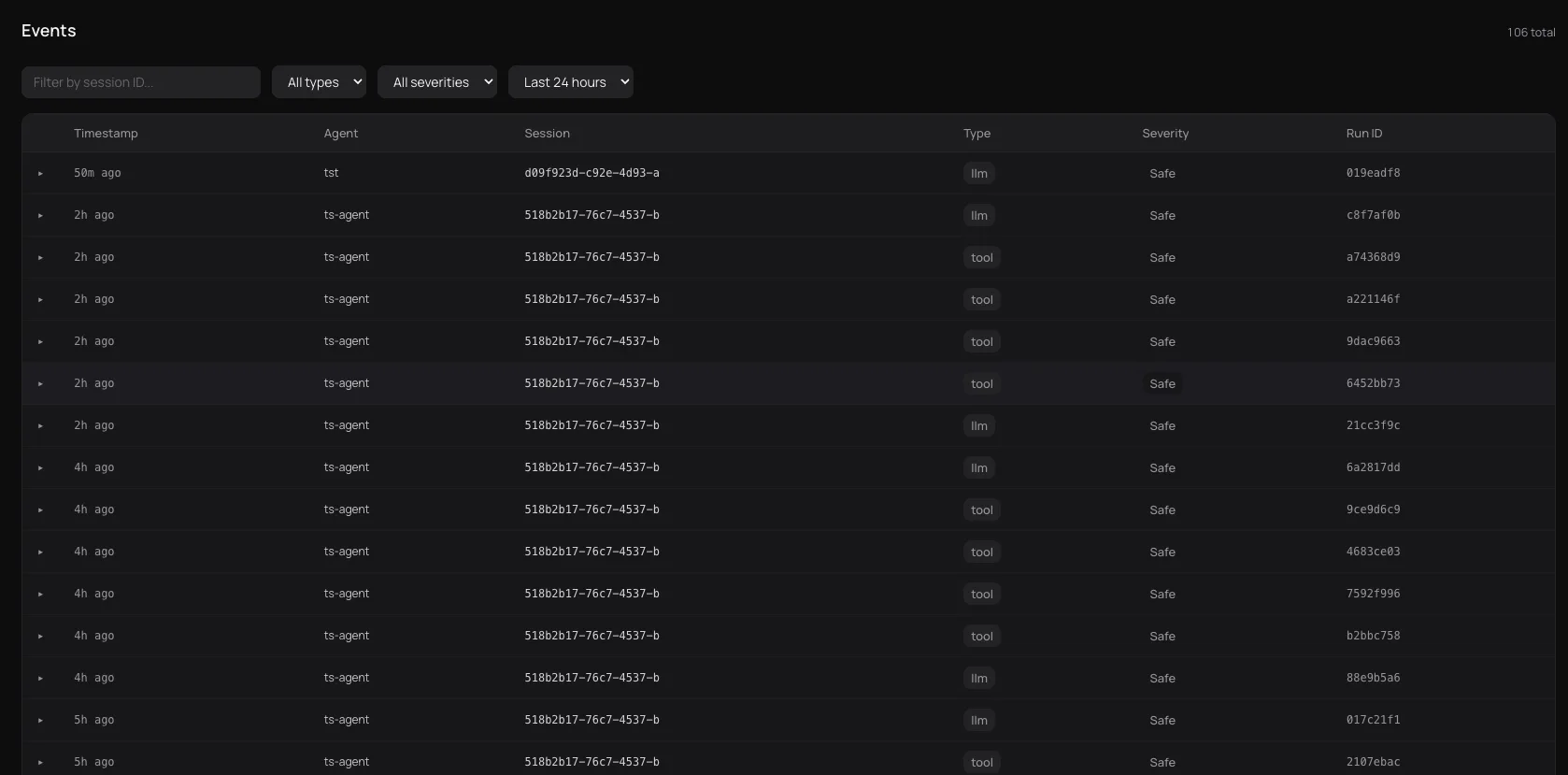
Open-source runtime AI agent security tool - monitors and controls AI agents, catching malicious tool use, prompt injection, and policy drift in real time, before the agent acts.
Adrian's Python and TypeScript SDKs gained cross-provider reasoning capture, and a new Claude Code plugin added WebSocket-based human-in-the-loop verdicts with built-in PII filtering.
└──▷ WHAT SHIPPED · 5 FEATURESmost completely described firstwhat's the number?
Each feature carries 0–100 for how completely the vendor documented
it — not how big or important the work is. A major capability
described in eight words scores low, and that is the finding.
depth0–40what it does and how it works or what changed
specificity0–30names real surfaces — APIs, flags, formats, limits, numbers
actionability0–30enough to go use it — a named endpoint, flag, or config key tops this; a UI path is a starting point
Code and config rank first by construction: a documented endpoint,
flag or config key scores at the top of specificity and actionability,
so it sorts above a feature described only in prose. Under
60 the notes go thin — everything below the “thinner
coverage” line is thinner documentation, not smaller work.
Hover any meter for that feature's three sub-scores.
01
Reasoning capture across LangChain, OpenAI and Anthropic modelsNEW85how completely this was documenteddepth35/40specificity30/30actionability20/3085 / 100
Adds a reasoning field to LLM end events in the Python SDK, populated via _extract_reasoning() from LangChain ChatGeneration messages. Supports three provider layouts: a summary list of {type: 'summary_text', text: ...} entries (OpenAI Responses / LangChain default), a bare reasoning string (LangChain output_version='v1'), and Anthropic's thinking string. Also extends reasoning capture to the TypeScript OpenAI SDK integration, reading delta.reasoning_content from streamed chat completion chunks for OpenAI-compatible servers.
— Names exact fields and functions but gives no runnable examplepython-sdk-v1.2.0
02
Claude Code plugin with server-driven execution modesNEW85how completely this was documenteddepth35/40specificity30/30actionability20/3085 / 100
New Claude Code plugin (integrations/claude-code/adrian_cc/agent.py) connects Claude Code hooks to the Adrian backend via WebSocket, supporting three server-driven execution modes: MODE_ALERT (fire-and-forget), MODE_BLOCK (wait for verdict, block on policy), and MODE_HITL (wait for human approval on the dashboard). HITL verdicts are now forwarded to Claude Code for native inline approval, letting human-in-the-loop decisions flow directly back to a running Claude Code session.
PII filtering in Claude Code pluginNEW75how completely this was documenteddepth30/40specificity30/30actionability15/3075 / 100
Adds PII filtering (integrations/claude-code/adrian_cc/pii/_patterns.py), detecting 12 categories — EMAIL, PHONE, SSN, CREDIT_CARD, IP_ADDRESS, DATE_OF_BIRTH, IBAN, PASSPORT, STREET_ADDRESS, POSTAL_CODE, DRIVER_LICENSE, and AWS_KEY — in agent conversations before they are forwarded to the backend.
— Lists all 12 categories and file path but no config togglepython-sdk-v1.1.0
thinner coverage below
04
Severity badges and event list API updatesIMPROVED55how completely this was documenteddepth20/40specificity20/30actionability15/3055 / 100
Severity badges now appear in the Events table and mobile cards, based on MAD codes. The event list API response adds latest verdict metadata while omitting full payload and token fields from list rows.
— Names UI surfaces and API field changes, no endpoint path givenpython-sdk-v1.1.0
05
Anthropic SDK integration and LangChain handler refactorNEW50how completely this was documenteddepth20/40specificity20/30actionability10/3050 / 100
Adds Anthropic SDK integration, allowing Adrian to instrument Anthropic API calls alongside existing LangChain/LangGraph support. LangChain/LangGraph instrumentation is extracted into langchain_handler.py, isolating the handler for cleaner integration management.
— Names new integration and refactored file, thin on mechanismpython-sdk-v1.1.0
Open-Source Evaluation & Testing library for LLM Agents
Giskard shipped its v3 rewrite: a modular, async-first evaluation and red-teaming library for LLM agents built around vulnerability_scan, quality_scan, and a Scenario/Suite checks API with built-in LLM-as-judge checks, alongside breaking changes that drop Giskard v2 and require Python 3.12+.
└──▷ WHAT SHIPPED · 10 FEATURESmost completely described firstwhat's the number?
Each feature carries 0–100 for how completely the vendor documented
it — not how big or important the work is. A major capability
described in eight words scores low, and that is the finding.
depth0–40what it does and how it works or what changed
specificity0–30names real surfaces — APIs, flags, formats, limits, numbers
actionability0–30enough to go use it — a named endpoint, flag, or config key tops this; a UI path is a starting point
Code and config rank first by construction: a documented endpoint,
flag or config key scores at the top of specificity and actionability,
so it sorts above a feature described only in prose. Under
60 the notes go thin — everything below the “thinner
coverage” line is thinner documentation, not smaller work.
Hover any meter for that feature's three sub-scores.
01
Scenario API for multi-turn eval chainingNEW90how completely this was documenteddepth30/40specificity30/30actionability30/3090 / 100
The Scenario API in giskard.checks composes multi-turn eval interactions via .interact() and .check() chaining, with a .run() async entrypoint and .print_report() output.
Verify a RAG answer is grounded in its retrieved context using the built-in LLM-as-judge check, catching hallucinations in CI.
python
import asyncio
from giskard.checks import Scenario, Groundedness

def get_answer(inputs: str) -> str:
    return "Paris"  # replace with your RAG pipeline

async def main() -> None:
    scenario = (
        Scenario("test_capital_grounded")
        .interact(inputs="What is the capital of France?", outputs=get_answer)
        .check(
            Groundedness(
                name="answer is grounded",
                context="France is in Western Europe. Its capital is Paris.",
            )
        )
    )
    result = await scenario.run()
    result.print_report()

asyncio.run(main())
— Full method chain named with a runnable async examplev3.0.0b3
02
Giskard v2 deprecation and Python 3.12 requirementBREAKING90how completely this was documenteddepth30/40specificity30/30actionability30/3090 / 100
Giskard v2 is no longer actively maintained; the v2 automatic tabular scan (giskard.Model + giskard.Dataset), the giskard.testing ML test suite, and Giskard Hub are absent from v3 — install pip install 'giskard[llm]>2,<3' to retain v2 behavior. v3 also requires Python 3.12+; earlier Python versions are no longer supported.
— Exact removed surfaces and a runnable pinning commandv3.0.0b3
03
vulnerability_scan for automated agent red-teamingNEW85how completely this was documenteddepth30/40specificity25/30actionability30/3085 / 100
vulnerability_scan in giskard.scan automates red-teaming of agents across OWASP LLM Top-10 threat categories including prompt injection, harmful content, stereotypes, and misinformation, accepting target, description, and languages parameters. The built-in prompt-injection dataset was later expanded with additional scenarios and templates to broaden adversarial coverage.
Red-team a customer-facing chatbot against prompt injection and harmful content probes without writing any test cases manually.
python
import asyncio
from giskard.scan import vulnerability_scan

async def my_agent(inputs: str) -> str:
    return f"Echo: {inputs}"  # replace with your real agent

async def main() -> None:
    await vulnerability_scan(
        target=my_agent,
        description="A customer support chatbot for an e-commerce platform.",
        languages=["en"],
    )

asyncio.run(main())
Built-in LLM-as-judge checksIMPROVED75how completely this was documenteddepth25/40specificity25/30actionability25/3075 / 100
Ships Groundedness, Conformity, and LLMJudge checks in giskard.checks, with default model openai/gpt-4o-mini. A later release enforces non-blank judge reasons so these checks always carry an explanatory rationale.
Verify a RAG answer is grounded in its retrieved context using the built-in LLM-as-judge check, catching hallucinations in CI.
python
import asyncio
from giskard.checks import Scenario, Groundedness

def get_answer(inputs: str) -> str:
    return "Paris"  # replace with your RAG pipeline

async def main() -> None:
    scenario = (
        Scenario("test_capital_grounded")
        .interact(inputs="What is the capital of France?", outputs=get_answer)
        .check(
            Groundedness(
                name="answer is grounded",
                context="France is in Western Europe. Its capital is Paris.",
            )
        )
    )
    result = await scenario.run()
    result.print_report()

asyncio.run(main())
generate_suite and custom scenario generatorsIMPROVED70how completely this was documenteddepth30/40specificity25/30actionability15/3070 / 100
generate_suite accepts custom ScenarioGenerator instances, with a vulnerability_suite_generator_registry for registering domain-specific generators. A later release exposed the default registry generators on the public API via vulnerability_suite_generator_registry, enabling third-party generators to be registered and consumed by both vulnerability_scan and generate_suite.
Strict scenario validation and target_key renameBREAKING70how completely this was documenteddepth30/40specificity20/30actionability20/3070 / 100
Unknown fields anywhere in the persisted-scenario tree are now rejected via strict validation, so saved scenarios containing unrecognised fields fail to load after upgrade. The field holding the value under test on every check is renamed to target_key, breaking any code that referenced the previous field name.
Install extras and telemetry opt-outNEW65how completely this was documenteddepth20/40specificity25/30actionability20/3065 / 100
New giskard[scan], giskard[openai], and giskard[anthropic] install extras wire in provider SDKs and scanner dependencies independently. Telemetry can be disabled via DO_NOT_TRACK=1 or GISKARD_TELEMETRY_DISABLED=1 environment variables set before import.
— Exact extras and env var names given, no example runv3.0.0b3
08
quality_scan for RAG knowledge-base evaluationNEW60how completely this was documenteddepth25/40specificity20/30actionability15/3060 / 100
quality_scan with KnowledgeBase support in giskard-scan evaluates RAG knowledge-base quality, replacing the v2 RAGET functionality.
— Function and module named but no usage example givenv3.0.0b3
thinner coverage below
09
Type stubs and public type exportsIMPROVED55how completely this was documenteddepth20/40specificity25/30actionability10/3055 / 100
Ships PEP 561 py.typed marker files for giskard-core, giskard-llm, giskard-checks, and giskard-scan, enabling full static-type-checking support in downstream projects, and exports and tightens public Literal/status types from giskard.types as a stable import surface.
!Unknown fields anywhere in the persisted-scenario tree are now rejected (strict validation); saved scenarios containing unrecognised fields will fail to load after upgrade.
!The field holding the value under test on every check is renamed to target_key; any code that referenced the previous field name will break.
!Giskard v2 is no longer actively maintained; the v2 automatic tabular scan (giskard.Model + giskard.Dataset), giskard.testing ML test suite, and Giskard Hub are not present in v3 — install pip install 'giskard[llm]>2,<3' to retain v2 behavior.
!Requires Python 3.12+; earlier Python versions are no longer supported.
A full-stack AI Red Teaming platform securing AI ecosystems via Agent Scan, Skills Scan, MCP scan, AI Infra scan and LLM jailbreak evaluation.
AI-Infra-Guard open-sourced its frontend and split Skill-Scan, Agent-Scan, and MCP-Scan into standalone CLI/PyPI modules, while adding multi-turn jailbreak attacks, more Agent-Scan and MCP-Scan detection skills, and growing its vulnerability/fingerprint library to 2000+ CVE rules across 130+ AI components.
└──▷ WHAT SHIPPED · 10 FEATURESmost completely described firstwhat's the number?
Each feature carries 0–100 for how completely the vendor documented
it — not how big or important the work is. A major capability
described in eight words scores low, and that is the finding.
depth0–40what it does and how it works or what changed
specificity0–30names real surfaces — APIs, flags, formats, limits, numbers
actionability0–30enough to go use it — a named endpoint, flag, or config key tops this; a UI path is a starting point
Code and config rank first by construction: a documented endpoint,
flag or config key scores at the top of specificity and actionability,
so it sorts above a feature described only in prose. Under
60 the notes go thin — everything below the “thinner
coverage” line is thinner documentation, not smaller work.
Hover any meter for that feature's three sub-scores.
01
Standalone CLI modularization of scan modulesNEW83how completely this was documenteddepth30/40specificity28/30actionability25/3083 / 100
Skill-Scan is repackaged as a standalone PyPI package aig-skill-scan for easy CI/CD integration, Agent-Scan is modularized as a standalone CLI with AIG integration support, and MCP-Scan is modularized with dual-mode support (CLI + AIG Web) plus a new standalone mcp-scan-lite module.
— Names installable packages and CLI modes, directly runnable.v4.5.0
02
Agent-Scan OWASP detection skills expandedIMPROVED68how completely this was documenteddepth25/40specificity28/30actionability15/3068 / 100
Agent-Scan gained new OWASP-based detection skills across releases: v4.5.1 added agentic-supply-chain, cascading-failure, human-agent-trust, inter-agent-comm, unexpected-code-execution, and web-exfiltration-detection, bringing the total to 10 detection skills; v4.5.0 added 4 additional (unnamed) detection skills for AI agent security.
— Names most new skills but leaves later additions unnamed.v4.5.1v4.5.0
03
Vulnerability and fingerprint library expansionIMPROVED60how completely this was documenteddepth25/40specificity25/30actionability10/3060 / 100
The vulnerability/fingerprint library grew across this window: v4.5.0 expanded coverage to 130 AI components and 1888 rules with new AI component fingerprints; v4.5.1 updated the rule set to the 2026-07-24 release; v4.5.2 expanded further to 2000+ CVE rules and added GET-only fingerprint detection for Qdrant, Chroma, and Weaviate.
— Concrete numbers and named databases but no runnable steps.v4.5.2v4.5.1v4.5.0
04
Multi-turn jailbreak attacks in PromptSecurityNEW60how completely this was documenteddepth20/40specificity25/30actionability15/3060 / 100
Adds Many-Shot, PAIR, GOAT, and ActorAttack multi-turn jailbreak attack methods to PromptSecurity evaluation.
— Names four attack methods but no invocation details.v4.5.1
05
Skill-Scan Agent Skill security auditingNEW60how completely this was documenteddepth25/40specificity20/30actionability15/3060 / 100
Adds Skill-Scan Agent Skill security auditing support with 9 risk categories, achieving a SkillTrustBench top score of 0.9848; skill audits can also export SARIF 2.1.0 output.
— Names risk category count, benchmark score, and output format.v4.5.0
thinner coverage below
06
MCP-Scan security detection rules expandedIMPROVED54how completely this was documenteddepth20/40specificity22/30actionability12/3054 / 100
MCP-Scan's detection rule set grew across releases: v4.5.1 added 4 new MCP security detection rules covering hardcoded secrets and insecure deserialization; v4.5.0 added 2 new MCP security detection rules plus ATR-derived MCP detection rules covering additional attack surfaces.
— Names rule categories but no exact rule IDs or commands.v4.5.1v4.5.0
07
Skill-Scan Stage 2 Code Audit output format changeBREAKING40how completely this was documenteddepth15/40specificity15/30actionability10/3040 / 100
Skill-Scan Stage 2 Code Audit now outputs a Markdown report instead of XML.
— States the change but no migration guidance.v4.5.0
08
Open-sourced frontend codeNEW35how completely this was documenteddepth15/40specificity10/30actionability10/3035 / 100
Open-sources the full frontend code with open-source environment configuration.
— States what was released but no repo path or setup steps.v4.5.0
09
Agentic-tool-misuse dataset in Eval moduleNEW27how completely this was documenteddepth10/40specificity12/30actionability5/3027 / 100
Adds an agentic-tool-misuse evaluation dataset to the Eval module.
— Names the module and dataset but no usage details.v4.5.0
10
SkillJack research projectNEW15how completely this was documenteddepth10/40specificity5/30actionability0/3015 / 100
Adds the SkillJack research project, a new AI red-teaming research capability within the platform.
— Bare name with no explanation of function or use.v4.5.2
└──▷ BREAKING ON UPGRADE
!Skill-Scan Stage 2 Code Audit now outputs a Markdown report instead of XML.
Security scanner for AI agent skills. Detect vulnerabilities, malicious patterns, security risks, prompt injection, data exfiltration, and supply-chain risks in Claude Code, Codex, and MCP skills before you install them.
SkillSpector's biggest change this window is inspection-ledger accounting that lets CI distinguish a complete scan from a failed one, paired with a breaking baseline-fingerprint migration; alongside it the scanner gained new detection rules, MCP registry posture scanning, bounded ingest limits, LLM provider and concurrency controls, and an HTTP MCP transport restriction.
└──▷ WHAT SHIPPED · 10 FEATURESmost completely described firstwhat's the number?
Each feature carries 0–100 for how completely the vendor documented
it — not how big or important the work is. A major capability
described in eight words scores low, and that is the finding.
depth0–40what it does and how it works or what changed
specificity0–30names real surfaces — APIs, flags, formats, limits, numbers
actionability0–30enough to go use it — a named endpoint, flag, or config key tops this; a UI path is a starting point
Code and config rank first by construction: a documented endpoint,
flag or config key scores at the top of specificity and actionability,
so it sorts above a feature described only in prose. Under
60 the notes go thin — everything below the “thinner
coverage” line is thinner documentation, not smaller work.
Hover any meter for that feature's three sub-scores.
01
Inspection-ledger accounting and fail-closed exit codesBREAKING100how completely this was documenteddepth40/40specificity30/30actionability30/30100 / 100
Adds execution_successful top-level status field and analysis_completeness.ledger_exceptions diagnostics to JSON/SARIF output, with canonical inspection-ledger accounting across static and LLM analysis stages, per-component coverage, and explicit out-of-scope records. The CLI now exits with code 2 for a fatal execution or accounting failure even when a JSON report was produced, enabling fail-closed CI gates, and recursive scans propagate child scan failures into the combined report, returning non-zero exit when any child fails. Baseline files must be regenerated with skillspector baseline <path> to produce version 2 fingerprints that bind accepted findings to the scanner version, source content, and full finding evidence — version 1 fingerprints are rejected on upgrade (rules-only v1 baselines remain supported with a warning) — and JSON integrations must now treat invalid/missing output, a nonzero exit, or execution_successful: false as a blocking error and inspect analysis_completeness.ledger_exceptions for diagnosis.
Gate CI on scan completeness — block pipelines where the scan itself failed, not just where findings were found.
$ skillspector scan ./my-skill/ --format json --output report.json; python3 -c "import json,sys; r=json.load(open('report.json')); sys.exit(1 if not r.get('execution_successful') else 0)"
After upgrading, regenerate a version 2 baseline so fingerprints bind to the new scanner version before committing.
— Full mechanism, fields, exit codes and migration steps with runnable examples.v2.5.0
02
Async LLM batch concurrency throttlingNEW85how completely this was documenteddepth30/40specificity25/30actionability30/3085 / 100
Adds SKILLSPECTOR_MAX_LLM_CONCURRENCY environment variable to configure the default async LLM batch concurrency; blank or invalid values retain the default of 10, and values below 1 clamp to 1.
Serialize LLM analyzer requests to avoid bursting a rate-limited provider such as one with a strict requests-per-minute cap.
— Exact env var, default/clamp behavior, and two runnable examples.v2.5.1
03
Bounded ingest limits for URLs, archives and Git clonesNEW75how completely this was documenteddepth30/40specificity30/30actionability15/3075 / 100
Enforces INGEST_MAX_BYTES (100 MiB per-ingest cap) and INGEST_MAX_ZIP_MEMBERS (10,000 entries) for streamed URL downloads, zip archives, and Git repository clones, failing closed with IngestLimitExceededError on breach.
— Concrete limits and error type named, but no example command shown.v2.5.2
04
Opt-in baseline file auto-discoveryNEW70how completely this was documenteddepth25/40specificity20/30actionability25/3070 / 100
Adds opt-in automatic discovery of a top-level .skillspector-baseline.yaml file; a baseline explicitly supplied via --baseline remains authoritative over the discovered file.
Let SkillSpector auto-discover the committed baseline so CI suppresses known findings without an explicit flag.
$ skillspector baseline ./my-skill/ -o .skillspector-baseline.yaml
# commit .skillspector-baseline.yaml to the repo root, then in CI:
skillspector scan ./my-skill/
— Names the file and flag precedence with a runnable CI workflow example.v2.9.5
05
MCP registry posture scanningNEW67how completely this was documenteddepth20/40specificity25/30actionability22/3067 / 100
Adds MCP registry posture scanning via the skillspector mcp command, installed with the mcp extra (skillspector[mcp]).
— Names the subcommand and install extra but no full example.v2.5.2
06
HTTP MCP transport restricted to remote scansBREAKING67how completely this was documenteddepth25/40specificity22/30actionability20/3067 / 100
HTTP MCP clients can no longer scan local filesystem paths or supply local YARA-rule directories; use a remote repository or URL for HTTP requests, or switch to stdio transport for local scans.
— States the restriction and a clear migration path.v2.9.4
07
New detection rules for deserialization, prompt-injection and supply-chain risksNEW63how completely this was documenteddepth25/40specificity28/30actionability10/3063 / 100
Adds static analysis coverage for insecure deserialization patterns surfaced as AST10, TT6, and DS1–DS4 findings; detects whitespace-padding techniques used to conceal prompt-injection instructions inside skill content; and adds a HIGH-severity SC8 finding when a skill ships Python bytecode or __pycache__ content.
— Finding IDs named but no example scan output demonstrating them.v2.9.4v2.9.5
thinner coverage below
08
New provider support: Ollama, Azure OpenAI, OpenAI-compatibleNEW55how completely this was documenteddepth20/40specificity25/30actionability10/3055 / 100
Adds Ollama support for local OpenAI-compatible inference, Azure OpenAI deployment routing, and a configurable provider for other OpenAI-compatible endpoints via SKILLSPECTOR_PROVIDER.
— Providers and env var named, but no configuration example given.v2.9.5
09
YARA matching accuracy and namespace scoping fixesIMPROVED48how completely this was documenteddepth25/40specificity18/30actionability5/3048 / 100
Uses byte offsets when mapping YARA matches back to source lines so non-ASCII content in scanned files is reported at accurate locations, and scopes the destructive-autonomy YARA post-filter to SkillSpector's built-in rule namespace, preventing custom YARA rules that reuse a built-in rule name from being incorrectly post-filtered.
— Internal fixes described with mechanism but nothing for a user to run.v2.9.5
10
Least-privilege guidance and companion skill guideIMPROVED32how completely this was documenteddepth12/40specificity12/30actionability8/3032 / 100
Recognises allowed-tools as valid least-privilege permission guidance in remediations and documentation, and ships a Skill Inspector companion skill guide.
— Thin documentation update with no concrete excerpt or path.v2.9.4
└──▷ BREAKING ON UPGRADE
!HTTP MCP clients can no longer scan local filesystem paths or supply local YARA-rule directories; use a remote repository or URL for HTTP requests, or use stdio transport for local scans.
!Baseline files containing version 1 fingerprints are rejected on upgrade. Run skillspector baseline <path>, review the generated version 2 entries, and commit the replacement; rules-only version 1 baselines remain supported with a warning.
!JSON integrations must now treat invalid or missing output, a nonzero process exit, or execution_successful: false as a blocking validation error and surface analysis_completeness.ledger_exceptions for diagnosis.
Mend AI is a software composition analysis tool that identifies and manages security vulnerabilities and open source compliance issues in code dependencies.
Mend AI introduces framework-based discovery of AI agents and their connected tools, plus entity-level suppression and audit trails for triaging AI inventory findings.
└──▷ WHAT SHIPPED · 2 FEATURESmost completely described firstwhat's the number?
Each feature carries 0–100 for how completely the vendor documented
it — not how big or important the work is. A major capability
described in eight words scores low, and that is the finding.
depth0–40what it does and how it works or what changed
specificity0–30names real surfaces — APIs, flags, formats, limits, numbers
actionability0–30enough to go use it — a named endpoint, flag, or config key tops this; a UI path is a starting point
Code and config rank first by construction: a documented endpoint,
flag or config key scores at the top of specificity and actionability,
so it sorts above a feature described only in prose. Under
60 the notes go thin — everything below the “thinner
coverage” line is thinner documentation, not smaller work.
Hover any meter for that feature's three sub-scores.
01
Framework-based AI agent discovery and dashboardNEW70how completely this was documenteddepth30/40specificity22/30actionability18/3070 / 100
Mend AI adds framework-based agent discovery that detects AI agents and their connected tools and Model Context Protocols (MCPs) within projects, surfacing referenced models and system prompts. A new dedicated agent dashboard and detailed agent views (currently in beta) let teams manage and secure the AI agent ecosystem; accessible via the AI Inventory section's new 'Agents' dashboard (beta).
After upgrading, navigate to the new agent dashboard to review discovered AI agents, their connected MCPs, and referenced system prompts across your projects.
📍In the Mend AI platform, go to the AI Inventory section and select the new 'Agents' dashboard (beta) to view discovered agents, their connected tools and MCPs, and the models and system prompts they reference.
— Explains mechanism and scope, gives UI navigation path(09-August-2026)
02
Entity-level suppression and audit trail for AI inventoryNEW64how completely this was documenteddepth28/40specificity24/30actionability12/3064 / 100
Adds entity-level suppression and review for AI entities — Models, System Prompts, Agent Configs, and Agents — including a status column tracking triage states (unreviewed, manually reviewed, or suppressed), bulk actions, and an audit trail that persists across scans.
— Names entity types and states but no direct UI/API path given(09-August-2026)
garak v0.16.0 introduces intent/technique-aware scanning via a new IntentProbe class and a unified run.spec selection grammar, adds a native Anthropic generator, and hardens Bedrock parameter handling, string detection, and web-injection defenses.
└──▷ WHAT SHIPPED · 7 FEATURESmost completely described firstwhat's the number?
Each feature carries 0–100 for how completely the vendor documented
it — not how big or important the work is. A major capability
described in eight words scores low, and that is the finding.
depth0–40what it does and how it works or what changed
specificity0–30names real surfaces — APIs, flags, formats, limits, numbers
actionability0–30enough to go use it — a named endpoint, flag, or config key tops this; a UI path is a starting point
Code and config rank first by construction: a documented endpoint,
flag or config key scores at the top of specificity and actionability,
so it sorts above a feature described only in prose. Under
60 the notes go thin — everything below the “thinner
coverage” line is thinner documentation, not smaller work.
Hover any meter for that feature's three sub-scores.
01
Unified run.spec selection grammarBREAKING75how completely this was documenteddepth30/40specificity25/30actionability20/3075 / 100
Adds a unified run.spec selection grammar that combines probe, buff, and intent selection into a single specification, replacing separate probe_spec and buff_spec config keys. Existing config files using top-level probe_spec or buff_spec will break, and CLI plugin selection options for probes and buffs are now deprecated (backwards-compatible aliases remain).
— Names exact config keys but no migration command shownv0.16.0
02
Expanded technique/intent reporting in report.jsonlBREAKING70how completely this was documenteddepth30/40specificity25/30actionability15/3070 / 100
Adds probe_summary entries and an enriched technique_intent_matrix (with names and descriptions) to report.jsonl output, providing per-probe and cross-technique/intent reporting. The report.jsonl structure changes accordingly: a new probe_summary entry type is added, the digest format is expanded, and older digest values tied to the removed *_spec configuration keys are no longer emitted.
— Names exact output fields but no read/consume examplev0.16.0
03
Native Anthropic generator pluginNEW70how completely this was documenteddepth20/40specificity20/30actionability30/3070 / 100
Adds a native Anthropic generator plugin, enabling direct scanning of Anthropic Claude models without going through a compatibility shim.
Scan an Anthropic Claude model directly using the new native Anthropic generator.
— Includes a runnable scan command against Claudev0.16.0
04
Suppressed inference parameters in BedrockGeneratorNEW65how completely this was documenteddepth20/40specificity25/30actionability20/3065 / 100
Adds suppressed_params support to the BedrockGenerator, allowing callers to exclude specific inference parameters from AWS Bedrock requests.
— Names class and flag but no example call shownv0.16.0
thinner coverage below
05
IntentProbe base class for technique/intent mappingNEW55how completely this was documenteddepth25/40specificity20/30actionability10/3055 / 100
Introduces IntentProbe — a new probe base class enabling context-aware scanning that maps attack techniques to intents and automatically selects detectors based on intent mappings.
— Mechanism described but no usage example givenv0.16.0
06
Hardened web_injection exfiltration detectorsIMPROVED50how completely this was documenteddepth20/40specificity20/30actionability10/3050 / 100
Hardens web_injection markdown exfiltration detectors against domain, extension, and parameter evasion.
— Names evasion vectors addressed but no mechanism detailv0.16.0
07
Unicode normalisation in StringDetectorIMPROVED40how completely this was documenteddepth15/40specificity15/30actionability10/3040 / 100
Adds Unicode normalisation to StringDetector to improve detection consistency across text encodings.
— Names the detector but no behavioural detail beyond the changev0.16.0
└──▷ BREAKING ON UPGRADE
!probe_spec and buff_spec configuration keys move into the run definition as part of the new unified spec; existing config files using top-level probe_spec or buff_spec will break.
!CLI plugin selection options for probes and buffs are now deprecated (backwards-compatible aliases remain, but dependence on the old forms should be migrated).
!report.jsonl output structure changes: new probe_summary entry type added, digest format expanded, and older digest values tied to the removed *_spec configuration keys are no longer emitted.
ADR secures enterprise AI agents through observability, security benchmarking, and threat detection. Deployed at Uber.
ADR launched its first public sensor package, a Python telemetry collector that normalizes AI coding agent activity into a unified schema for observability and detection.
└──▷ WHAT SHIPPED · 1 FEATUREmost completely described firstwhat's the number?
Each feature carries 0–100 for how completely the vendor documented
it — not how big or important the work is. A major capability
described in eight words scores low, and that is the finding.
depth0–40what it does and how it works or what changed
specificity0–30names real surfaces — APIs, flags, formats, limits, numbers
actionability0–30enough to go use it — a named endpoint, flag, or config key tops this; a UI path is a starting point
Code and config rank first by construction: a documented endpoint,
flag or config key scores at the top of specificity and actionability,
so it sorts above a feature described only in prose. Under
60 the notes go thin — everything below the “thinner
coverage” line is thinner documentation, not smaller work.
Hover any meter for that feature's three sub-scores.
01
ADR Sensor telemetry packageNEW90how completely this was documenteddepth30/40specificity30/30actionability30/3090 / 100
adr-sensor, installable via pip install adr-sensor, is a Python package that collects and normalizes agent telemetry from Claude Code, Cursor, Codex, opencode, and Claude Desktop into a unified schema. It supports agent observability across macOS, Linux, and Windows, capturing agent intent, tool use, and execution traces from 7+ AI coding tools.
Install the ADR Sensor package to begin collecting normalized agent telemetry from AI coding tools on an endpoint.
$ pip install adr-sensor
— Names package, install command, supported tools and OSes.sensor-v1.0.0
Knostic shifted AgentMesh from open access to a four-tier freemium model, introducing paid API access and bundling Kirin agent licenses into higher tiers.
└──▷ WHAT SHIPPED · 1 FEATUREmost completely described firstwhat's the number?
Each feature carries 0–100 for how completely the vendor documented
it — not how big or important the work is. A major capability
described in eight words scores low, and that is the finding.
depth0–40what it does and how it works or what changed
specificity0–30names real surfaces — APIs, flags, formats, limits, numbers
actionability0–30enough to go use it — a named endpoint, flag, or config key tops this; a UI path is a starting point
Code and config rank first by construction: a documented endpoint,
flag or config key scores at the top of specificity and actionability,
so it sorts above a feature described only in prose. Under
60 the notes go thin — everything below the “thinner
coverage” line is thinner documentation, not smaller work.
Hover any meter for that feature's three sub-scores.
01
Freemium access tiers for AgentMeshBREAKING77how completely this was documenteddepth32/40specificity30/30actionability15/3077 / 100
AgentMesh transitions from open access to a tiered freemium model: an Anonymous tier (no login) exposes 100 items per category via the Web UI; a Signed-In free tier unlocks 300 items per category plus a trial of 20 API calls/month capped at 1/day; a Premium tier ($15/user/month) grants full catalog access, 300 API calls/month capped at 20/day, and a bundled Kirin endpoint-agent license; a Pro tier ($850/user/month) grants unlimited API access with no daily cap and a bundled Kirin IDE license, targeting automated pipelines and production integrations; and a custom-priced Enterprise tier covers deployments of 10 or more users with dedicated support. Existing users without a paid plan are now subject to the Anonymous or Signed-In tier limits.
!AgentMesh transitions from open-access to a freemium model; existing users without a paid plan will be subject to the Anonymous or Signed-In tier limits (100 or 300 items per category; API access capped at 20 calls/month, 1/day).
Certiv is an AI-powered code security tool that identifies and remediates vulnerabilities in software development workflows.
Certiv shipped Privacy Mode, a risk-proportional access control layer for agent session visibility, and published its first public API for lead capture.
└──▷ WHAT SHIPPED · 2 FEATURESmost completely described firstwhat's the number?
Each feature carries 0–100 for how completely the vendor documented
it — not how big or important the work is. A major capability
described in eight words scores low, and that is the finding.
depth0–40what it does and how it works or what changed
specificity0–30names real surfaces — APIs, flags, formats, limits, numbers
actionability0–30enough to go use it — a named endpoint, flag, or config key tops this; a UI path is a starting point
Code and config rank first by construction: a documented endpoint,
flag or config key scores at the top of specificity and actionability,
so it sorts above a feature described only in prose. Under
60 the notes go thin — everything below the “thinner
coverage” line is thinner documentation, not smaller work.
Hover any meter for that feature's three sub-scores.
01
Privacy Mode for agent session visibilityNEW71how completely this was documenteddepth32/40specificity24/30actionability15/3071 / 100
Privacy Mode (now in Preview) restricts session visibility by default so that only agent sessions with policy violations are automatically surfaced to security teams; compliant sessions without violations remain private unless an authorized governance team member records an explicit justification for access, with Certiv logging who accessed the session and why. It integrates with the existing Policy Engine and Scout endpoint observer — Block, Pause, and Steer runtime interventions continue operating unchanged, since Privacy Mode governs only post-session review access.
Public Lead Capture APINEW48how completely this was documenteddepth15/40specificity18/30actionability15/3048 / 100
Certiv now publishes a public API with 2 endpoints in the Lead Capture area, for requesting a demo or subscribing to the newsletter, documented at https://www.certiv.ai/openapi.json.
— Names the API location but not exact endpoint paths1.0.0
Groq is a high-speed AI inference platform that runs large language models extremely fast with minimal latency.
Groq added two new OpenAI GPT-OSS mixture-of-experts models to its chat completions API, both offering 131K context windows, built-in browser search and code execution at very high throughput.
└──▷ WHAT SHIPPED · 1 FEATUREmost completely described firstwhat's the number?
Each feature carries 0–100 for how completely the vendor documented
it — not how big or important the work is. A major capability
described in eight words scores low, and that is the finding.
depth0–40what it does and how it works or what changed
specificity0–30names real surfaces — APIs, flags, formats, limits, numbers
actionability0–30enough to go use it — a named endpoint, flag, or config key tops this; a UI path is a starting point
Code and config rank first by construction: a documented endpoint,
flag or config key scores at the top of specificity and actionability,
so it sorts above a feature described only in prose. Under
60 the notes go thin — everything below the “thinner
coverage” line is thinner documentation, not smaller work.
Hover any meter for that feature's three sub-scores.
01
OpenAI GPT-OSS 20B and 120B models addedNEW85how completely this was documenteddepth32/40specificity28/30actionability25/3085 / 100
The POST /openai/v1/chat/completions endpoint now supports openai/gpt-oss-20b (20B MoE, 32 experts, 131K token context, 32K max output tokens, ~1000+ TPS) and openai/gpt-oss-120b (120B MoE, 128 experts, 131K token context, 32K max output tokens, ~500+ TPS). Both models support structured outputs, built-in browser search, and code execution.
Run a reasoning query against the 20B model to get fast, benchmark-grade responses in CI or agentic pipelines.
$ curl https://api.groq.com/openai/v1/chat/completions \
  -H "Authorization: Bearer $GROQ_API_KEY" \
  -H "Content-Type: application/json" \
  -d '{"model": "openai/gpt-oss-20b", "messages": [{"role": "user", "content": "Explain why fast inference is critical for reasoning models"}]}'
Use the 120B model for high-accuracy multilingual or health-domain analysis where benchmark quality matters most.
$ curl https://api.groq.com/openai/v1/chat/completions \
  -H "Authorization: Bearer $GROQ_API_KEY" \
  -H "Content-Type: application/json" \
  -d '{"model": "openai/gpt-oss-120b", "messages": [{"role": "user", "content": "Summarise this clinical report and flag any anomalies"}]}'
— Names endpoint, both models, exact specs and throughput figures.snapshot-20260823
OpenAI provides APIs and tools for accessing advanced language models like GPT for building AI-powered applications.
OpenAI shipped GPT-Realtime-2.1 and a mini variant, updating its realtime reasoning models with better voice handling and a faster, cheaper option.
└──▷ WHAT SHIPPED · 2 FEATURESmost completely described firstwhat's the number?
Each feature carries 0–100 for how completely the vendor documented
it — not how big or important the work is. A major capability
described in eight words scores low, and that is the finding.
depth0–40what it does and how it works or what changed
specificity0–30names real surfaces — APIs, flags, formats, limits, numbers
actionability0–30enough to go use it — a named endpoint, flag, or config key tops this; a UI path is a starting point
Code and config rank first by construction: a documented endpoint,
flag or config key scores at the top of specificity and actionability,
so it sorts above a feature described only in prose. Under
60 the notes go thin — everything below the “thinner
coverage” line is thinner documentation, not smaller work.
Hover any meter for that feature's three sub-scores.
01
GPT-Realtime-2.1 model releaseNEW60how completely this was documenteddepth25/40specificity20/30actionability15/3060 / 100
New gpt-realtime-2.1 model adds improved alphanumeric recognition, silence and noise handling, and interruption behavior for realtime reasoning workloads.
— Names model and behavior improvements but no metrics or migration detail.snapshot-20260823
thinner coverage below
02
GPT-Realtime-2.1 mini variantNEW50how completely this was documenteddepth20/40specificity15/30actionability15/3050 / 100
New gpt-realtime-2.1-mini model offers a faster, lower-cost distilled reasoning option for latency-sensitive or cost-constrained realtime applications.
— Names model and use case but no pricing or benchmark specifics.snapshot-20260823
HyperFrames v0.8.9 makes its drawElement self-check more resilient by detecting missing ffmpeg capabilities and falling back automatically.
└──▷ WHAT SHIPPED · 1 FEATUREmost completely described firstwhat's the number?
Each feature carries 0–100 for how completely the vendor documented
it — not how big or important the work is. A major capability
described in eight words scores low, and that is the finding.
depth0–40what it does and how it works or what changed
specificity0–30names real surfaces — APIs, flags, formats, limits, numbers
actionability0–30enough to go use it — a named endpoint, flag, or config key tops this; a UI path is a starting point
Code and config rank first by construction: a documented endpoint,
flag or config key scores at the top of specificity and actionability,
so it sorts above a feature described only in prose. Under
60 the notes go thin — everything below the “thinner
coverage” line is thinner documentation, not smaller work.
Hover any meter for that feature's three sub-scores.
thinner coverage below
01
Automatic fallback when ffmpeg psnr filter missingIMPROVED53how completely this was documenteddepth25/40specificity18/30actionability10/3053 / 100
HyperFrames now probes for ffmpeg's psnr filter at startup. If the filter is absent, it automatically falls back to screenshot-based frame comparison so the drawElement self-check keeps running instead of silently disabling itself.
— Explains mechanism and trigger but no config/flag to invoke itv0.8.9
Anthropic is an AI safety company providing Claude, a large language model AI assistant for text generation, analysis, and conversation.
Anthropic shipped Python SDK v1.0 with a breaking httpx2 migration and API removals, took the Files, Skills, and computer-use toolsets out of beta, added Compliance API endpoints for local and remote session transcripts plus beta inference hooks for Enterprise governance, and expanded Claude Managed Agents with spend caps, advisor models, geo-pinned inference, and domain-restricted web tools.
└──▷ WHAT SHIPPED · 10 FEATURESmost completely described firstwhat's the number?
Each feature carries 0–100 for how completely the vendor documented
it — not how big or important the work is. A major capability
described in eight words scores low, and that is the finding.
depth0–40what it does and how it works or what changed
specificity0–30names real surfaces — APIs, flags, formats, limits, numbers
actionability0–30enough to go use it — a named endpoint, flag, or config key tops this; a UI path is a starting point
Code and config rank first by construction: a documented endpoint,
flag or config key scores at the top of specificity and actionability,
so it sorts above a feature described only in prose. Under
60 the notes go thin — everything below the “thinner
coverage” line is thinner documentation, not smaller work.
Hover any meter for that feature's three sub-scores.
01
Python SDK v1.0 breaking changesBREAKING95how completely this was documenteddepth35/40specificity30/30actionability30/3095 / 100
The Python SDK ships v1.0, migrating the HTTP layer from httpx to httpx2 (build custom http_client, Timeout, and transport objects from httpx2; call httpx2.alias_httpx() at startup to preserve httpx-patching tracing/mocking libraries) and now requires Python 3.10 or later. It removes the legacy Text Completions API, drops the temperature, top_p, and top_k parameters from Messages methods, removes the tool runner's compaction_control, changes the async client so .with_raw_response results now require await response.parse() instead of a synchronous call, and makes AnthropicBedrock raise an error when no AWS region is configured instead of silently defaulting to us-east-1.
Preserve httpx-based mocking or tracing libraries after upgrading to the httpx2 HTTP layer.
— Full breaking-change list with runnable migration examples.August 20, 2026
02
Domain restrictions for web tools in Managed AgentsNEW90how completely this was documenteddepth30/40specificity30/30actionability30/3090 / 100
Claude Managed Agents can restrict web_search and web_fetch tools by setting allowed_domains or blocked_domains on the tool's entry in the agent_toolset_20260401configs array; web_fetch also accepts max_content_tokens and web_search accepts user_location.
Restrict a Managed Agents web_search tool to approved domains to prevent agents from reaching untrusted sites.
— Exact config keys with a runnable JSON example.August 19, 2026
03
Files API out of betaIMPROVED90how completely this was documenteddepth30/40specificity30/30actionability30/3090 / 100
The Files API (/v1/files endpoints) is promoted to GA — the files-api-2025-04-14 beta header is no longer required. The new response format adds expires_at on file objects, expires_in_seconds on upload, page/next_page pagination, and an ids[] filter on list requests; requests sent without the beta header now receive this new format rather than the previous one.
Upload a file with an expiry and list files filtered by ID using the now-GA Files API without a beta header.
$ # Upload a file with a 7-day expiry
curl https://api.anthropic.com/v1/files \
  -H 'x-api-key: $ANTHROPIC_API_KEY' \
  -H 'anthropic-version: 2023-06-01' \
  -F '[email protected];type=application/pdf' \
  -F 'expires_in_seconds=604800'

# List specific files by ID with pagination
curl 'https://api.anthropic.com/v1/files?ids[]=file_abc123&ids[]=file_def456&page=1' \
  -H 'x-api-key: $ANTHROPIC_API_KEY' \
  -H 'anthropic-version: 2023-06-01'
— Concrete endpoint, fields, and runnable curl example.August 19, 2026
04
Computer use toolset GA with batch actionsIMPROVED78how completely this was documenteddepth30/40specificity28/30actionability20/3078 / 100
computer_toolset_20260801 is promoted to GA on the Claude API — no beta header required — adding batch actions (multiple actions per turn), enabling zoom by default, and supporting per-member configuration via configs; earlier beta versions remain available. Existing computer-use integrations must follow the 'Migrate from computer_20251124' guide since the request shape and tool handling change. Both computer_toolset_20260801 and browser_toolset_20260801 are available for Claude Fable 5, Claude Mythos 5, Claude Opus 5, Claude Sonnet 5, and Claude Opus 4.8.
— Named toolset version and models, migration guide referenced but not linked.August 19, 2026
05
Advisor models in Managed AgentsNEW70how completely this was documenteddepth20/40specificity25/30actionability25/3070 / 100
Managed Agents can consult a strategic advisor model mid-turn via the multiagent config, e.g. {"multiagent": [{"type": "advisor", "model": "claude-opus-5"}]}.
Give an agent access to a strategic advisor model that the primary thread can consult mid-turn.
— Runnable config example naming exact field.August 7, 2026
07
Workbench renamed to Playground with full API coverageIMPROVED65how completely this was documenteddepth25/40specificity20/30actionability20/3065 / 100
Workbench is renamed to Playground, now available at platform.claude.com/playground and covering every Messages API parameter in an interactive UI. It adds built-in templates demonstrating features like code execution and web search, and surfaces the full SDK request and raw API response for each run.
Explore and prototype any Messages API parameter interactively, then copy the generated SDK request directly into your integration.
📍In the Claude Console, go to platform.claude.com/playground, select a template (e.g. 'code execution' or 'web search'), adjust parameters, run the prompt, and copy the full SDK request shown in the results panel.
— Exact URL and navigation steps, but no code endpoint.August 18, 2026
08
Retirement of claude-opus-4-1-20250805BREAKING65how completely this was documenteddepth20/40specificity25/30actionability20/3065 / 100
The claude-opus-4-1-20250805 model has been retired; all API requests to that model now return an error. Upgrade to Claude Opus 5.
GitHub-sourced skills for Managed AgentsNEW10how completely this was documenteddepth5/40specificity5/30actionability0/3010 / 100
Claude Managed Agents gained support for skills sourced from GitHub, per the release summary; no further mechanism or configuration details were provided.
— Mentioned only in release title, no detail given.August 7, 2026
└──▷ BREAKING ON UPGRADE
!The HTTP layer moves from httpx to httpx2; custom http_client, Timeout, and transport objects must now be constructed from httpx2, not httpx.
!Tracing or mocking libraries that patch httpx will no longer intercept SDK calls unless httpx2.alias_httpx() is called at startup.
!Python 3.9 and earlier are no longer supported; Python 3.10 or later is required.
!The legacy Text Completions API is removed.
!The temperature, top_p, and top_k parameters on Messages methods are removed.
!The tool runner's compaction_control option is removed.
!On the async client, .with_raw_response results now require await response.parse() — code that called .parse() synchronously will break.
!AnthropicBedrock now raises an error when no AWS region is configured, breaking setups that relied on the implicit us-east-1 default.
!Upgrading an existing computer-use integration to computer_toolset_20260801 changes the request shape and tool handling — existing integrations must follow the migration guide at 'Migrate from computer_20251124'.
!Files API requests sent without the files-api-2025-04-14 beta header now receive the new response format (which includes expires_at, expires_in_seconds, page/next_page, and ids[]), not the previous format.
!The claude-opus-4-1-20250805 model has been retired; all API requests to that model now return an error. Upgrade to Claude Opus 5.
Modal is a cloud platform for running, scaling, and deploying Python code and machine learning models serverlessly.
Modal's 1.5.4 release adds programmatic and CLI access to workspace pricing, an opt-in faster Sandbox backend for higher concurrency, and a CLI command to stream live logs from deployed apps.
└──▷ WHAT SHIPPED · 2 FEATURESmost completely described firstwhat's the number?
Each feature carries 0–100 for how completely the vendor documented
it — not how big or important the work is. A major capability
described in eight words scores low, and that is the finding.
depth0–40what it does and how it works or what changed
specificity0–30names real surfaces — APIs, flags, formats, limits, numbers
actionability0–30enough to go use it — a named endpoint, flag, or config key tops this; a UI path is a starting point
Code and config rank first by construction: a documented endpoint,
flag or config key scores at the top of specificity and actionability,
so it sorts above a feature described only in prose. Under
60 the notes go thin — everything below the “thinner
coverage” line is thinner documentation, not smaller work.
Hover any meter for that feature's three sub-scores.
01
Faster Sandbox backend via environment variableNEW80how completely this was documenteddepth25/40specificity25/30actionability30/3080 / 100
Setting MODAL_SANDBOX_V2=1 when running an app (e.g. modal run my_sandbox_app.py) opts into the faster Sandbox backend to handle higher concurrency workloads without any code changes.
Opt into the faster Sandbox backend to handle higher concurrency workloads without any code changes.
$ MODAL_SANDBOX_V2=1 modal run my_sandbox_app.py
— Exact env var and command given, clear before/after benefit1.5.4 (2026-08-12)
02
Live log streaming for deployed appsNEW65how completely this was documenteddepth15/40specificity20/30actionability30/3065 / 100
modal image logs <app-name> streams live logs from a deployed App to monitor execution in real time.
Stream live logs from a deployed App to monitor execution in real time.
Replit Agent is an AI assistant that helps developers build, debug, and deploy code projects directly within the Replit IDE.
Replit Agent added enterprise governance controls (per-provider model policies, Clerk-based app SSO, and SAML SSO for Enterprise Organizations) alongside a new Project Security Center with agent-driven security scans and Level 3 black-box pen testing, plus Free Mode, Routines scheduling, Steer/Queue mid-run controls, GitHub Skill import, and Conversations as a workspace entry point.
└──▷ WHAT SHIPPED · 9 FEATURESmost completely described firstwhat's the number?
Each feature carries 0–100 for how completely the vendor documented
it — not how big or important the work is. A major capability
described in eight words scores low, and that is the finding.
depth0–40what it does and how it works or what changed
specificity0–30names real surfaces — APIs, flags, formats, limits, numbers
actionability0–30enough to go use it — a named endpoint, flag, or config key tops this; a UI path is a starting point
Code and config rank first by construction: a documented endpoint,
flag or config key scores at the top of specificity and actionability,
so it sorts above a feature described only in prose. Under
60 the notes go thin — everything below the “thinner
coverage” line is thinner documentation, not smaller work.
Hover any meter for that feature's three sub-scores.
01
Project Security Center with agent scans and black-box pen testingNEW88how completely this was documenteddepth35/40specificity28/30actionability25/3088 / 100
The Project Security Center lets developers choose a security scan, review findings, and fix vulnerabilities before publishing a Replit App. Agent security scans perform source-code security review, finding assessment, Agent-assisted remediation, and fix verification in one workflow, while the Level 3 scan adds a black-box pen test that combines dependency/package checks, Agent static analysis of source code, and an external black-box test of the live Preview, running the source-code review and external test in parallel.
Run a black-box pen test against a deployed Replit App to catch runtime vulnerabilities that static analysis misses.
📍In the Project Security Center, select 'Level 3 - Black-box pen test', start the scan, then review browser and network interaction findings in the findings panel.
Run a Level 3 black-box pen test to combine dependency checks, static analysis, and a live external scan of your deployed Preview in parallel.
📍In your Replit Workspace, open the Security panel and select 'Level 3' scan. Replit will run the dependency and package checks, Agent static analysis of source code, and an external black-box test of the live Preview concurrently.
— Details scan levels and mechanism, exact scan step includedsnapshot-20260823
02
Steer and Queue mid-run message controlsNEW86how completely this was documenteddepth30/40specificity28/30actionability28/3086 / 100
Steer is now the default mid-run message mode for Conversations and Projects, letting users inject new context into an active Agent turn; the preference can be switched to Queue per context at Settings > Personalization, and Cmd+Enter (Mac) or Ctrl+Enter (Windows/Linux) toggles the opposite behavior for a single message.
Switch mid-run message handling to Queue for Projects when you want Agent to finish its current turn before acting on your next message.
📍In the Replit console, go to Settings › Personalization and set the Projects message mode to 'Queue'. To override for a single message while Agent is running, press Ctrl+Enter (Windows/Linux) or Cmd+Enter (Mac).
Per-provider model controls for Enterprise WorkspacesNEW80how completely this was documenteddepth30/40specificity25/30actionability25/3080 / 100
Admins can set an account-wide policy per model provider and then choose model availability per Workspace using Enable all, Enable selected, or Disabled, letting Enterprise organizations restrict which Agent models are available in each Workspace.
Restrict available AI models across your organisation by disabling a provider for all Workspaces, then selectively re-enabling approved models per Workspace.
📍In the Enterprise admin console, go to Settings › Model Controls, set the provider policy to 'Disabled' for the target provider, then open an individual Workspace and set its model access to 'Enable selected', choosing only the approved models.
— Names exact policy options with navigation examplesnapshot-20260823
04
SAML SSO setup for Enterprise OrganizationsNEW80how completely this was documenteddepth30/40specificity25/30actionability25/3080 / 100
SAML SSO for Replit Enterprise Organizations is now configurable directly from workspace settings, including IdP configuration and email domain claims. Setup happens under Settings > Identity and Access Management > SAML SSO, where admins enter an IdP metadata URL or XML, configure email domain claims, then save to activate.
Set up SAML SSO for your Replit Enterprise org so all members authenticate through your corporate IdP without managing separate credentials.
📍In your Replit Enterprise workspace, go to Settings › Identity and Access Management › SAML SSO, enter your IdP metadata URL or XML, configure email domain claims, then save to activate.
— Exact settings path and configuration steps givenproduct docs
05
Import Skills from GitHub with per-member access levelsNEW68how completely this was documenteddepth25/40specificity28/30actionability15/3068 / 100
Users can import Skills from a public GitHub repository, folder, or file URL with a preview step before adding; saved Project Skills now support per-member access levels of Required, Available, or No access.
Free Mode for chatting and building without creditsNEW65how completely this was documenteddepth25/40specificity25/30actionability15/3065 / 100
Free Mode is a new Agent mode that lets users chat, explore, and build without consuming Power Mode or Max Mode credits; the model is selected automatically via Auto and remaining allowance is visible at Settings > Usage.
Routines for scheduled recurring Agent runsNEW55how completely this was documenteddepth25/40specificity20/30actionability10/3055 / 100
Routines let users schedule and repeat work inside a Conversation, with each run returning results to the same Conversation; active Routines, schedules, and run history are reviewable in one place, and runs consume Power Mode or Max Mode budget.
SSO for app users via ClerkNEW50how completely this was documenteddepth20/40specificity20/30actionability10/3050 / 100
New SSO integration via the Clerk dashboard lets app end users sign in with company identity providers such as Okta and Microsoft Entra ID, plus multi-factor authentication and session controls.
— Describes providers and controls but no setup steps givenproduct docs
09
Conversations as a Workspace starting pointNEW45how completely this was documenteddepth20/40specificity15/30actionability10/3045 / 100
Conversations are now a new starting point inside a Workspace, letting users ask questions, attach context, run a Routine, or describe an outcome before escalating to file-editing work.
Warp is a modern terminal emulator with AI-powered command suggestions, built-in collaboration features, and improved productivity for developers.
Warp shipped a major expansion of its cloud Oz orchestration platform and CLI, a full-featured Warp TUI (renamed from warp-tui to warp) with slash commands and alt-screen support, prompt queueing, custom model routers, and Tab Groups, alongside broad SSH/remote-session parity, billing/BYOK, and editor improvements across 14 releases.
└──▷ WHAT SHIPPED · 40 FEATURESmost completely described firstwhat's the number?
Each feature carries 0–100 for how completely the vendor documented
it — not how big or important the work is. A major capability
described in eight words scores low, and that is the finding.
depth0–40what it does and how it works or what changed
specificity0–30names real surfaces — APIs, flags, formats, limits, numbers
actionability0–30enough to go use it — a named endpoint, flag, or config key tops this; a UI path is a starting point
Code and config rank first by construction: a documented endpoint,
flag or config key scores at the top of specificity and actionability,
so it sorts above a feature described only in prose. Under
60 the notes go thin — everything below the “thinner
coverage” line is thinner documentation, not smaller work.
Hover any meter for that feature's three sub-scores.
01
Warp URI deep link schemesNEW90how completely this was documenteddepth30/40specificity30/30actionability30/3090 / 100
Adds warp://tab_config/<name> to open a saved tab config in the active window, or a new window with ?new_window=true (tab configs also now run their commands sequentially); adds warp://action/open_file_editor so external apps can open files at specific locations in Warp; adds warp://settings/warp_agent to open the Warp Agent settings page directly; and adds warp://settings deep links that open settings directly, pre-fill the search bar with ?q=, or jump to a specific setting with ?widget=.
Open a saved tab config by name directly from a browser or script — add ?new_window=true to force a fresh window instead of reusing the active one.
$ open 'warp://tab_config/my-dev-setup?new_window=true'
Jump directly to a specific Warp settings widget from a browser or script — useful for sharing onboarding instructions or automating configuration walkthroughs.
$ open 'warp://settings?widget=keybindings'
Search Warp settings by keyword without navigating the UI — handy for quickly locating a setting from docs or a runbook link.
Prompt queueing systemNEW88how completely this was documenteddepth35/40specificity28/30actionability25/3088 / 100
Adds a /queue command and a 'Queue until response finishes' default submission mode (configurable in settings) to queue multiple follow-up prompts while the agent is working, activatable via a chip in the warping line; adds a 'Send Now' button for immediate execution without leaving queue mode; adds a setting to control whether mid-conversation prompts interrupt or queue the agent; /compact-and and /fork-and-compact were updated to use the queued-prompts UI; terminal commands can now be queued in addition to prompts; an auto-queue setting queues prompts until the end of a long-running command (enabled by default); pressing Enter with an empty input and queued prompts automatically sends the top queued prompt; and a Copy action was added to the locked initial queued prompt in cloud mode.
Queue follow-up prompts while the agent is still running so your next instructions are ready the moment it finishes.
📍In the Warp input line, click the queue chip to activate prompt queueing mode, or type /queue followed by your next prompt to add it to the queue.
Oz CLI command additionsNEW88how completely this was documenteddepth30/40specificity30/30actionability28/3088 / 100
The oz CLI gained commands for operating over reusable agents; commands for memory store management (list/get/update stores, list store agents, list/create/update/delete memories, and view memory version history); oz runner CLI commands for creating, listing, and managing cloud runners; and accepts harness-specific model IDs via --harness claude and --harness codex.
Warp TUI: commands, alt-screen support, and status lineNEW88how completely this was documenteddepth32/40specificity28/30actionability28/3088 / 100
Adds /exit, Ctrl+D, /view-logs, /logout, and /fast-forward slash commands to the Warp TUI; adds natural language detection with /enable//disable slash commands; adds Ctrl+P to expand/collapse inline plans; the TUI now renders and forwards input to alt-screen applications (vim, htop, etc.) including mouse interactions; renders formatted Markdown in Agent Mode output; persists TUI prompt history across sessions; adds a status line showing shell, cwd, and agent mode context; surfaces generic tool call, file edit, and shell command permission requests with shell commands editable before confirming; and shows ghosted keybinding hints that adapt to agent mode, ! shell mode, and long-running command state.
Quit the Warp TUI from the keyboard or slash command after a session.
$ /exit
Enable natural language detection in the TUI so Warp auto-routes your input to agent or shell mode.
$ /enable
Toggle per-conversation autoexecute (fast-forward) mode without leaving the TUI.
Oz cloud orchestration platformNEW85how completely this was documenteddepth35/40specificity30/30actionability20/3085 / 100
Enables Oz OIDC authentication on the stable channel; adds an Oz workflow to run any agent harness (Claude Code, Codex) in the cloud with tracking and steering of agents; Warp Agents can orchestrate swarms of subagents for parallel task execution; opening a cloud agent conversation attaches to its existing session when available; displays cloud agent environment name and setup status alongside vertical-tabs working directory; adds a View in Oz action to orchestration child-agent pill menus; Oz refreshes GitHub credentials during task runs to keep Git operations authenticated; adds a create-environment flow to the orchestration environment picker; adds an execution profile permission controlling whether agents can use run_agents; adds search to the Oz Cloud API Keys settings page; orchestration child agent pills sort by status, surfacing attention-needed items first; cloud agent sessions can now be started without an initial prompt; authentication secrets for agent orchestration can be deleted directly from the selector menu; adds keyboard shortcuts for cycling through orchestrator and subagent sessions; cloud agent runs now continue without MCP servers that fail to start within a 20-second startup window instead of failing the run; Oz cloud environment setup supports cloning GitLab repositories; agent responses surface fetched memories as citations; adds a connection indicator for cloud agent sessions; the run details Status chip links directly to the corresponding run in Oz web; adds agent_identity_uid support for remote child agent execution; and enables Cloud Runners and Cloud Agent Runners for all users.
SSH extension platform support and reliabilityIMPROVED83how completely this was documenteddepth30/40specificity28/30actionability25/3083 / 100
The SSH extension now supports the amd64 architecture; the remote server binary is verified with --version after install; SSH extension install now automatically retries via SCP fallback on network failures; install is skipped on unsupported remote platforms; a disconnection banner is shown when remote SSH sessions lose connection, with transient network error banners now surfacing underlying error details; and adds a warpify.ssh.reuse_existing_control_master opt-in setting so Warp's SSH wrapper attaches to an existing SSH ControlMaster for the destination host instead of creating its own, preserving user-managed masters and port forwards.
Prevent Warp from overwriting your existing SSH ControlMaster (and its port forwards) when connecting to a remote host.
Code editor: Vim navigation, line numbers, and save behaviorNEW79how completely this was documenteddepth28/40specificity26/30actionability25/3079 / 100
Vim ctrl-d/ctrl-u now scroll the code editor by half a page in normal and visual mode, and zz centers the cursor line vertically; adds 'Reveal in Finder' to the code pane overflow menu; adds configurable absolute and relative line numbers for code editors; adds a 'Format on save' setting (Settings → Code) to disable automatic LSP formatting on save while keeping other LSP features enabled; and adds an opt-in 'Auto save' setting (Settings > Code > Code Editor and Review) that saves changes as you type and on focus loss.
Jump straight to Warp Agent settings from a browser or script without navigating through the Settings UI.
📍Go to Settings → Code and enable or disable 'Format on save' to control whether LSP auto-formatting fires on every save while keeping completions and diagnostics active.
Tab organization: colors, groups, pinning, and cross-window draggingNEW78how completely this was documenteddepth32/40specificity26/30actionability20/3078 / 100
Adds directory-color associations so tabs automatically adopt a configured color when their working directory matches (Settings > Appearance); adds Summary mode for vertical tabs; adds 'Cycle Most Recent Tab' as a third Ctrl+Tab behavior option; enables cross-window tab dragging on stable for Windows and macOS; adds Tab Groups to organize tabs into named, collapsible groups with custom colors, names, drag-to-reorder, and keyboard shortcut management; supports pinning individual tabs and tab groups to keep them at the front of the tab bar; double-clicking the empty area of the vertical tabs panel opens a new tab; and adds toggles in Settings → Appearance to control which tabs appear in the tools panel.
Color-code tabs by working directory to instantly distinguish project contexts at a glance.
📍Go to Settings › Appearance, then associate a color with each directory path — tabs will automatically adopt that color when their working directory matches.
Organize a busy terminal session into named Tab Groups for project isolation — drag related tabs together, then collapse groups you are not actively using.
📍In the tab bar, right-click a tab and choose 'New Group with Tab'. Name the group (e.g. 'infra-deploy'), assign a color, then drag additional tabs into it. Use the assigned keyboard shortcut to collapse or expand the group.
Remote SSH session feature parityIMPROVED74how completely this was documenteddepth28/40specificity26/30actionability20/3074 / 100
Enables the CMD+O shortcut and @ context menu in remote SSH sessions; adds diff statistics to the diff chip in remote SSH sessions; remote sessions now discover and apply project rules files such as WARP.md and AGENTS.md; git operations are now supported on remote sessions, including git chips (diff status indicators) over remote environments; and remote SSH Agent conversations now use bundled skills, home skills, and file-based global rules from the remote host.
Automatically apply project-level AI rules on a remote session by placing instructions in the repository root.
📍In your remote repository root, create a WARP.md or AGENTS.md file with project rules — Warp remote sessions will discover and apply them automatically.
Keyboard shortcut remapping via Settings and Agent ModeNEW74how completely this was documenteddepth25/40specificity24/30actionability25/3074 / 100
Adds workspace:rename_active_pane as a remappable keyboard binding, reachable from Settings → Keyboard shortcuts in addition to the right-click context menu; Agent Mode can now edit keybindings.yaml directly to remap shortcuts on request; and adds the ability to assign a custom keyboard shortcut to 'New File' from Settings > Keybindings.
Ask Agent Mode to remap a keyboard shortcut — it will write the change directly into your keybindings file.
📍In the Warp agent input, type: 'Remap the new tab shortcut to Cmd+T' — Agent Mode will locate and edit keybindings.yaml for you.
CLI shell completions expandedNEW73how completely this was documenteddepth22/40specificity26/30actionability25/3073 / 100
Adds missing flag completions for gh pr merge; adds dotnet CLI completions; adds openssl command-line completions; adds completions for vagrant subcommands and dynamic machine names; and pkill <TAB> now suggests running process names instead of filesystem paths.
Explore vagrant completions to discover subcommands and dynamic machine names without memorizing the CLI.
Local-to-cloud agent handoffIMPROVED70how completely this was documenteddepth30/40specificity22/30actionability18/3070 / 100
Local Warp Agent conversations can now be handed off to the cloud; a macOS setting automatically hands off active local sessions to Cloud Mode before sleep; Warp prompts once to enable this automatic handoff and shows a confirmation toast when it completes; handoff was extended to locally orchestrated conversations and to sessions with empty prompts, supporting single-click handoff; and in-progress cloud runs (including third-party harnesses like Codex and Claude Code) can be switched back to local execution via a 'Continue locally' button.
Custom inference endpoint configuration and model selectorIMPROVED67how completely this was documenteddepth28/40specificity24/30actionability15/3067 / 100
Context window size is now configurable for custom model endpoints; custom inference endpoint configuration for AI models is enabled on the stable channel; custom inference endpoints show token usage with friendly alias names in Agent Mode; the agent context window indicator now shows remaining context instead of consumed context; custom inference model lists are now scrollable; the model selector shows AWS Bedrock indicators for Bedrock-enabled models; and the host picker shows connected AI provider labels when choosing between available agents.
Custom model routers for Agent ModeNEW66how completely this was documenteddepth28/40specificity20/30actionability18/3066 / 100
Warp Agent supports custom model routers — complexity-based (routed by task difficulty) or rule-based (routed by natural language prompts) — with routing rules definable directly in Warp Agent settings without manual YAML editing.
File navigation and pane layout UI improvementsIMPROVED66how completely this was documenteddepth26/40specificity22/30actionability18/3066 / 100
Double-clicking pane dividers now evenly redistributes panes in a split; the new-tab worktree menu abbreviates the home directory to ~, left-truncates long paths, and surfaces the full path on hover; reorders the tools panel to show the project explorer first and conversation list second; adds a toggle to show hidden files in the Project Explorer and a matching 'Show hidden files' toggle in Settings; adds a 'Clear' action to the terminal right-click context menu; adds 'Copy file path' to the file viewer pane right-click menu; double-clicking a collapsed hidden section in the diff editor fully expands it; [macOS] adds an option to hide Warp from the Dock while using the dedicated hotkey window (Settings → Features → Global hotkey); adds a 'Copy as Markdown' action to AI planning document menus; and adds artifact download notifications with links to open the file or its containing directory.
Hide Warp from the Dock when summoning it via the global hotkey, keeping your desktop uncluttered.
📍In Warp, open Settings → Features → Global hotkey and enable 'Hide Warp from Dock when using hotkey window'.
Declutter the tools panel by hiding tabs you don't use regularly.
📍In Warp, go to Settings → Appearance and use the new toggles to show or hide individual tabs in the tools panel.
Code review pane enhancementsIMPROVED64how completely this was documenteddepth24/40specificity20/30actionability20/3064 / 100
Adds a keybinding to toggle file navigation in Code Review; adds git operations to the code review pane; and enables sending code review comments to the agent via keyboard shortcut (Ctrl/Cmd+Enter), with the shortcut labeled on the 'Send to Agent' button.
BYOK, billing, and API key managementNEW63how completely this was documenteddepth28/40specificity20/30actionability15/3063 / 100
Enables solo-user bring-your-own-key (BYOK) support and launches a redesigned Billing & Usage page; adds CLI commands for managing API keys; after saving a BYOK API key, Warp suggests a provider-appropriate default model; conversation usage breakdown now surfaces inference vs. platform credit split; adds a Subscribe button to the out-of-credits AI error for quick upgrade access; and highlights the currently selected period in the Billing & Usage dropdown.
Command Palette actions expandedNEW62how completely this was documenteddepth22/40specificity18/30actionability22/3062 / 100
Adds Command Palette entries for toggle settings across Appearance, Features, Code, Privacy, AI, and other settings pages that were previously missing; adds a Command Palette action to write a heap profile to disk; and adds a Copy current path action for quick clipboard access to the current directory path.
Quickly copy the current working directory path to the clipboard without typing pwd — useful when switching between terminals and editors.
📍Open the Command Palette and search for 'Copy current path', then press Enter to copy the current directory to your clipboard.
Grok (xAI) model integrationIMPROVED62how completely this was documenteddepth20/40specificity20/30actionability22/3062 / 100
SuperGrok xAI Grok model integration moves from dogfood to stable, allowing users to connect an xAI Grok subscription for use in the agent, via the /connect-grok command.
Connect a Grok account without leaving the Warp Agent CLI — useful when setting up X Premium / SuperGrok as your AI provider.
Asynchronous find for large terminal outputsIMPROVED58how completely this was documenteddepth20/40specificity18/30actionability20/3058 / 100
Adds an opt-in Asynchronous find setting under Settings → Features to keep the UI responsive when searching large terminal outputs; later enabled for all users by default.
Enable the faster async find to keep Warp responsive when searching large command outputs.
📍In Warp, go to Settings → Features → Asynchronous find and toggle it on.
Conversation renamingNEW58how completely this was documenteddepth18/40specificity18/30actionability22/3058 / 100
Adds a /rename-conversation command to rename conversations directly from the input, and conversations can also be renamed by double-clicking their title in the conversation list.
Rename the current conversation without leaving the terminal input.
Warp TUI binary rename and keybinding changeBREAKING57how completely this was documenteddepth22/40specificity20/30actionability15/3057 / 100
The Warp TUI binary has been renamed from warp-tui to warp; any scripts or aliases referencing warp-tui will break. The TUI orchestration tab bar also now uses Down (instead of Shift+Down) to focus the input.
Settings additions: input, voice, orchestration, and layoutNEW57how completely this was documenteddepth22/40specificity20/30actionability15/3057 / 100
Adds a setting to submit Rich Input on Ctrl+Enter so Enter inserts a newline for multi-line prompt composition; adds a setting to control whether orchestration messages are expanded or collapsed by default; adds a setting to hide the title bar search bar in the vertical tab layout; and adds a Speech Language setting for voice input so multilingual users can force a transcription language instead of relying on auto-detect.
Agent Mode conversation and input behavior improvementsIMPROVED55how completely this was documenteddepth25/40specificity18/30actionability12/3055 / 100
Adds an autonomy speedbump when agents use the Ask-User-Question tool; Agent Mode project rules are now re-indexed on app startup; run duration is now visible on shell commands in conversation transcripts, with start/end timestamps on hover; adds a way to jump directly to the latest agent message; long-running command agent boxes can be resized by dragging their top or left edge; improves detection of natural-language input versus shell commands; and MCP tool-call request/response previews in Agent Mode now render in monospace font.
warpctl/warpctrl CLI wrapper distributionIMPROVED55how completely this was documenteddepth20/40specificity20/30actionability15/3055 / 100
Ships channel-specific warpctrl CLI wrappers with PATH install/uninstall support on macOS, and the Warp CLI and warpctl binaries are now statically compiled on Linux for improved compatibility.
/pr-comments replaced by PR Comments skillBREAKING55how completely this was documenteddepth20/40specificity20/30actionability15/3055 / 100
Replaces the /pr-comments slash command with the bundled PR Comments skill; any workflows using /pr-comments directly need to switch to the PR Comments skill.
Mermaid diagram rendering controlsIMPROVED52how completely this was documenteddepth22/40specificity15/30actionability15/3052 / 100
Adds Raw and Rendered display controls for Mermaid code blocks in notebooks, planning documents, and rendered Markdown views; Mermaid diagrams in notebooks can be opened in a lightbox by clicking the rendered diagram; and Mermaid diagrams now tolerate and apply supported frontmatter formatting directives when rendered.
Platform integration and startup performanceIMPROVED50how completely this was documenteddepth22/40specificity18/30actionability10/3050 / 100
WSL sessions now prefer Linux-side git and gh binaries over Windows interop; adds the installation path into the Windows Registry; improves PowerShell startup time on Windows by deferring cmdlet loading during bootstrap; and speeds up app startup via lazy loading of persisted agent conversations instead of full decode at launch.
tmux SSH warpification removedBREAKING47how completely this was documenteddepth20/40specificity15/30actionability12/3047 / 100
The experimental tmux-based SSH warpification flow has been removed in favor of Warp's SSH extension; users who had opted into the tmux wrapper see a one-time notice on their next SSH session.
MCP gallery and third-party agent notification integrationsNEW46how completely this was documenteddepth18/40specificity18/30actionability10/3046 / 100
Adds a richer notifications plugin for Codex; adds Droid rich status listener support for structured CLI agent notifications; and adds Resend and Sentry product icons to the MCP gallery.
PR and repository metadata in agent contextIMPROVED43how completely this was documenteddepth20/40specificity15/30actionability8/3043 / 100
Agent requests now include PR and repository metadata for more context-aware responses, extended to include the pull request URL and repository host in Git context.
Markdown viewing and syntax highlightingIMPROVED37how completely this was documenteddepth15/40specificity12/30actionability10/3037 / 100
Markdown files opened from remote SSH sessions now render in the markdown viewer with Rendered/Raw toggle support, and Markdown files now have syntax highlighting in the editor.
!Custom AI model selection is no longer available for cloud agent runs; custom endpoints remain available for local agents and non-cloud conversations.
!The experimental tmux-based SSH warpification flow has been removed in favor of Warp's SSH extension; users who had opted into the tmux wrapper see a one-time notice on their next SSH session.
!The /pr-comments slash command has been replaced by the bundled PR Comments skill — any workflows using /pr-comments directly will need to switch to the PR Comments skill.
!The Warp TUI binary has been renamed from warp-tui to warp; any scripts or aliases referencing warp-tui will break.
!TUI orchestration tab bar now uses Down (instead of Shift+Down) to focus the input.
Daytona is an open-source development environment platform that enables developers to spin up standardized, reproducible coding environments instantly.
Daytona's SDK gained direct, proxy-free file transfer and more predictable error handling for client code.
└──▷ WHAT SHIPPED · 2 FEATURESmost completely described firstwhat's the number?
Each feature carries 0–100 for how completely the vendor documented
it — not how big or important the work is. A major capability
described in eight words scores low, and that is the finding.
depth0–40what it does and how it works or what changed
specificity0–30names real surfaces — APIs, flags, formats, limits, numbers
actionability0–30enough to go use it — a named endpoint, flag, or config key tops this; a UI path is a starting point
Code and config rank first by construction: a documented endpoint,
flag or config key scores at the top of specificity and actionability,
so it sorts above a feature described only in prose. Under
60 the notes go thin — everything below the “thinner
coverage” line is thinner documentation, not smaller work.
Hover any meter for that feature's three sub-scores.
01
Pre-signed file URLs for sandbox filesNEW65how completely this was documenteddepth30/40specificity20/30actionability15/3065 / 100
The SDK now provides pre-signed download and upload URLs for sandbox files, enabling direct S3-compatible file transfer without proxying through the API.
— Mechanism and benefit clear but no exact SDK method named.snapshot-20260823
thinner coverage below
02
Typed error codes in SDKIMPROVED45how completely this was documenteddepth20/40specificity15/30actionability10/3045 / 100
The SDK introduces structured error responses with typed error codes, giving clients a stable contract to match against specific failure conditions.
— Describes purpose but no specific error codes or API listed.snapshot-20260823
Autonomous coding agent as an SDK, IDE extension, or CLI assistant.
Cline's hub (CLI, SDK, and desktop) gains graceful drain-and-upgrade with durable event replay so restarts no longer drop in-flight work, plus richer Langfuse trace attribution — alongside a breaking default-model change for several providers.
└──▷ WHAT SHIPPED · 4 FEATURESmost completely described firstwhat's the number?
Each feature carries 0–100 for how completely the vendor documented
it — not how big or important the work is. A major capability
described in eight words scores low, and that is the finding.
depth0–40what it does and how it works or what changed
specificity0–30names real surfaces — APIs, flags, formats, limits, numbers
actionability0–30enough to go use it — a named endpoint, flag, or config key tops this; a UI path is a starting point
Code and config rank first by construction: a documented endpoint,
flag or config key scores at the top of specificity and actionability,
so it sorts above a feature described only in prose. Under
60 the notes go thin — everything below the “thinner
coverage” line is thinner documentation, not smaller work.
Hover any meter for that feature's three sub-scores.
01
Hub drain, upgrade, and durable event replayNEW93how completely this was documenteddepth35/40specificity28/30actionability30/3093 / 100
The hub can now be told to stop accepting new mutating work while in-flight runs finish via cline hub drain (with cline hub drain --reason <text> to annotate why), and lifted with cline hub drain --off. cline hub upgrade gracefully drains the hub, waits for it to go idle, stops it, restarts on the current build, and automatically lifts the drain if the upgrade is aborted. Draining queues durable runs instead of dropping them, and reconnecting clients (CLI, SDK, and desktop app) replay missed events from a durable event log, deduplicated by event ID so nothing is delivered twice; the desktop app implements this as a restarting Hub refusing new work until current tasks finish and replaying any events missed during disconnection.
Drain the hub before a maintenance window so no new work is accepted while current runs finish.
Default model change for several providersBREAKING60how completely this was documenteddepth20/40specificity25/30actionability15/3060 / 100
The resolved default model for DeepSeek, Crof, CrossModel, Eden AI, Kilo, and NanoGPT has changed — users of any of those providers who don't pin a specific model will see runs use a different model after upgrading.
— Names affected providers and gives clear migration action: pin a modelsdk/sdk/v0.0.78
thinner coverage below
03
Session and client identity in Langfuse tracesIMPROVED55how completely this was documenteddepth25/40specificity20/30actionability10/3055 / 100
Langfuse traces for hub-backed and delegated-agent runs now carry session ID and client identity: hub sessions reconstruct client name and version from request headers, and delegated agents group under their parent session instead of appearing as unattributed traces, enabling reliable session grouping and user association in the Langfuse Sessions and Users views.
Server-side feature flags in desktop appNEW25how completely this was documenteddepth10/40specificity10/30actionability5/3025 / 100
The desktop app now supports server-side feature flags, which are refreshed automatically when the account changes.
— Bare description, no flag names or configuration surface givendesktop-v0.0.16
└──▷ BREAKING ON UPGRADE
!The resolved default model for DeepSeek, Crof, CrossModel, Eden AI, Kilo, and NanoGPT has changed — if you use any of those providers without pinning a model, your runs will use a different model after upgrading.
Lightweight coding agent that runs in your terminal
Codex CLI overhauled Amazon Bedrock support with multi-agent V1 protocol and Responses-based remote compaction that removes the legacy compaction protocol entirely, while also adding a codex agents session-config subcommand, MCP OAuth/discovery hardening, and several TUI interaction improvements.
└──▷ WHAT SHIPPED · 7 FEATURESmost completely described firstwhat's the number?
Each feature carries 0–100 for how completely the vendor documented
it — not how big or important the work is. A major capability
described in eight words scores low, and that is the finding.
depth0–40what it does and how it works or what changed
specificity0–30names real surfaces — APIs, flags, formats, limits, numbers
actionability0–30enough to go use it — a named endpoint, flag, or config key tops this; a UI path is a starting point
Code and config rank first by construction: a documented endpoint,
flag or config key scores at the top of specificity and actionability,
so it sorts above a feature described only in prose. Under
60 the notes go thin — everything below the “thinner
coverage” line is thinner documentation, not smaller work.
Hover any meter for that feature's three sub-scores.
thinner coverage below
01
Tool cancellation aborts pending Guardian reviewsIMPROVED55how completely this was documenteddepth25/40specificity20/30actionability10/3055 / 100
Cancellation tokens for tool calls now propagate into Guardian approval reviews, so interrupting a tool also aborts its pending review, including server-initiated MCP approval elicitation.
Network policy enforcement and untrusted project isolationIMPROVED40how completely this was documenteddepth15/40specificity15/30actionability10/3040 / 100
Enforces environment network policies for remote execution, and ignores project instructions for untrusted projects.
!The legacy dedicated compaction protocol is removed from provider capabilities; remote compaction now defaults to unsupported and must be explicitly enabled per provider (currently OpenAI, Azure Responses, and Amazon Bedrock).
Crush v0.91.0 adds keyboard- and mouse-driven text selection to the prompt editor and brings mouse support to the session picker.
└──▷ WHAT SHIPPED · 2 FEATURESmost completely described firstwhat's the number?
Each feature carries 0–100 for how completely the vendor documented
it — not how big or important the work is. A major capability
described in eight words scores low, and that is the finding.
depth0–40what it does and how it works or what changed
specificity0–30names real surfaces — APIs, flags, formats, limits, numbers
actionability0–30enough to go use it — a named endpoint, flag, or config key tops this; a UI path is a starting point
Code and config rank first by construction: a documented endpoint,
flag or config key scores at the top of specificity and actionability,
so it sorts above a feature described only in prose. Under
60 the notes go thin — everything below the “thinner
coverage” line is thinner documentation, not smaller work.
Hover any meter for that feature's three sub-scores.
01
Text selection in prompt editorNEW90how completely this was documenteddepth30/40specificity30/30actionability30/3090 / 100
Adds text selection in the prompt editor via shift+arrow keys or click-and-drag, with ctrl+shift+a to select all, ctrl+shift+c to copy, ctrl+shift+x to cut, and ctrl+shift+v to paste.
— Exact key bindings given, ready to use immediately.v0.91.0
02
Mouse support in session pickerNEW65how completely this was documenteddepth25/40specificity20/30actionability20/3065 / 100
The session picker now supports mouse wheel scrolling, single-click to select a session, and double-click to open it.
— Describes behavior but only UI interactions, no commands.v0.91.0
An open-source AI coding agent that lives in your terminal.
Qwen Code v0.22.0 deepens its review-loop automation with machine-readable convergence codes and expanded Aone Code checks, binds GitHub PRs to their originating sessions, extends non-blocking slash commands to eleven built-ins, and brings auto permission mode to the Python and Java SDKs.
└──▷ WHAT SHIPPED · 12 FEATURESmost completely described firstwhat's the number?
Each feature carries 0–100 for how completely the vendor documented
it — not how big or important the work is. A major capability
described in eight words scores low, and that is the finding.
depth0–40what it does and how it works or what changed
specificity0–30names real surfaces — APIs, flags, formats, limits, numbers
actionability0–30enough to go use it — a named endpoint, flag, or config key tops this; a UI path is a starting point
Code and config rank first by construction: a documented endpoint,
flag or config key scores at the top of specificity and actionability,
so it sorts above a feature described only in prose. Under
60 the notes go thin — everything below the “thinner
coverage” line is thinner documentation, not smaller work.
Hover any meter for that feature's three sub-scores.
01
Aone Code checks in the /review workflowIMPROVED85how completely this was documenteddepth35/40specificity30/30actionability20/3085 / 100
/review presubmit on Aone targets now detects self-MRs and head drift by routing through the a1 CLI and comparing author identity. /review --comment output on Aone targets now discloses that posted comments are unmarked and only join the generic discussion gate. The /review skill cleanup audit was extended to Aone Code targets, flagging comments or edits made within the review window that were not submitted via the sanctioned path.
— Names endpoints, CLI and audit mechanism across three related checksv0.22.0
02
Non-blocking slash commands expanded to eleven built-insIMPROVED70how completely this was documenteddepth25/40specificity25/30actionability20/3070 / 100
Non-blocking execution now covers eleven built-in slash commands including /theme and /tools, allowing them to run immediately while a response is still streaming.
— Names the commands and behavior but not the full list of elevenv0.22.0
03
Machine-readable convergence observation codes for review loopsNEW65how completely this was documenteddepth25/40specificity25/30actionability15/3065 / 100
Adds machine-readable convergence observation codes such as root-cause-triage and batch-fixes to review loop output, enabling automated actions to be driven off review results.
— Names the codes but not how consumers act on themv0.22.0
04
Import widening in fetch-pr --sinceIMPROVED65how completely this was documenteddepth20/40specificity25/30actionability20/3065 / 100
Integrates import widening logic into fetch-pr --since to streamline incremental scope calculation and reduce token usage.
— Names the flag and stated benefit, no mechanism detailv0.22.0
05
GitHub PR session bindingNEW65how completely this was documenteddepth25/40specificity25/30actionability15/3065 / 100
Binds created GitHub PRs to their originating sessions with a searchable list and sidebar badge, supporting up to 10 PRs per session with latest-first ordering.
— Concrete limit and ordering named, but UI-only entry pointv0.22.0
06
Fallback installer for GitHub extensions on older GitNEW60how completely this was documenteddepth25/40specificity20/30actionability15/3060 / 100
Adds a secure fallback path for installing public GitHub extensions on older Git versions by resolving commits via GitHub's anonymous API and downloading archives directly.
— Explains mechanism but no exact command or flag givenv0.22.0
07
Auto permission mode in Python and Java SDKsIMPROVED60how completely this was documenteddepth20/40specificity25/30actionability15/3060 / 100
Updates the Python and Java SDKs to support the auto permission mode, aligning them with the CLI and TypeScript SDK for LLM-based tool call approval.
— Names mode and SDKs but not configuration syntaxv0.22.0
thinner coverage below
08
list_directory disabled by default in coreBREAKING50how completely this was documenteddepth15/40specificity20/30actionability15/3050 / 100
Makes list_directory opt-in (disabled by default) in core.
— Names the tool but not how to re-enable itv0.22.0
09
Dedicated subagent type for review agentsIMPROVED50how completely this was documenteddepth20/40specificity20/30actionability10/3050 / 100
Assigns review agents a dedicated subagent type with only six required tools to reduce token usage and improve performance.
— States the mechanism but not which tools or configurationv0.22.0
10
Review loops explain non-convergenceIMPROVED45how completely this was documenteddepth20/40specificity15/30actionability10/3045 / 100
Review loops now explain why they are not settling by citing specific files with recurring findings or comment volumes that are not shrinking.
— Describes behavior but no interface or command to trigger itv0.22.0
11
Autofix audits PR simplicity before stoppingIMPROVED45how completely this was documenteddepth20/40specificity15/30actionability10/3045 / 100
Autofix now audits the PR approach for simplicity and minimal change instead of stopping automation immediately upon a growth-budget breach.
— Describes before/after behavior without config or threshold detailv0.22.0
12
Web Shell keeps running turns expandedIMPROVED40how completely this was documenteddepth15/40specificity15/30actionability10/3040 / 100
Web Shell keeps conversation turns expanded while their background shells are running, collapsing them only after completion.
— Simple UI behavior change with no further mechanism givenv0.22.0
v0 is an AI-powered code generation tool that creates React components and full-stack applications from natural language descriptions.
v0's biggest changes this window are a redesigned, persistent sidebar and a unified Import menu with a new Paper source, alongside AI updates including Claude Opus 5, direct Figma inspection, composer prompt history, and automatic AI-feature building.
└──▷ WHAT SHIPPED · 4 FEATURESmost completely described firstwhat's the number?
Each feature carries 0–100 for how completely the vendor documented
it — not how big or important the work is. A major capability
described in eight words scores low, and that is the finding.
depth0–40what it does and how it works or what changed
specificity0–30names real surfaces — APIs, flags, formats, limits, numbers
actionability0–30enough to go use it — a named endpoint, flag, or config key tops this; a UI path is a starting point
Code and config rank first by construction: a documented endpoint,
flag or config key scores at the top of specificity and actionability,
so it sorts above a feature described only in prose. Under
60 the notes go thin — everything below the “thinner
coverage” line is thinner documentation, not smaller work.
Hover any meter for that feature's three sub-scores.
01
Composer prompt history recallNEW85how completely this was documenteddepth30/40specificity25/30actionability30/3085 / 100
In the v0 composer, pressing Up recalls the previous prompt including any attachments and skills, which can be edited and resubmitted with Cmd+Enter (macOS) or Ctrl+Enter (Windows/Linux).
Iterate on a prompt without losing earlier context — navigate back to a previous prompt and its attachments to resubmit or refine it.
📍In the v0 composer, press Up to recall the previous prompt (including any attachments and skills), edit as needed, then press Cmd+Enter (macOS) or Ctrl+Enter (Windows/Linux) to send.
Sidebar redesign with project groupingIMPROVED65how completely this was documenteddepth30/40specificity25/30actionability10/3065 / 100
The sidebar is redesigned with resizable width that persists across sessions, chats grouped by project and ordered by recent activity, right-click context menus on chats and projects, a favicon badge indicating result-ready or input-needed states, and archive-instead-of-delete for chats.
LangSmith is a platform for debugging, testing, and monitoring LLM applications built with LangChain.
LangSmith shipped thread evaluator testing against real conversations via the /runs/rules/validate endpoint, switched bulk export to zstd compression by default, added bulk dataset split management in experiment views, and surfaced OpenTelemetry resource attributes as trace metadata — alongside two breaking changes to the dataset comparison API and the run ingestion log format.
└──▷ WHAT SHIPPED · 2 FEATURESmost completely described firstwhat's the number?
Each feature carries 0–100 for how completely the vendor documented
it — not how big or important the work is. A major capability
described in eight words scores low, and that is the finding.
depth0–40what it does and how it works or what changed
specificity0–30names real surfaces — APIs, flags, formats, limits, numbers
actionability0–30enough to go use it — a named endpoint, flag, or config key tops this; a UI path is a starting point
Code and config rank first by construction: a documented endpoint,
flag or config key scores at the top of specificity and actionability,
so it sorts above a feature described only in prose. Under
60 the notes go thin — everything below the “thinner
coverage” line is thinner documentation, not smaller work.
Hover any meter for that feature's three sub-scores.
01
OTEL resource metadata on tracesNEW75how completely this was documenteddepth25/40specificity25/30actionability25/3075 / 100
Setting OTEL_RESOURCE_ATTRIBUTES (e.g. user IDs, deployment environment) causes those values to surface as otel.resource.* metadata, such as otel.resource.user.id, on every trace without changing span emission code.
Attach OpenTelemetry resource attributes so user IDs and environment tags surface as otel.resource.* metadata on every trace without changing span emission code.
$ export OTEL_RESOURCE_ATTRIBUTES="user.id=u_12345,deployment.environment=production,service.version=2.1.0"
export LANGSMITH_ENDPOINT="https://<your-byoc-endpoint>"
# Run your application — resource attributes appear as otel.resource.user.id, etc. in LangSmith traces
— Concrete env vars and shell example, though not documented in changelog bullets.snapshot-20260823
thinner coverage below
02
Overflow badge on Experiments table config chipsIMPROVED55how completely this was documenteddepth20/40specificity20/30actionability15/3055 / 100
Model, prompt, and tool chips in the Experiments table config cells now include a clickable +N overflow badge whose entries expose filter, group-by, open-in-playground, and details actions.
— UI element and its actions named, no navigation steps given.snapshot-20260823
└──▷ BREAKING ON UPGRADE
!Legacy dataset comparison helpers are removed from the public OpenAPI spec and generated SDKs (existing HTTP routes continue to work for LangSmith UI clients only).
!The batched-run ingestion log now emits run_verbs as a list of run_id and verbs objects instead of a map keyed by run UUID — structured-log aggregators parsing the old map shape will need to update their parsers.
PromptLayer is a platform that logs, manages, and analyzes LLM prompts and API calls for debugging and optimization.
PromptLayer's biggest window addition is a native OpenRouter integration that brings audio, image-generation, and text-to-speech models into the Playground with unified cost tracking, alongside a new centralized MCP Server Management page, an automated Signals system for labeling production traffic, and real-time WebSocket-based evaluation progress tracking, plus a string of trace, analytics, and Smart Table improvements.
└──▷ WHAT SHIPPED · 14 FEATURESmost completely described firstwhat's the number?
Each feature carries 0–100 for how completely the vendor documented
it — not how big or important the work is. A major capability
described in eight words scores low, and that is the finding.
depth0–40what it does and how it works or what changed
specificity0–30names real surfaces — APIs, flags, formats, limits, numbers
actionability0–30enough to go use it — a named endpoint, flag, or config key tops this; a UI path is a starting point
Code and config rank first by construction: a documented endpoint,
flag or config key scores at the top of specificity and actionability,
so it sorts above a feature described only in prose. Under
60 the notes go thin — everything below the “thinner
coverage” line is thinner documentation, not smaller work.
Hover any meter for that feature's three sub-scores.
01
Signals for automated traffic labeling and annotationNEW90how completely this was documenteddepth35/40specificity30/30actionability25/3090 / 100
Signals let teams automatically label production traffic: evaluate requests with yes/no questions with reasoning and quote support per evaluation, test Signals against real logs before enabling them in production, and filter request logs by Signal results directly from the UI. Per-hook sampling rate configuration controls evaluation frequency, and Signal bindings can be individually updated or deleted, with support for multiple bindings on the same prompt template using different version or label filters. Signal Annotations extend this with custom signals (custom names, colors, and scope rules) that automatically apply to matching requests and appear as visual indicators throughout the dashboard; signals can be tested against historical request logs before deployment, and requests can be filtered and searched by signal presence in the request logs view.
Filter production request logs to only those where a Signal flagged a result, to triage misbehaving traffic without leaving the logs UI.
📍In the PromptLayer UI, go to Request Logs, open the Signals filter panel, select your Signal, and choose 'Yes' or 'No' to scope the log view to matching results.
Tag and filter request logs automatically by defining a custom signal with scope rules, then verify it against historical logs before enabling it in production.
📍In the dashboard, go to Signal Annotations, define a new signal with a custom name, color, and scope rules, then use 'Test against historical request logs' to validate matches before deploying. Filter request logs by signal presence using the signal-based filter in structured search.
Multi-modal OpenRouter model support in PlaygroundNEW85how completely this was documenteddepth35/40specificity30/30actionability20/3085 / 100
The Playground now supports OpenRouter audio-capable chat models (e.g., GPT-4 Audio) with real-time streaming voice output, pre-configured voice options, and browser playback controls; OpenRouter image generation models (including vector-capable models like Recraft) with configurable aspect ratio, quality, and output format plus inline preview and download; and OpenRouter text-to-speech models (MiniMax Speech, Deepgram, MAI Voice) with model-specific voice selection, automatic MP3/PCM response format adaptation, and audio speed control where supported. Model parameter controls now show or hide based on actual API support for the selected model, and the streaming toggle automatically locks when streaming is required or disallowed.
Try an OpenRouter audio model in the Playground to generate and immediately play back a spoken response in the browser.
📍In the Playground, go to Model Selection › choose an OpenRouter audio-capable model (e.g., GPT-4 Audio) › open the Model Parameters panel › select a voice option from the pre-populated voice list › run your prompt › use the playback controls to stream the audio response.
Generate a vector SVG image via an OpenRouter image generation model (e.g., Recraft) and download the result directly from the Playground.
📍In the Playground, go to Model Selection › choose an OpenRouter image generation model (e.g., Recraft) › configure aspect ratio, quality, and output format (SVG will surface automatically for vector-capable models) › run your prompt › use the inline preview to inspect then download the output.
— Named models and formats, but only UI navigation givenAugust 10, 2026
03
MCP Server ManagementNEW80how completely this was documenteddepth30/40specificity25/30actionability25/3080 / 100
A new MCP Servers page in workspace settings lets teams centrally configure, test, and manage external Model Context Protocol servers, with credentials stored in workspace environment variables. Servers configured once per workspace can be referenced across multiple prompt templates, with automatic tool discovery and import from connected servers.
Configure a new MCP server workspace-wide so its tools are available in all prompt templates.
📍In PromptLayer, go to Workspace Settings › MCP Servers, click 'Add Server', enter the server URL and credentials (referencing workspace environment variables), then click 'Test Connection' to discover and verify available tools before saving.
Smart Tables column import and conversionNEW80how completely this was documenteddepth30/40specificity25/30actionability25/3080 / 100
Smart Tables gain an 'Import' action on Request and Trace column cells to link existing request logs or traces as anchor columns, auto-populating nested metadata like latency, cost, model, and tokens. Column headers can now be right-clicked to convert Prompt Template columns to Request columns, or Workflow columns to Trace columns, with downstream columns auto-recalculating.
Import an existing request log into a Smart Table anchor column to enrich analysis with nested execution metadata.
📍In a Smart Table, locate a Request column cell, click 'Import', select the existing request log by its source ID, and the table will auto-populate nested columns for latency, cost, model, and tokens.
Playground Evaluation DraftsNEW80how completely this was documenteddepth30/40specificity25/30actionability25/3080 / 100
Playground evaluations can now be saved as draft Tables before publishing, supporting mapping of Playground variables to Table columns and configuring row filters. Drafts can be exported as permanent Tables, optionally linked to prompt versions in the registry, and the limit on input sets in draft evaluations was raised to up to 50.
Iterate on a Playground evaluation without affecting your workspace — save as a draft, tune prompt configs and row filters, then publish when ready.
📍In the Playground, run your evaluation and select 'Save as Draft Table'. Map Playground variables to Table columns, configure row filters, then choose 'Export as Permanent Table' and optionally link to a prompt version in your registry.
— Concrete numeric limit and workflow steps givenJuly 28, 2026
06
OpenRouter provider integrationNEW75how completely this was documenteddepth30/40specificity25/30actionability20/3075 / 100
PromptLayer integrates with OpenRouter as a new provider, routing requests across OpenAI, Anthropic, Google, Meta, and other AI labs through a single API key with unified cost and usage tracking in the dashboard. The integration supports specialized OpenRouter model types including chat, image generation, video generation, and text-to-speech, and the model selector UI now displays available API types per provider.
When you want to route LLM requests through OpenRouter to access hundreds of models without managing separate provider credentials.
📍In the PromptLayer dashboard, go to your provider settings and add OpenRouter as a provider using your OpenRouter API key. Then select any OpenRouter-hosted model (e.g. from Anthropic, Google, or Meta) in the model selector when creating or running a prompt template.
— Providers and model types named, no endpoint or flag givenAugust 03, 2026
07
Trajectory evaluator empty tool list assertionsNEW70how completely this was documenteddepth25/40specificity20/30actionability25/3070 / 100
Trajectory evaluators now support empty tool lists in trajectory scenarios, letting you assert a workflow made zero tool calls to validate fallback paths and flows that must avoid external API calls. Set the expected tool list to an empty array [] in a trajectory scenario to make the assertion.
Validate that a fallback workflow made zero tool calls by asserting an empty tool trajectory in a trajectory scenario.
📍In the trajectory evaluator, open your scenario and set the expected tool list to an empty array [] to assert that no tools were called during execution.
— Concrete assertion syntax given via empty arrayAugust 05, 2026
08
Wrangler natural-language scorecard managementNEW70how completely this was documenteddepth30/40specificity25/30actionability15/3070 / 100
Wrangler can now create, retrieve, and recalculate scorecards via natural language commands, including multi-criterion scorecards with STRUCTURE and ASSERT_VALID validators, and supports triggering scorecard recalculations for specific rows or evaluation steps programmatically. JSON Schema validation criteria are now supported alongside structured output prompts in scorecard configuration.
— Named validators and criteria types, lacks exact command syntaxJuly 29, 2026
09
Trace detail previews and tabbed span panelNEW65how completely this was documenteddepth30/40specificity20/30actionability15/3065 / 100
The trace detail view now automatically extracts the first user message and final assistant response and displays them above the span tree as an input/output preview, useful for quickly grasping multi-step agent traces with tool calls. The span details panel was redesigned with tabs to switch between metadata, inputs/outputs, and entity references, plus hover cards for inline preview without fully opening the panel.
Quickly grasp what a complex multi-step agent trace accomplished without drilling into every span — open any trace and read the input/output preview at the top of the trace summary section.
📍In the PromptLayer UI, open a trace in the trace detail view. The initial user input and final assistant response are now displayed in the trace summary section above the span tree.
Inspect span metadata, inputs/outputs, and entity references side-by-side without losing context — use the new tabbed panel and hover cards to review span details inline.
📍In the PromptLayer UI, click any span in the span tree to open the span details panel. Use the tabs to switch between metadata, inputs/outputs, and entity references. Hover over a span to preview details without fully opening the panel.
— UI-only feature with no named API or config surfaceAugust 20, 2026
10
Request Volume Tail AnalyticsNEW65how completely this was documenteddepth25/40specificity20/30actionability20/3065 / 100
A new Request Volume Tail Analytics view shows request volume trends over time with interactive time-series charts, breakdowns by template name, invocation site, or custom signals, and historical request pattern analysis. It is accessed via Analytics > Request Volume Tail Analytics, with filters by 'Template Name' or 'Invocation Site'.
Identify which templates or invocation sites are driving unexpected request spikes over a given time window.
📍In PromptLayer, go to Analytics › Request Volume Tail Analytics, select your time range, then apply a filter by 'Template Name' or 'Invocation Site' to drill into the breakdown.
— Exact navigation path and filter names givenJuly 30, 2026
11
Input Variables column in workflow analyticsNEW65how completely this was documenteddepth25/40specificity20/30actionability20/3065 / 100
A new 'Input Variables' column in the workflow version analytics table shows all input parameters passed to each workflow execution, with a click-to-expand popover to view full values without leaving the table.
Inspect workflow execution inputs inline when debugging a failed workflow run, without opening each execution individually.
📍In the PromptLayer UI, navigate to Workflows › select your workflow › Analytics, locate the 'Input Variables' column in the version analytics table, and click any cell to expand the full variable values in the popover.
— Exact column name and navigation, limited further detailJuly 29, 2026
12
Full trace visibility for Playground and Smart Table runsNEW60how completely this was documenteddepth25/40specificity20/30actionability15/3060 / 100
All Playground runs and Smart Table cell executions now generate complete traces in the Traces view, including per-run traces for batch/completion runs and conversation-level traces for chat sessions. Smart Table prompt cells show full execution traces including LLM calls and tool invocations.
— Describes scope but no navigation or config specificsJuly 28, 2026
thinner coverage below
13
Custom date range filtering for analyticsIMPROVED55how completely this was documenteddepth25/40specificity15/30actionability15/3055 / 100
Workflow version analytics now support custom date ranges, enabling comparison of latency, cost, and execution count across specific time periods. Prompt template analytics gain the same date range filtering for granular performance insights, including the ability to export analytics data for specific time windows.
— Names metrics compared but no exact UI controlsJuly 27, 2026
14
AI-generated trace summariesNEW50how completely this was documenteddepth25/40specificity15/30actionability10/3050 / 100
The trace detail page now shows AI-generated natural language summaries describing what each trace accomplished by analyzing spans and tool calls, alongside totals for tool calls, LLM requests, tokens, and cost. Summaries regenerate automatically as traces grow to stay accurate.
— Behavior described but no configuration options givenAugust 05, 2026
Braintrust is an open-source evals framework for testing and monitoring AI applications with custom test cases and metrics.
Braintrust expanded Gateway model access and opened MCP write tools for coding agents, alongside SDK updates across Python, TypeScript and Go — including several breaking changes to span formats for Anthropic, Bedrock, Google GenAI and Eino providers.
└──▷ WHAT SHIPPED · 8 FEATURESmost completely described firstwhat's the number?
Each feature carries 0–100 for how completely the vendor documented
it — not how big or important the work is. A major capability
described in eight words scores low, and that is the finding.
depth0–40what it does and how it works or what changed
specificity0–30names real surfaces — APIs, flags, formats, limits, numbers
actionability0–30enough to go use it — a named endpoint, flag, or config key tops this; a UI path is a starting point
Code and config rank first by construction: a documented endpoint,
flag or config key scores at the top of specificity and actionability,
so it sorts above a feature described only in prose. Under
60 the notes go thin — everything below the “thinner
coverage” line is thinner documentation, not smaller work.
Hover any meter for that feature's three sub-scores.
01
Eino span format changes in Go SDKBREAKING90how completely this was documenteddepth35/40specificity30/30actionability25/3090 / 100
Go SDK v0.11.1: Eino ChatModel span output is now an OpenAI-compatible choices array ([{"index": 0, "finish_reason": "...", "message": {...}}]) instead of a flat message map; embedding input is now {"inputs": [{"content": "..."}]} and output is {"count": N}, removing embedding_length and renaming embeddings_count; provider metadata is now lowercase (e.g. "openai" instead of "OpenAI"). Update trace queries that rely on the previous formats.
— Full before/after formats with explicit migration notesnapshot-20260823
02
Anthropic span metadata changes in Go SDKBREAKING75how completely this was documenteddepth30/40specificity30/30actionability15/3075 / 100
Go SDK v0.11.0: Anthropic span metadata no longer includes endpoint, the output field is now a single message object instead of an array, and non-streaming spans no longer emit time_to_first_token.
— Describes exact before/after fields but no migration instructionsnapshot-20260823
03
Bedrock span metadata changes in Go SDKBREAKING75how completely this was documenteddepth30/40specificity30/30actionability15/3075 / 100
Go SDK v0.11.0: Bedrock span metadata renames stop_sequences to stop and removes additional_model_request_fields; image, document, and tool block shapes now align with Bedrock's native wire format.
— Names exact field renames and removals, no migration stepssnapshot-20260823
04
New open-source models via Braintrust GatewayNEW65how completely this was documenteddepth25/40specificity25/30actionability15/3065 / 100
Adds kimi-k3 and deepseek-v4-flash-0731 as requestable model identifiers through the Braintrust Gateway, joining GLM-5.2 as built-in open-source models with no AI provider setup required; usage draws from monthly model credits shared with Topics.
— Names models and mechanism but no request examplesnapshot-20260823
05
Google GenAI provider metadata rename in Go SDKBREAKING65how completely this was documenteddepth20/40specificity25/30actionability20/3065 / 100
Go SDK v0.11.1: provider metadata changed from "gemini" to "google" for Google GenAI spans; update trace queries that filter on the previous provider value.
— Exact value change with explicit migration instructionsnapshot-20260823
06
Collapsible query sidebar in SQL sandboxNEW60how completely this was documenteddepth25/40specificity20/30actionability15/3060 / 100
Adds a collapsible query sidebar to the SQL sandbox with search by name, drag-to-reorder, command-bar jump, and a 'Copy share link' action that generates a URL opening the query in a teammate's sandbox without running it.
— Describes UI features and share link behavior, no direct examplesnapshot-20260823
thinner coverage below
07
Async invoke_async() in Python SDKNEW50how completely this was documenteddepth15/40specificity20/30actionability15/3050 / 100
Adds invoke_async() as an async counterpart to invoke() in the Python SDK (v0.32.0).
!Python SDK v0.32.0: LiveKit Agents audio attachments on agent_speaking spans are now disabled by default. Set BRAINTRUST_CAPTURE_AGENT_AUDIO_ATTACHMENTS=true to restore the previous behavior.
!Go SDK v0.11.1 (Google GenAI): Provider metadata changed from "gemini" to "google". Update trace queries that filter on the previous provider value.
!Go SDK v0.11.1 (Eino): ChatModel span output is now an OpenAI-compatible choices array ([{"index": 0, "finish_reason": "...", "message": {...}}]) instead of a flat message map. Embedding input is now {"inputs": [{"content": "..."}]} and output is {"count": N}, removing embedding_length and renaming embeddings_count. Provider metadata is now lowercase (e.g. "openai" instead of "OpenAI"). Update trace queries that rely on the previous formats.
!Go SDK v0.11.0 (Anthropic): Span metadata no longer includes endpoint. The output field is now a single message object instead of an array. Non-streaming spans no longer emit time_to_first_token.
!Go SDK v0.11.0 (Bedrock): Span metadata renames stop_sequences to stop and removes additional_model_request_fields. Image, document, and tool block shapes now align with Bedrock's native wire format.
gridctl added LM Studio as a supported MCP client and introduced a post-link notes channel that surfaces client-specific guidance after linking.
└──▷ WHAT SHIPPED · 2 FEATURESmost completely described firstwhat's the number?
Each feature carries 0–100 for how completely the vendor documented
it — not how big or important the work is. A major capability
described in eight words scores low, and that is the finding.
depth0–40what it does and how it works or what changed
specificity0–30names real surfaces — APIs, flags, formats, limits, numbers
actionability0–30enough to go use it — a named endpoint, flag, or config key tops this; a UI path is a starting point
Code and config rank first by construction: a documented endpoint,
flag or config key scores at the top of specificity and actionability,
so it sorts above a feature described only in prose. Under
60 the notes go thin — everything below the “thinner
coverage” line is thinner documentation, not smaller work.
Hover any meter for that feature's three sub-scores.
01
LM Studio client support in gridctl linkNEW82how completely this was documenteddepth30/40specificity26/30actionability26/3082 / 100
Adds lmstudio as a supported client for gridctl link and the link: block in stack YAML, enabling auto-configuration of LM Studio as an MCP gateway consumer. It is the 16th supported client, live-verified against LM Studio 0.4.x, and supports --group <name> to limit the tool surface exposed to local-model clients.
Link LM Studio to the running gateway with a scoped tool group to avoid overwhelming a local model with a large tool list.
$ gridctl link lmstudio --group <name>
— Names flag, config block and verified client versionv0.1.0-rc.3
thinner coverage below
02
Post-link client guidance notesNEW45how completely this was documenteddepth20/40specificity15/30actionability10/3045 / 100
Introduces a post-link notes channel that surfaces client-specific guidance in the CLI and in the Connections detail pane after a client is linked.
— Describes UI location but no command or config keyproduct docs
 THE AI TOOLCHAIN